Why Are Prescription Drugs So Expensive in America?
When the Price of Medicine Becomes a Public Health Problem
There is something deeply troubling about a medicine that can save someone's life but remains financially out of reach for the person who needs it.
Modern medicine has achieved things that would have seemed impossible only generations ago.
We can control HIV with medication.
Prevent strokes with anticoagulants.
Manage diabetes with increasingly sophisticated therapies.
Treat some cancers for years.
Use biologic medications for autoimmune diseases.
And transform metabolic medicine with newer treatments for obesity and diabetes.
Yet alongside these extraordinary scientific achievements, the United States faces a contradiction:
We have some of the world's most advanced medicines—and some of the world's highest prescription-drug prices.
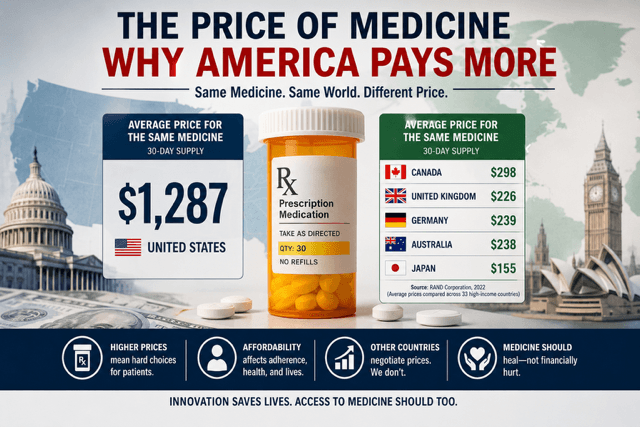
A major RAND analysis commissioned by the U.S. Department of Health and Human Services compared American prescription-drug prices with those in 33 other OECD countries.
Using 2022 data, researchers estimated that U.S. prices across brand-name and generic drugs combined were approximately 2.78 times those in the comparison countries.
The disparity was even greater for many brand-name medications.
That raises an uncomfortable question:
Why should an American patient pay dramatically more for a medicine than a patient in another developed country?
And perhaps the more important question:
What happens when the price of treatment becomes a barrier to treatment itself?
The Same Human Body, a Very Different Price
Diabetes does not recognize national borders.
Neither does cancer.
Neither do rheumatoid arthritis, cardiovascular disease, multiple sclerosis, asthma, obesity, or hypertension.
The biological problem may be similar whether a patient lives in Detroit, Toronto, London, Paris, Sydney, or Tokyo.
Yet the financial experience of receiving treatment can be remarkably different.
The RAND international comparison found that U.S. prescription-drug prices averaged nearly three times those of 33 comparison countries in 2022.
But an important distinction must be made.
Not every medicine in America is more expensive.
Generic drugs can actually be comparatively inexpensive in the United States.
The greatest international disparities are particularly associated with brand-name medicines.
For patients who depend on those expensive medications every month, however, averages are not merely statistics.
They become household economics.
They influence what families can afford.
And sometimes, they influence whether treatment is received at all.
Insulin: A Symbol of the Problem
Few medications illustrate America's drug-pricing debate more powerfully than insulin.
For people with Type 1 diabetes, insulin is not an optional product.
It is necessary for survival.
Its discovery in the early 1920s became one of modern medicine's defining achievements.
Yet approximately a century later, insulin affordability became a major American public-health and political issue.
International comparisons have historically demonstrated dramatically higher U.S. insulin prices than those in other wealthy nations.
Recent reforms have improved affordability for many Medicare beneficiaries, which represents meaningful progress.
But insulin teaches us a broader lesson:
Scientific discovery alone does not guarantee healthcare access.
We can discover a lifesaving therapy.
Manufacture it.
Prescribe it.
Place it on a pharmacy shelf.
But if the patient cannot afford to obtain it, something has failed between discovery and delivery.
GLP-1 Drugs: A Modern Version of the Same Debate
GLP-1–based therapies provide a more recent example.
Medications such as semaglutide and tirzepatide have transformed conversations surrounding Type 2 diabetes, obesity, cardiovascular risk, and metabolic health.
But their prices in the United States have also generated significant debate.
The article cites KFF reporting that U.S. list prices for GLP-1 medications could range approximately from $936 to $1,349 before insurance coverage, rebates, or coupons, while actual patient costs can vary substantially.
International comparisons have also shown considerably lower list prices for some of these medications in peer countries.
This creates a difficult healthcare question.
Imagine developing a treatment capable of improving metabolic health for millions of people—but pricing or insurance restrictions prevent many of those people from obtaining it.
We then have to ask:
Is a medical breakthrough truly revolutionary if large portions of the population cannot access it?
Why Does America Pay So Much?
There is no single explanation.
And there is no single villain.
The American pharmaceutical marketplace involves an unusually complex network.
Drug manufacturers develop and price medications.
Insurers determine coverage.
Pharmacy benefit managers, or PBMs, negotiate formularies and rebates.
Wholesalers distribute medicines.
Pharmacies dispense them.
Employers purchase health benefits.
Government programs operate under separate rules.
Money, discounts, reimbursements, and rebates can move through several layers before a prescription reaches the patient.
As a result:
The list price may be different from the net price.
The insurer's cost may differ from both.
And the patient's out-of-pocket cost may be different again.
This makes prescription pricing extraordinarily difficult for ordinary patients to understand.
When we purchase gasoline, the price is displayed.
When we shop online, we can usually compare prices.
When we purchase an airline ticket, multiple options can be reviewed.
Healthcare often works differently.
A patient may not know what a prescription will actually cost until the pharmacy processes the insurance claim.
That is not what most people would consider a transparent marketplace.
Other Countries Negotiate Differently
One important contributor to international price differences is how other countries purchase and evaluate medicines.
Many use centralized systems to negotiate or regulate pharmaceutical prices.
Governments or national health systems may consider:
How effectively a medication works.
How it compares with existing treatment.
What additional benefit it provides.
Whether the price reflects that benefit.
And how much the healthcare system is willing to pay.
The United States historically developed a much more fragmented system.
Instead of one national purchaser negotiating for an entire population, numerous private insurers, employers, PBMs, and government programs participate in different negotiations.
That fragmentation can make purchasing more complicated and reduce the ability to use unified negotiating leverage.
But the American system is beginning to change.
For the first time, Medicare negotiated prices for a group of high-expenditure medications under authority created by the Inflation Reduction Act.
The negotiated prices for the first 10 selected Medicare Part D drugs took effect January 1, 2026.
Whatever one's political philosophy, this represents an important shift in American pharmaceutical policy.
The United States is actively reconsidering how it purchases expensive medicines.
But What About Pharmaceutical Innovation?
Any serious conversation about drug prices must acknowledge the other side.
Developing new medicines is expensive, uncertain, and scientifically difficult.
Thousands of potential compounds may be investigated before a successful treatment reaches patients.
Clinical trials can take years.
Many experimental treatments fail.
Companies finance laboratories, scientists, clinical trials, manufacturing, regulatory submissions, safety monitoring, and unsuccessful research programs.
And pharmaceutical and biotechnology companies have unquestionably produced extraordinary advances.
Vaccines.
Cancer therapies.
Antivirals.
Biologics.
Immunotherapies.
Rare-disease treatments.
Cardiovascular medicines.
Modern diabetes therapies.
Society should be careful not to create a system that eliminates the financial incentives required to undertake enormous scientific risks.
Innovation matters.
Research matters.
Investment matters.
And profit itself is not inherently unethical.
A company investing billions into developing successful treatments reasonably expects a financial return.
The real debate therefore should not be:
“Should pharmaceutical companies make money?”
The more meaningful question is:
“How much should society pay for innovation—and how should that cost be distributed?”
Are Americans Paying a Disproportionate Share?
This leads to one of the most difficult questions in the pharmaceutical-pricing debate.
If manufacturers can obtain substantially higher prices in the United States while governments elsewhere negotiate more aggressively, American healthcare spending may contribute disproportionately to global pharmaceutical revenue.
That does not mean other countries are responsible for America's high prices.
Their healthcare systems and negotiation structures are fundamentally different.
But it raises a legitimate question:
Should American patients, employers, insurers, and taxpayers carry such a large portion of the financial burden associated with pharmaceutical innovation?
A sustainable global pharmaceutical marketplace should reward research and innovation.
But it should also distribute those costs in a way that does not place unreasonable pressure on one country's healthcare system.
When Patients Cannot Afford Medicine
This is where drug pricing stops being merely an economic debate.
A prescription that remains at the pharmacy because a patient cannot afford it provides no therapeutic benefit.
Cost can influence whether patients:
Delay filling prescriptions.
Skip doses.
Split tablets.
Take medications less frequently than prescribed.
Choose between medications.
Or discontinue treatment entirely.
An affordability problem can therefore become a clinical problem.
Imagine someone with hypertension reducing medication use because of cost.
The short-term savings may seem meaningful.
But what happens if uncontrolled hypertension contributes to a stroke?
Imagine a patient with diabetes who cannot consistently obtain medication.
What happens if uncontrolled disease eventually contributes to kidney failure, neuropathy, vascular disease, hospitalization, or amputation?
Or consider someone with asthma stretching an inhaler longer than recommended and eventually requiring emergency treatment.
This demonstrates one of healthcare economics' greatest contradictions:
Saving money on medication today can create enormous medical expenses tomorrow.
The Hidden Price Is Human
Drug-pricing debates often revolve around billions of dollars.
But healthcare is ultimately experienced one patient at a time.
Behind every statistic is someone sitting at a kitchen table looking at bills.
Someone wondering whether insurance will cover next month's prescription.
Someone balancing medication against groceries.
Someone approaching retirement while worrying about healthcare expenses.
Someone fighting cancer while simultaneously fighting an insurance denial.
Someone caring for a child with a rare disease.
Someone standing at a pharmacy counter discovering that the prescribed medicine costs far more than expected.
For those people, pharmaceutical pricing is not an abstract economic argument.
It is personal.
Medicare Negotiation: An Important American Experiment
The United States is entering a new period in prescription-drug policy.
For the first time, Medicare negotiated prices for a group of high-expenditure prescription medications.
The first negotiated prices for 10 selected Medicare Part D drugs took effect in 2026.
This does not solve America's pharmaceutical-cost problem.
Far from it.
Private insurance markets remain complicated.
Specialty medications can still be extraordinarily expensive.
New biologic medicines and gene therapies create entirely new affordability challenges.
But Medicare negotiation establishes an important principle:
Large public purchasers can negotiate over the price of medicines rather than simply accepting whatever price structure emerges from the market.
What happens next deserves careful evaluation.
Will patients pay less?
Will taxpayers save money?
How will pharmaceutical investment respond?
Will innovation change?
Could negotiated pricing influence the broader private market?
Healthcare policy should be judged by outcomes rather than slogans.
If reforms reduce unnecessary costs while preserving innovation and access to effective new therapies, those results matter.
If unintended consequences emerge, they should be studied and addressed.
Good healthcare policy requires both action and the willingness to evaluate what that action actually accomplishes.
Generics and Biosimilars Matter
One of the most powerful mechanisms for reducing pharmaceutical costs is not complicated:
Competition.
When patents and exclusivity periods expire, generic competitors can dramatically reduce prices for many traditional medicines.
Biosimilars have the potential to create similar competition for expensive biologic treatments.
The RAND research discussed earlier reveals an important nuance.
American generic prices can actually compare favorably with those in other countries.
The much larger international price disparities are concentrated more heavily among brand-name products.
That tells us something important:
Competition works.
Policies that responsibly accelerate generic and biosimilar competition—while maintaining rigorous standards for safety, effectiveness, and quality—should remain an important component of any serious affordability strategy.
Patients Deserve Greater Price Transparency
One of the most frustrating features of American healthcare is that almost nobody sees the entire financial picture.
The manufacturer has one price.
An insurer may negotiate another.
A pharmacy benefit manager may receive rebates.
A pharmacy has reimbursement arrangements.
An employer pays premiums.
An employee pays premiums.
And the patient may face a deductible, copayment, or coinsurance.
Somewhere in the middle of this complicated system is a person asking a remarkably simple question:
“How much will my medicine cost?”
That should not be an unreasonable question.
Patients deserve meaningful price transparency.
Healthcare professionals should ideally be able to consider affordability when discussing clinically appropriate treatment alternatives.
A medication may be scientifically excellent.
But if a patient cannot obtain it consistently, its theoretical effectiveness has limited value to that individual.
The best treatment plan must also be a treatment plan the patient can realistically follow.
Drug Affordability Is Preventive Medicine
We usually discuss preventive medicine in terms of:
Exercise.
Nutrition.
Vaccination.
Smoking cessation.
Cancer screening.
Blood-pressure management.
But medication affordability deserves a place in that conversation too.
Consider a relatively inexpensive blood-pressure medication that helps prevent a stroke.
Its value is not limited to the price of the prescription.
Preventing a stroke may also prevent hospitalization, rehabilitation, disability, lost productivity, long-term care, and enormous human suffering.
The same principle applies elsewhere.
Effective diabetes treatment may help reduce the risk of complications such as kidney disease.
Appropriate statin therapy may help prevent cardiovascular events in selected patients.
Consistent access to an inhaler may help prevent severe asthma exacerbations and hospital visits.
Medication access therefore isn't simply pharmaceutical policy.
It is preventive healthcare.
What Should America Do?
There is no single policy capable of solving prescription-drug affordability.
The system is too complicated for one intervention.
A meaningful strategy will likely require several approaches working together.
Improve price transparency.
Patients, employers, clinicians, and policymakers should better understand how money moves through the pharmaceutical supply chain.
Evaluate Medicare negotiation carefully.
If negotiated pricing produces meaningful benefits for patients and taxpayers without unacceptable consequences for innovation or access, policymakers can use that evidence to inform future decisions.
Encourage generic and biosimilar competition.
Competition remains one of the strongest tools available for reducing prices after exclusivity ends.
Examine unnecessary barriers to competition.
Policies or practices that artificially delay appropriate generic or biosimilar entry deserve scrutiny.
Increase transparency around PBMs and rebates.
Employers, policymakers, clinicians, and consumers should better understand how these arrangements influence drug costs.
Help patients identify appropriate lower-cost alternatives.
When clinically equivalent or appropriate alternatives exist, affordability should be part of the treatment conversation.
Continue examining international price differences.
If Americans consistently pay substantially more for certain medications, understanding why should remain an important policy priority.
But perhaps most importantly:
Stop treating innovation and affordability as mutually exclusive goals.
America needs both.
The Ethical Question We Cannot Avoid
Eventually, healthcare economics becomes healthcare ethics.
What is another year of life worth?
How should limited healthcare resources be distributed?
What represents a reasonable financial return for a lifesaving medicine?
How much should society spend on extremely expensive treatments that benefit relatively small numbers of patients?
There are no simple answers.
Innovation costs money.
Scientific risk deserves reward.
Healthcare resources are finite.
But one principle deserves serious consideration:
A patient's ability to survive should not depend unnecessarily on that patient's ability to navigate an opaque pharmaceutical pricing system.
Medicine exists to alleviate suffering.
Restore function.
Prevent disease.
And preserve life.
Business is necessary to finance innovation and bring treatments to market.
But business should ultimately support the purpose of medicine—not overwhelm it.
Innovation and Affordability Should Not Be Enemies
Drug-pricing discussions can easily become polarized.
One side may argue that pharmaceutical companies are simply charging too much.
Another may argue that reducing prices will inevitably destroy innovation.
Reality is more complicated.
The United States needs pharmaceutical companies willing to invest enormous amounts of capital into uncertain scientific research.
It needs biotechnology startups pursuing ideas that may fail.
It needs universities conducting foundational research.
It needs investors willing to finance scientific risk.
It needs manufacturers capable of producing complex therapies safely and at scale.
But patients also need medicines they can afford.
These goals should not automatically be treated as incompatible.
The better policy question is:
How can we create a pharmaceutical marketplace that rewards genuine innovation while ensuring that successful innovation actually reaches the patients it was created to help?
That is a more difficult question.
But it is also a more productive one.
America Can Do Better
The United States should be proud of its contribution to modern medicine.
American universities, scientists, physicians, entrepreneurs, biotechnology companies, and pharmaceutical researchers have helped produce discoveries that changed humanity.
That ecosystem deserves protection.
But protecting innovation does not require accepting every feature of the existing pricing system.
The international evidence cited in this article found that Americans were paying approximately 2.78 times the prescription-drug prices across 33 comparison countries in 2022, considering brand-name and generic drugs together.
That should make us ask questions.
Not anti-business questions.
Not partisan questions.
Healthcare questions.
Can we reward innovation without financially punishing illness?
Can pharmaceutical companies remain profitable while medicines become more affordable?
Can insurers, PBMs, manufacturers, pharmacies, employers, and government create a system patients can actually understand?
Can America lead the world not only in discovering medicines—but also in making those medicines accessible?
I believe we can.
A Prescription Is Worthless If the Patient Cannot Fill It
Perhaps this is the simplest way to understand the entire debate.
We can build extraordinary hospitals.
Train brilliant physicians.
Develop artificial intelligence for healthcare.
Sequence genomes.
Create revolutionary drugs.
And invest billions of dollars in biomedical research.
But if that entire journey ends with a patient standing at a pharmacy counter unable to afford the medicine a clinician prescribed, something has gone wrong.
The next great achievement in American medicine may therefore not come entirely from a laboratory.
Part of it may come from redesigning the healthcare system around the patient.
Because the ultimate measure of medical progress should not simply be:
“Can we invent the treatment?”
We must also ask:
“Can the person who needs it actually receive it?”
That is the difference between medical innovation and meaningful healthcare.
Final Reflection: Innovation Means Little Without Access
America has extraordinary scientific capabilities.
The country has helped develop therapies that save lives, extend survival, improve function, and transform once-devastating diseases into manageable conditions.
We should protect that capacity.
But medical progress cannot be measured only by patents, approvals, scientific publications, or the number of new medicines entering the market.
It must eventually be measured at the patient level.
Did the treatment reach the person who needed it?
Could they afford to continue taking it?
Did it improve their health?
Did the healthcare system make treatment easier to obtain—or create another obstacle?
A medicine sitting behind a pharmacy counter has scientific value.
A medicine reaching the patient who needs it has human value.
The challenge for America is therefore not choosing between pharmaceutical innovation and affordability.
It is building a system capable of achieving both.
Reward discovery.
Encourage research.
Protect meaningful innovation.
Increase competition.
Improve transparency.
Address unnecessary costs.
And never forget the patient at the end of the pharmaceutical supply chain.
Because healthcare does not fulfill its purpose when we simply discover what can save a life.
It fulfills its purpose when the person whose life depends on that discovery can actually receive it.
Author’s Note
This article is intended to encourage thoughtful discussion about prescription-drug affordability, healthcare access, pharmaceutical innovation, and public policy.
Drug prices can vary considerably according to medication, insurance coverage, rebates, discounts, pharmacy, country, and healthcare system. International comparisons should therefore be interpreted carefully, and list prices do not necessarily represent what every patient or insurer ultimately pays.
“Medical innovation reaches its highest purpose not when we simply discover a treatment, but when the patient who needs that treatment can actually receive it. We should never have to choose between rewarding innovation and making medicine accessible—we must build a healthcare system capable of doing both.” — Dr. Vijay Kumar