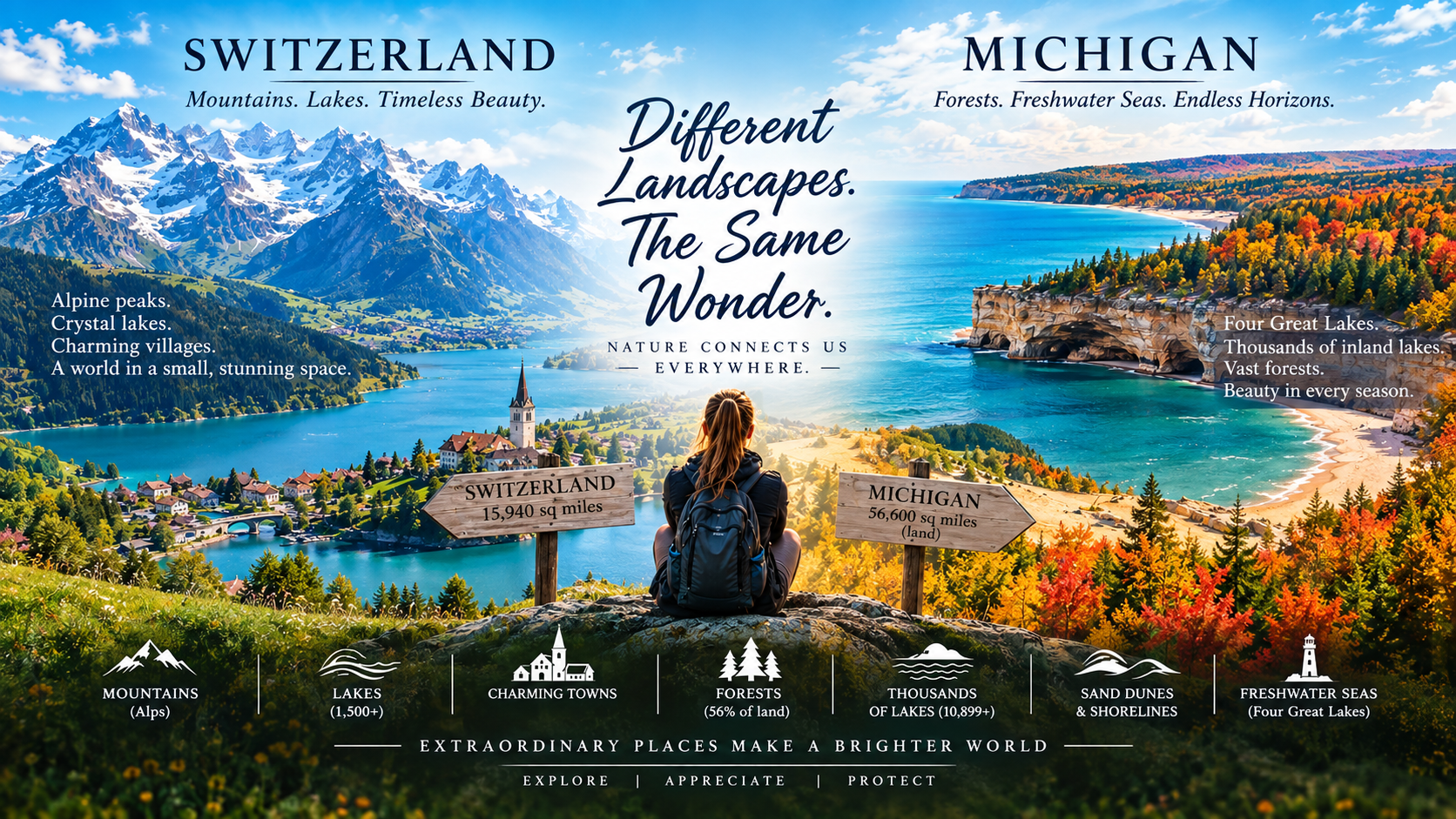
Michigan: America's Freshwater Wonderland — A Landscape That Deserves to Be Seen Beside Switzerland
Lakes, forests, shorelines, waterfalls and four seasons make Michigan one of the world's most underrated natural landscapes
When people around the world think of spectacular landscapes, certain destinations immediately come to mind.
Switzerland is one of them.
Mention Switzerland and we picture snow-covered Alps rising behind blue lakes, green valleys dotted with villages, mountain streams, forests, waterfalls and roads that seem designed for postcards. Switzerland has earned its reputation as one of the most beautiful countries on Earth.
But there is another place whose beauty is very different — and, in my opinion, often underestimated.
That place is Michigan.
Michigan does not have Switzerland's Alps. It does not have 15,000-foot peaks or villages clinging to steep Alpine valleys. Comparing the two as though they were geographically identical would miss the point.
Instead, consider what Michigan has.
It is surrounded by enormous bodies of freshwater that can look and behave like inland seas. It contains thousands upon thousands of inland lakes. More than half of its land is forested. It has thousands of miles of Great Lakes shoreline, enormous sand dunes, islands, wetlands, rivers, waterfalls, rocky cliffs and beaches stretching beyond the horizon.
And then there are the seasons.
A Michigan summer can feel like a northern coastal holiday. Autumn transforms entire forests into brilliant shades of red, orange and gold. Winter turns lakes and forests into landscapes of snow and ice. Spring brings rushing rivers, waterfalls and the rebirth of millions of acres of woodland.
For someone who knows Switzerland well but has never really explored Michigan, perhaps the easiest way to understand Michigan is this: Switzerland's landscape is defined by mountains and water. Michigan's landscape is defined by forests and water.
And once we look at the numbers, the scale becomes remarkable.
First, How Big Is Michigan?
According to U.S. Census Bureau geographic measurements, Michigan contains approximately 56,600 square miles of land, or roughly 146,500 square kilometers.
Its official total geographic area, however, is much larger — about 96,700 square miles, or approximately 250,500 square kilometers — because Michigan's official area includes substantial portions of the Great Lakes.
The U.S. Geological Survey, using Census Bureau state-area measurements, lists Michigan at approximately:
- Total area: 96,714 square miles
- Land area: 56,539 square miles
- Water area: 40,175 square miles
- Percentage classified as water: 41.5%
That last number is astonishing.
More than four out of every ten square miles in Michigan's official geographic area are water.
But an important clarification is necessary.
That does not mean that 41.5% of the land inside Michigan's familiar two peninsulas is covered by little lakes. Most of that official water area — about 38,174 square miles — comes from Michigan's apportioned portions of the Great Lakes. The USGS identifies about 2,001 square miles as inland water.
That distinction matters because otherwise the statistic can easily be misunderstood.
Yet it also reveals something even more extraordinary about Michigan: the state is not merely a piece of land containing lakes.
Michigan is a landscape embedded within one of the greatest freshwater systems on Earth.
Now Compare Michigan With Switzerland
Switzerland covers approximately 41,285 square kilometers, or about 15,940 square miles.
Michigan's land alone is therefore approximately 3.5 times the size of the entire country of Switzerland.
Include Michigan's officially attributed Great Lakes water area, and Michigan's total geographic area is more than six times Switzerland's total area.
That provides an entirely different perspective on the state.
Imagine placing Switzerland inside Michigan's land area. You could fit the equivalent area of Switzerland into Michigan roughly three and a half times.
Yet because Switzerland contains enormous mountains, its landscape often feels geographically larger than the numbers suggest. Michigan achieves a similar psychological effect in another way: through water.
In Switzerland, mountains dominate the horizon. In Michigan, sometimes the horizon itself is water.
Switzerland Is a Country of Lakes. Michigan Is Almost a World of Lakes.
Switzerland is extraordinarily rich in freshwater.
Official Swiss information describes approximately 1,500 lakes, and lakes and rivers together cover roughly 4% of Switzerland's surface area. Switzerland is sometimes called the "water tower of Europe" because major European rivers originate in the Alps and the country contains an important share of Europe's freshwater resources.
That is impressive.
Now consider Michigan.
The Michigan Department of Natural Resources reports 10,899 inland lakes of five acres or larger.
That is more than seven times Switzerland's approximate number of lakes, although direct comparisons require caution because countries and states do not necessarily use identical definitions or minimum lake sizes.
And if very small ponds and water bodies are counted, Michigan's number becomes much larger still.
But the number of lakes tells only part of the story.
Michigan touches four of the five Great Lakes: Lake Superior, Lake Michigan, Lake Huron, and Lake Erie. Only Lake Ontario does not border Michigan.
These are called "lakes," but standing on their shores can challenge your understanding of that word.
Look across Lake Michigan from Sleeping Bear Dunes. Stand beside Lake Superior at Pictured Rocks. Watch a storm approach across Lake Huron.
In many places, you cannot see the opposite shore. The water disappears into the horizon exactly as an ocean does. There are waves, storms, beaches, dunes, lighthouses, shipwrecks, harbors and islands.
But the water is fresh.
This is one of Michigan's defining wonders.
Michigan's 41.5% Water Figure: What It Really Means
The statistic deserves to be understood rather than simply repeated.
USGS figures put Michigan's total official area at about 96,714 square miles, consisting of roughly 56,539 square miles of land and 40,175 square miles of water. That produces the extraordinary figure of 41.5% water.
Switzerland, by comparison, reports lakes and rivers covering around 4% of its surface area.
But these percentages are measuring somewhat different geographical realities. Michigan's calculation includes its jurisdictional portions of the Great Lakes; Switzerland's lakes sit largely within or along the country's land boundaries.
So it would be misleading simply to say, "Michigan has ten times Switzerland's percentage of lake coverage."
The better comparison is conceptual.
Water is important to Switzerland's geography. Water is inseparable from Michigan's identity.
The Great Lakes shape Michigan's climate, economy, recreation, settlement patterns, wildlife, tourism and even the physical outline of the state.
Remove the lakes from Switzerland and Switzerland would still have the Alps. Remove the Great Lakes from Michigan and Michigan would barely be recognizable.
Michigan's Extraordinary Relationship With Water
There is another statistic that captures Michigan better than almost any other.
According to the Michigan Department of Natural Resources, you are never more than six miles from a body of water in Michigan and never more than 85 miles from a Great Lake.
Think about what that means.
Whether someone is living in a large metropolitan area, driving through farmland, hiking in northern Michigan or traveling through the forests of the Upper Peninsula, water is never very far away.
Michigan also has approximately 3,300 miles of Great Lakes shoreline, according to the DNR — the longest freshwater coastline of any U.S. state. The state has more total shoreline than any American state except Alaska.
There are also more than 52,000 miles of streams.
Michigan is therefore not simply a state with some attractive lakes.
It is a giant network of water.
Lakes feed rivers. Rivers flow through forests. Wetlands support wildlife. Streams feed larger watersheds. And surrounding almost everything are the Great Lakes.
The Other Half of Michigan's Beauty: Forest
If water is Michigan's soul, forests are its clothing.
Michigan has roughly 20 million acres of forest, and the Michigan DNR has reported that forests cover approximately 56% of the state's land.
This is another reason why visitors sometimes underestimate Michigan.
A map can show lakes and boundaries. It cannot adequately show what it feels like to drive for hours through northern Michigan or the Upper Peninsula while surrounded by trees.
Pine. Maple. Birch. Oak. Aspen. Hemlock. Cedar.
The forest changes as you travel north, and it changes dramatically with the seasons.
During summer, the landscape becomes intensely green.
Then comes autumn.
For a few weeks each year, Michigan becomes one of America's great natural color displays. Maples turn scarlet. Other trees become orange, yellow, copper and deep red. Lakes reflect those colors, sometimes creating an almost perfect mirror image.
This is where a comparison with Switzerland becomes especially interesting.
The Swiss landscape creates drama through vertical scale — mountains rising thousands of feet above valleys and lakes.
Michigan often creates beauty through horizontal scale — forests extending toward the horizon, interrupted by brilliant blue water.
One overwhelms you by looking upward. The other can overwhelm you by looking outward.
The Upper Peninsula: Michigan's Wilderness Country
Anyone attempting to understand Michigan's natural beauty must visit the Upper Peninsula.
The U.P. feels different from much of the American Midwest.
Population becomes sparse. Forests become immense. Roads stretch through wilderness. Lake Superior appears suddenly between trees, and its scale can be difficult to comprehend.
The Michigan tourism agency identifies more than 300 waterfalls in the Upper Peninsula.
Among the best known is Tahquamenon Falls, where tannin-rich water pours over a broad ledge surrounded by forest.
Then there is Pictured Rocks National Lakeshore. Here, colorful sandstone cliffs rise directly above Lake Superior. Waves enter caves carved into rock. Waterfalls drop toward the lake. Forests reach almost to the cliff edges.
Travel farther west and the landscape changes again.
The Porcupine Mountains provide rugged forest terrain and sweeping views. The Keweenaw Peninsula projects northward into Lake Superior. Remote beaches, rocky coastlines and historic mining communities appear along the route.
It may not resemble Switzerland. It should not. Its beauty belongs entirely to Michigan.
Michigan Has Something Switzerland Does Not: Freshwater Seas
Switzerland's lakes are beautiful partly because mountains surround them.
Lake Geneva, Lake Lucerne, Lake Zurich, Lake Thun and Lake Brienz offer combinations of blue water, historic settlements and mountain scenery that have made Switzerland internationally famous.
Michigan offers another experience entirely.
The Great Lakes can give a visitor the sensation of standing beside an ocean without actually being beside an ocean.
Lake Superior is particularly powerful. It is the largest of the Great Lakes by surface area and the largest freshwater lake in the world by surface area. Its water can appear deep blue, turquoise or nearly black depending on weather and light.
Lake Michigan provides enormous sandy beaches and dunes. Lake Huron is filled with bays and islands. Lake Erie connects southeastern Michigan to another vast aquatic ecosystem.
For travelers accustomed to thinking that great beaches require an ocean, Michigan can be a revelation.
Sand Dunes: Another Michigan Surprise
One of Michigan's least appreciated landscapes internationally is its dune country.
Along parts of Lake Michigan, enormous sand dunes rise above brilliant freshwater.
At Sleeping Bear Dunes National Lakeshore, visitors can stand high above Lake Michigan and see water stretching toward the horizon.
The visual combination can be startling: blue water, golden sand, green forest, huge sky.
There are moments when northern Lake Michigan can appear almost Caribbean in color, particularly on clear summer days.
Then the temperature, vegetation and northern latitude remind you where you are.
It is a landscape difficult to classify because it combines elements we normally associate with several different environments.
Four Seasons, Four Michigans
Perhaps one of Michigan's greatest strengths is that its beauty refuses to remain the same.
Spring
Snow melts. Rivers rise. Waterfalls become powerful. Forests awaken. Migratory birds return. The landscape gradually changes from brown to green.
Summer
This is Michigan's water season.
Boats appear everywhere. People swim, kayak, fish, sail and paddle. Small lake towns become active. Beaches fill. Long northern evenings create spectacular sunsets over Lake Michigan.
Autumn
Then Michigan transforms again.
Forests become red, orange, yellow and gold. A road trip through northern Lower Michigan or the Upper Peninsula during peak color can rival famous autumn destinations anywhere in North America.
Winter
And then comes another Michigan.
Lakes freeze. Snow blankets forests. Waterfalls become sculptures of ice. Communities near the Great Lakes experience heavy lake-effect snow. Cross-country skiing, snowmobiling, ice fishing and winter hiking replace summer boating.
The same lake visited in July and January can feel like two completely different places.
Michigan and Switzerland: Different Landscapes, Similar Emotional Power
Comparing natural beauty is always subjective.
There is no scientific formula that can declare Switzerland more beautiful than Michigan or Michigan more beautiful than Switzerland. Nor is such a competition necessary.
Switzerland has something Michigan cannot reproduce: the Alps. Michigan has something Switzerland cannot reproduce: the Great Lakes.
Switzerland's highest mountains rise above 4,000 meters. Michigan is comparatively low and gently shaped. Switzerland compresses mountains, valleys, lakes and villages into a relatively small geographic space. Michigan spreads forests, lakes, beaches, dunes, rivers and wilderness across a much larger land area.
Switzerland's beauty is often immediate and dramatic. Michigan's beauty can be quieter.
Sometimes you have to drive north. Leave the interstate. Follow a two-lane road. Walk through the trees. Climb a dune. Reach a lake.
And suddenly the landscape opens.
That sense of discovery is part of Michigan's character.
Putting the Numbers Into Perspective
The most striking comparison may be size.
Michigan's land area alone is roughly three and a half times Switzerland's entire area.
Michigan's official water area — largely because of the Great Lakes — is itself about two and a half times the total area of Switzerland.
Pause on that thought.
The water area officially associated with one American state is vastly larger than the entire territory of Switzerland.
That is the scale of the Great Lakes.
Why Isn't Michigan Better Known Internationally?
Perhaps Michigan suffers from the familiarity of the word "lake."
People hear "lake" and imagine a modest body of water surrounded by houses. That description works for some inland lakes. It does not prepare someone for Lake Superior. It does not describe standing on a Lake Michigan beach unable to see land on the opposite horizon. It does not explain cliffs at Pictured Rocks, dunes at Sleeping Bear, islands in Lake Huron, waterfalls in the Upper Peninsula or millions of acres of northern forest.
Michigan also sits far from America's most internationally promoted natural destinations.
Foreign travelers know the Grand Canyon. Yellowstone. Yosemite. Florida. California. New York. Hawaii.
Michigan rarely receives the same international attention.
Yet the Great Lakes constitute one of Earth's extraordinary geographical features, and Michigan occupies the center of that freshwater world.
A Different Definition of Luxury
Switzerland teaches us that natural landscapes can become part of a nation's identity.
Perhaps Michigan deserves to think about itself in the same way.
The state's greatest wealth is not only industrial history, automobiles, manufacturing or urban development.
It is also freshwater. Forests. Beaches. Wetlands. Wildlife. Open space. Clean air. And seasons.
In an increasingly crowded and warming world, access to freshwater and intact natural landscapes may become more valuable than we fully appreciate today.
Michigan possesses these resources on an extraordinary scale.
That creates both an opportunity and a responsibility.
Development should not destroy what makes Michigan special. Lakes need protection from pollution and invasive species. Wetlands need conservation. Shorelines need thoughtful management. Forests require sustainable stewardship.
The Great Lakes cannot be taken for granted simply because they appear endless.
Beauty survives only when people decide that it is worth protecting.
Switzerland of the Alps, Michigan of the Great Lakes
If I had to explain Michigan to someone in Switzerland, I would not say, "Michigan is America's Switzerland." It isn't.
I would say something more meaningful.
If Switzerland represents the extraordinary beauty that can emerge when mountains and water meet, Michigan represents the extraordinary beauty that can emerge when forests and freshwater meet.
Switzerland has the Alps. Michigan has the Great Lakes.
Switzerland has Alpine valleys. Michigan has immense northern forests.
Switzerland has famous mountain lakes. Michigan has thousands of inland lakes surrounded by four of the largest freshwater lakes on Earth.
Switzerland has mountain waterfalls. Michigan has hundreds of waterfalls hidden among northern forests.
Both have four distinct seasons. Both demonstrate how profoundly water can shape the identity of a place. And both remind us that nature does not need to look the same everywhere to be magnificent.
Michigan: More Than a State Surrounded by Lakes
There is an old habit of describing Michigan by pointing to your hand.
The Lower Peninsula looks like a mitten, and generations of Michiganders have used their palms as informal maps to show where they live.
It is charming.
But Michigan deserves another mental image as well.
Imagine two great peninsulas extending into an enormous freshwater system. Imagine approximately 56,600 square miles of land covered with cities, farms, wetlands and nearly 20 million acres of forest. Imagine 10,899 inland lakes of at least five acres scattered across that landscape. Imagine more than 52,000 miles of streams connecting portions of it. Imagine 3,300 miles of Great Lakes shoreline around it. And beyond those shores, imagine freshwater stretching all the way to the horizon.
That is Michigan.
Not Switzerland. Not Scandinavia. Not Canada. Not an ocean coast.
Something entirely its own.
Perhaps that is the perspective we sometimes miss when we live close to extraordinary things.
Familiarity can make beauty seem ordinary. A lake becomes "the lake." A forest becomes "the woods." A sunset over Lake Michigan becomes something we have seen before.
But look at Michigan through the eyes of someone arriving for the first time — particularly someone who understands the natural beauty of a place like Switzerland — and the scale becomes clearer.
Michigan is one of America's great freshwater landscapes. Its mountains may be modest, but its water is immense. Its scenery may not always announce itself dramatically, but it rewards exploration.
And when the evening sun falls toward the horizon over a Great Lake, the forest behind you and seemingly endless freshwater before you, numbers no longer seem necessary.
You understand why Michigan is called the Great Lakes State.
And perhaps you understand something else as well: some of the world's most remarkable beauty is not always found in the places that receive the most international attention. Sometimes it is much closer to home.
Author Note
"I wrote this after realizing how often I catch myself driving past a Great Lake without really looking at it. It's easy to let something extraordinary become background noise just because you see it often. Michigan taught me that familiarity is worth fighting against — the view doesn't get less remarkable just because you've seen it before." — Vijay Kumar