The Gateway of India: Where an Empire Arrived, a Nation Said Goodbye, and Mumbai Found an Icon
There are monuments we visit because they are famous, and there are monuments that become meaningful only when we understand what happened around them.
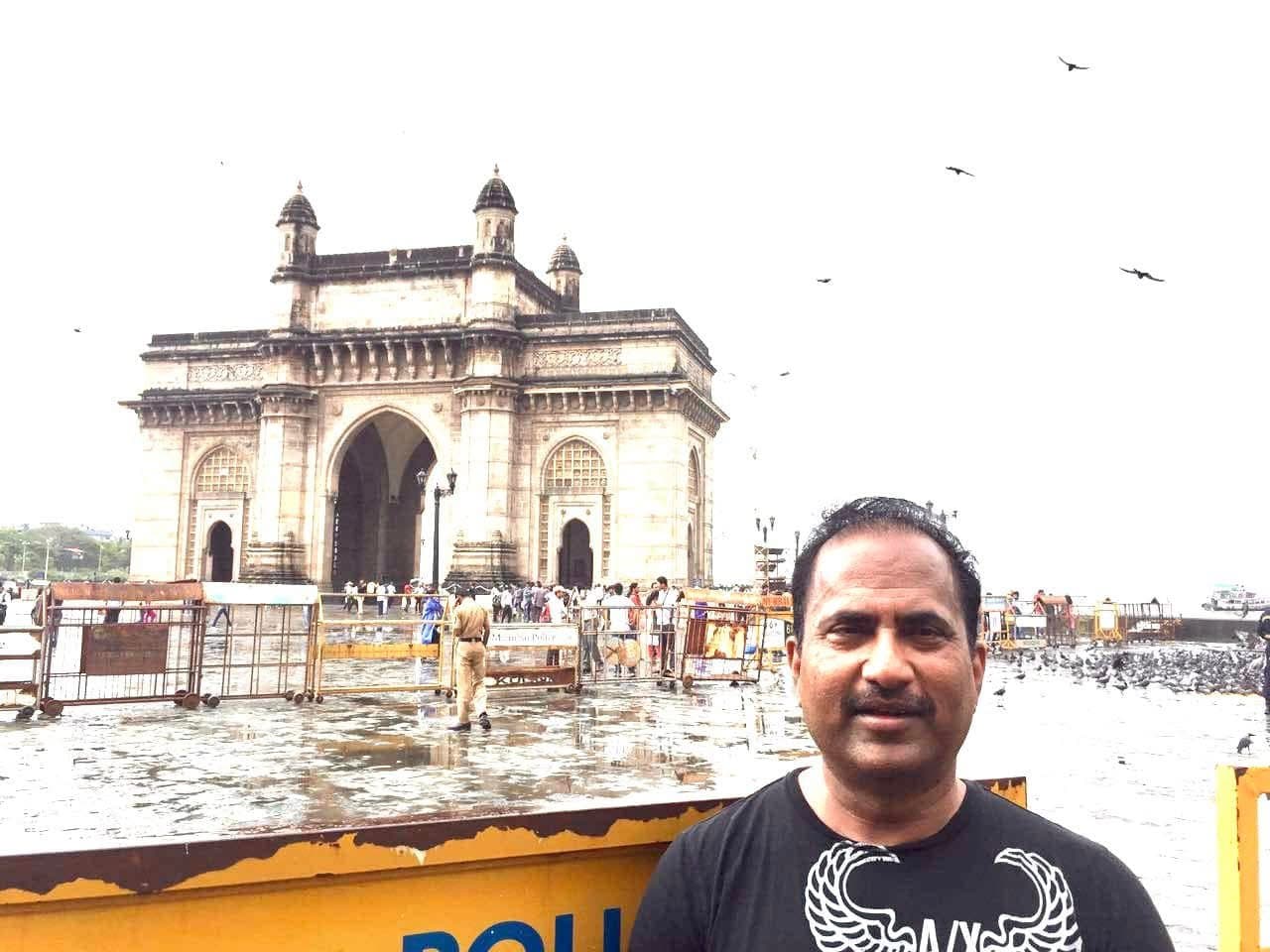
Standing in front of the Gateway of India in Mumbai, as I am in this photograph, it is easy to focus on the obvious — the enormous stone arch, the Arabian Sea behind it, the pigeons circling overhead, the crowds, photographers, boats and unmistakable energy of Mumbai.
But the Gateway deserves a second look.
Few monuments in India contain such an extraordinary historical irony. It was conceived during the height of British imperial power, commemorating the visit of a British king and queen. Decades later, almost the same spot became the setting for the ceremonial departure of the last British troops from independent India.
An arch intended to proclaim empire eventually became associated with the end of that empire.
Today, more than a century after its conception, the Gateway belongs neither to kings nor governors. It belongs to Mumbai — to ordinary Indians, travelers, families, students, vendors, photographers and millions of people who pass through this waterfront every year.
My photograph there therefore represents more than another stop during a journey. Behind me stands a structure through which we can read several chapters of modern Indian history: colonialism, architecture, independence, tragedy, resilience and ultimately the remarkable ability of a nation to give an old monument an entirely new meaning.
Before the Gateway: Apollo Bunder and the Sea
To understand the Gateway of India, we first have to understand its location.
The monument stands at Apollo Bunder on Mumbai's waterfront, overlooking the Arabian Sea. Long before the great arch appeared, this waterfront was connected with maritime activity. Mumbai City's official heritage information notes that the area had initially served as a jetty for local fisherfolk and was later developed as a landing place for British governors and other officials.
That maritime setting is essential to the Gateway's story.
Mumbai — Bombay during the colonial period — grew because of the sea. Its natural harbor helped transform it into one of the great commercial centers of Asia. Ships carried cotton, textiles, people, officials, soldiers, merchants and ideas between India and the wider world.
For travelers arriving by sea, the waterfront was not simply geography. It was their first impression of the city.
The British colonial government therefore had both practical and symbolic reasons for creating a grand ceremonial entrance at this location.
And the event that provided the immediate inspiration came in 1911.
A Royal Visit That Changed the Waterfront
In December 1911, King George V and Queen Mary visited India. Their arrival in Bombay was historically significant: George V was the reigning British monarch, and the visit occurred in an era when the British Empire was near the height of its global reach.
The Gateway of India was conceived to commemorate their landing.
Mumbai City's official government history describes the monument as having been erected to commemorate the arrival of King George V and Queen Mary at Apollo Bunder during their 1911 visit.
There is an interesting historical detail here.
The magnificent Gateway we recognize today did not yet exist when the royal couple arrived. The monument commemorating their visit would take years to design and construct.
The foundation stone was laid in 1911, while architect George Wittet's final design was sanctioned in 1914. Construction was eventually completed in 1924.
In other words, the royal visit came first. The architectural statement followed.
That distinction matters because monuments often create an illusion that history happened neatly around them. In reality, the Gateway was an attempt to turn a fleeting political event into something permanent.
Stone was being asked to preserve power.
History, however, had other plans.
George Wittet and an Architecture That Looked Both East and West
The architect entrusted with the final design was George Wittet, an important figure in Bombay's early-20th-century architectural development.
The Gateway rises approximately 26 meters — about 85 feet — above the waterfront. Government sources describe it as a basalt arch constructed primarily in the Indo-Saracenic architectural style.
"Indo-Saracenic" is more than an architectural label.
During the British colonial period, architects increasingly combined European structural concepts with visual elements drawn from Indian and Islamic architectural traditions. Domes, arches, turrets, stone screens and regional decorative forms were incorporated into monumental public buildings.
The Gateway demonstrates this fusion dramatically.
Its monumental central arch gives it the authority of a triumphal gateway, while its dome, turrets and ornamental stonework draw upon architectural traditions familiar across the Indian subcontinent. India's official tourism information describes a combination of Indian, Arabic and Western architectural elements and notes both Muslim and Hindu decorative influences.
The result is visually fascinating.
The British Raj commissioned the monument as an expression of imperial authority, yet the visual vocabulary it employed depended heavily upon the civilization it governed.
That contradiction is embedded in the building itself.
Look carefully at the Gateway and it does not look simply British. Nor is it a reproduction of one historic Indian style.
It is a hybrid — an architectural artifact of a complicated political era.
Perhaps that is one reason it could eventually be absorbed so completely into independent India's identity.
The Gateway Opens
The completed Gateway was opened in 1924.
By then, India was already changing dramatically.
The independence movement was gaining strength. Mahatma Gandhi had transformed the political landscape through mass mobilization and nonviolent resistance. Indian nationalism was becoming increasingly difficult for British authorities to contain.
Yet on Mumbai's waterfront stood this newly completed ceremonial arch representing imperial permanence.
British governors, viceroys and other important visitors arriving by sea could pass through the Gateway, which became a ceremonial entrance into colonial India. Mumbai City's government description explicitly notes this role as an entrance for viceroys and new governors of Bombay.
Imagine arriving in Bombay by ship during that period.
Before you would have been one of India's greatest port cities. And rising above the harbor would have been an imposing stone gateway announcing the authority and confidence of the colonial state.
But buildings can outlive the political systems that construct them.
Only twenty-three years after the Gateway's completion, India would become independent.
And within another year, one of the most symbolically powerful events in the monument's history would take place.
1947: India Becomes Free
At midnight on August 14–15, 1947, British colonial rule ended and India became an independent nation.
Political independence did not mean that every British military unit disappeared that same night. The withdrawal occurred as part of a broader transition.
Then came February 1948.
On February 28, 1948, the First Battalion of the Somerset Light Infantry — the last British troops to leave India — departed from Bombay in a formal ceremony associated with the Gateway of India.
Historical accounts describe the troops passing through the Gateway as part of their departure ceremony, accompanied by a 21-gun salute.
Consider the symbolism.
A monument created to commemorate the arrival of a British monarch now witnessed British soldiers leaving an independent India.
The empire had built its own ceremonial doorway. Independent India turned it into an exit.
There is almost poetic symmetry in that transformation.
No architect could have designed such symbolism deliberately. History created it.
That is perhaps the most important reason I find the Gateway fascinating.
Its meaning was not frozen in 1911 or 1924.
India rewrote it.
From Imperial Monument to Indian Landmark
After independence, India faced an interesting question shared by many postcolonial societies: what should be done with monuments inherited from colonial rule?
One option is destruction. Another is neglect. A third — and often more powerful — response is reinterpretation.
India has largely allowed the Gateway of India to remain, while changing what the monument means.
Today, few visitors approaching the Gateway experience it primarily as a celebration of George V.
They experience it as Mumbai.
It has become one of the city's defining images, standing alongside the neighboring Taj Mahal Palace hotel and the waterfront as part of Mumbai's visual identity. Official government tourism material describes it as one of the city's major attractions and a monument synonymous with Mumbai.
That transformation teaches an important lesson about history.
A monument's creator does not necessarily control its meaning forever. Societies inherit monuments and reinterpret them according to their own experiences.
The Gateway may have been commissioned by colonial authorities. But modern India has culturally reclaimed it.
The Gateway and the Taj Mahal Palace
It is almost impossible to discuss this part of Mumbai without mentioning the Taj Mahal Palace hotel, standing opposite the Gateway.
Together they create one of India's most recognizable urban landscapes.
Yet they emerged from very different contexts.
The Gateway was fundamentally an official imperial project. The Taj Mahal Palace, opened earlier in the 20th century, became associated with Indian enterprise, cosmopolitan Bombay and the emergence of a sophisticated modern Indian commercial class.
Standing in this area therefore places a visitor at an unusual intersection: sea and city, empire and enterprise, European and Indian architecture, colonial history and modern Indian identity.
And that intersection would acquire another, much darker historical layer in the 21st century.
The Gateway Has Also Witnessed Tragedy
History is rarely composed only of inspiring moments.
The Gateway of India has witnessed tragedy as well.
On August 25, 2003, Mumbai was struck by twin bomb explosions — one near the Gateway of India and another at Zaveri Bazaar. Contemporary accounts record dozens of deaths and hundreds of injuries, although exact casualty totals vary somewhat among reports.
Five years later came one of the darkest episodes in modern Mumbai's history.
Beginning on November 26, 2008, coordinated terrorist attacks struck multiple locations across Mumbai. The Taj Mahal Palace, directly opposite the Gateway, became one of the principal targets.
For days, television audiences around the world watched the tragedy unfold.
The Gateway itself became a gathering point for journalists, citizens and later public demonstrations of solidarity.
It is important to include these chapters when telling the Gateway's history — not to define Mumbai through tragedy, but because the city's response reveals something essential about its character.
Mumbai continued. People returned to work. Trains ran. Businesses reopened. Visitors came back. The waterfront filled again. The monument remained.
Resilience is sometimes an abstract word. In Mumbai, it can be observed in ordinary life continuing in places where extraordinary events have occurred.
The Mumbai I See in This Photograph
That is what makes this photograph personally meaningful to me.
At first glance, it is simply a travel photograph: I am standing in front of one of India's most famous monuments.
But look beyond me.
There are people walking around the plaza. Police barricades are visible. Pigeons cover portions of the waterfront. Boats can be seen beyond the monument. Birds are flying overhead. The Arabian Sea lies behind everything.
And the Gateway stands exactly where generations before us encountered it.
This is what I love about historical places.
History does not remain locked inside museums. It continues around us while ordinary life proceeds.
Someone may be buying tea. Someone else may be taking a family photograph. A child may be chasing pigeons. A tourist may be bargaining with a photographer. A boat may be preparing to leave the harbor.
Yet underneath those completely ordinary moments lies more than a century of extraordinary history.
That coexistence — past and present occupying the same physical space — is what makes travel intellectually rewarding.
Mumbai: A City That Constantly Reinvents Itself
The Gateway also reflects something larger about Mumbai.
This city has repeatedly reinvented itself.
Bombay grew from islands and coastal settlements into an important colonial port, then an industrial and commercial powerhouse, and eventually into modern Mumbai — a megacity associated with finance, cinema, entrepreneurship, migration, culture and ambition.
People have arrived here from virtually every part of India. Some came with education. Some with capital. Some with nothing more than determination.
Mumbai's mythology is built around possibility.
The Gateway therefore acquires another meaning today.
It is no longer merely the ceremonial entrance through which imperial officials once passed. It has become, metaphorically, a gateway into one of the world's great cities.
Behind it lies a Mumbai of enormous contrasts: skyscrapers and historic neighborhoods, extraordinary wealth and deep poverty, Bollywood and banking, street vendors and multinational corporations, old religious traditions and cutting-edge technology.
Mumbai can overwhelm you. But it rarely leaves you indifferent.
Why We Should Preserve Difficult History
There is sometimes a temptation to judge historical monuments only by the political systems that produced them.
That approach can be understandable, particularly when those systems involved exploitation or inequality.
But preservation does not require celebration.
We can preserve a monument while interpreting its history critically. Indeed, doing so can make the monument more valuable.
If the Gateway disappeared, future generations would lose a physical object through which they could examine colonialism, architecture, nationalism, independence and the evolution of Mumbai.
Standing monuments force us to confront complexity. They remind us that history was lived by real people in real places.
The Gateway's colonial origins should therefore not be hidden. They should be explained. Neither should its later transformation be ignored.
The complete story is far more interesting than either glorification or condemnation.
It is the story of how political symbols can change ownership — not legally, but culturally.
The Great Irony of the Gateway
For me, one fact remains irresistible.
The British built the Gateway to commemorate an arrival. India remembers it partly because of a departure.
King George V and Queen Mary arrived in 1911. The monument commemorating that arrival was completed in 1924. India became independent in 1947. The last British troops departed in 1948.
In roughly one generation, the meaning of the monument had been turned almost completely around.
That is history operating on stone.
Empires frequently build monuments because they want to appear permanent. But nothing political is permanent.
Governments change. Borders change. Ideas change. Generations change.
The stones remain and acquire new stories.
Travel Should Make Us Curious
I have always believed travel becomes much more rewarding when we ask questions.
Who built this? Why was it built? What happened here? Who stood here before me? What did this place mean one hundred years ago? What does it mean today?
Without those questions, the Gateway of India is an impressive background for a photograph.
With those questions, it becomes a classroom.
Standing there, one can explore architecture, colonialism, India's independence movement, maritime commerce, urban development, terrorism, resilience and the changing identity of Mumbai.
A single monument opens doors into an entire century.
That is the difference between simply seeing a place and trying to understand it.
From Their Gateway to Ours
Perhaps the most remarkable thing about the Gateway of India is that modern Indians do not need to deny its origins in order to claim it.
History cannot be undone. Nor should it be rewritten merely to make us comfortable.
The monument was conceived under British colonial rule. That is true. It commemorated a British royal visit. That is true. It served as a ceremonial entrance for colonial officials. That too is true.
But another truth followed.
India became independent. British troops left. Mumbai grew into one of the great cities of the modern world. Millions of Indians made this waterfront part of their own cultural landscape.
The monument survived, while the empire that commissioned it did not.
That may be the Gateway's greatest historical lesson.
Standing Before History
When I look again at this photograph, I see myself standing in Mumbai.
But I also see several Indias layered behind me.
There is colonial India, represented by the monument's origins. There is independent India, represented by the departure of British troops. There is wounded India, represented by the violence Mumbai has endured. There is resilient India, represented by the crowds that returned. And there is modern India — confident, complicated, democratic, ambitious and still evolving.
Perhaps that is why historical monuments matter.
They remind us that our own lives occupy only a tiny section of a much longer timeline.
Generations stood here before us. Generations will stand here after us. We are temporary visitors. The history is larger.
And yet every photograph adds one more small human moment to that continuing story.
Standing before the Gateway of India, with Mumbai and the Arabian Sea around me, I am reminded that history is not simply a record of what happened. It is a conversation between what happened, what survived, and what later generations choose to make of it.
The Gateway began as a monument to imperial arrival. It witnessed colonial departure. It endured tragedy. It became Mumbai's icon.
And today it stands not as the doorway to an empire, but as a gateway into India's extraordinary, complicated and continuing story.
Author Note
"What stays with me about the Gateway isn't the arch itself — it's how completely its meaning changed without a single stone being moved. Empires assume their monuments will outlive the people who built them and still mean what they intended. History rarely cooperates. I find that oddly reassuring: nothing is stuck being only what it was built to be." — Vijay Kumar