September 11, 2001 — Twenty-Five Years Later, I Still Cannot Forget
Twenty-five years.
It is difficult to believe that a quarter of a century has passed since the morning of September 11, 2001.
There are events we remember as history, and then there are events we remember as moments of our own lives. We remember where we were. We remember what we were doing. We remember the television screen. We remember the disbelief.
September 11 is one of those days for me.
I still remember watching the events unfold on television. At first, like millions of others, I struggled to understand what I was seeing. A commercial airplane had struck one of the towers of the World Trade Center in New York City.
Was it a terrible accident?
Then another airplane appeared.
And suddenly, the unimaginable became undeniable.
This was not an accident.
America was under attack.
Even twenty-five years later, those images remain difficult to comprehend. The smoke pouring from the towers. People looking upward in disbelief. Emergency vehicles racing toward Manhattan. Firefighters and police officers running toward buildings from which everyone else was desperately trying to escape.
And then the towers fell.
A city skyline changed before our eyes.
Thousands of lives disappeared in a matter of hours.
According to the National September 11 Memorial & Museum, 2,977 people were killed in the terrorist attacks of September 11, 2001 at the World Trade Center, the Pentagon, and near Shanksville, Pennsylvania.
But a number — no matter how large — can never adequately describe what happened that morning.
They were fathers and mothers. Husbands and wives. Sons and daughters. Friends and coworkers. Firefighters, police officers and emergency personnel. People traveling for business. People going on vacation. People sitting at their desks beginning another ordinary workday.
They came from different countries, religions, professions and backgrounds. The 9/11 Memorial Museum notes that the victims represented more than 90 nations.
Most had probably awakened that morning thinking about ordinary things: meetings, school, dinner plans, children, bills, vacations, birthdays and the thousand small details that make up a human life.
None could have imagined what the morning would bring.
How Much Hatred Does It Take?
Twenty-five years later, one question still troubles me: how much hatred must exist in the human mind to deliberately kill so many innocent people?
It is perhaps the most disturbing lesson of terrorism.
The victims were not personally known to the attackers. They had not individually harmed them. They were strangers.
Yet an ideology had reduced thousands of human beings into symbols and targets.
That is what hatred can ultimately do when it is nurtured long enough and combined with extremism: it can erase individuality.
A person is no longer someone's daughter. Someone's husband. Someone's father. Someone's best friend. Someone with dreams.
Instead, that human being becomes simply a member of "the other side."
And once society begins thinking in those terms — us and them — humanity becomes dangerously easy to discard.
September 11 should therefore remain more than a lesson about terrorism.
It should remain a warning about hatred itself.
Hatred rarely begins with airplanes flying into buildings. It begins much earlier — with intolerance, dehumanization, fanaticism and the belief that another human life somehow matters less than our own.
That is why fighting hatred cannot be only the responsibility of governments, intelligence agencies or police departments.
It begins with ordinary people. It begins with how we speak about people who are different from us. It begins with what we teach our children. It begins with whether disagreement becomes contempt. It begins with whether religion becomes a source of compassion or an excuse for division. It begins with whether we continue seeing the humanity in someone with whom we profoundly disagree.
The Courage We Also Witnessed
Yet when I remember September 11, I do not want hatred to have the final word.
Because alongside some of the worst examples of human cruelty, America witnessed extraordinary examples of human courage.
Firefighters climbed stairways while terrified civilians descended them. Police officers and emergency workers rushed toward danger. Ordinary people helped strangers. Passengers aboard United Airlines Flight 93 resisted the hijackers before the aircraft crashed in Pennsylvania.
More than 400 first responders were among those killed that day, according to the FBI.
Think about what that means.
When instinct told everyone to escape, there were men and women whose training, duty and humanity told them to go in.
Some undoubtedly knew they might not return.
They went anyway.
That is courage in its purest form.
There is something deeply important in remembering both sides of September 11.
Nineteen terrorists demonstrated how destructive human beings can become when consumed by extremist hatred. Thousands of responders, volunteers, medical professionals and ordinary citizens demonstrated something else: human beings are also capable of extraordinary courage, sacrifice and compassion.
We should remember both lessons.
America Changed
America before September 11 and America after September 11 were not quite the same country.
Those of us who lived through both periods can feel that difference even if it is sometimes difficult to explain to younger generations.
Air travel changed. Airport security changed. Government agencies changed. National security changed. Foreign policy changed. Our vocabulary changed. Our sense of vulnerability changed.
The FBI describes the investigation following 9/11 as the largest case in its history; at its peak, more than half of its agents were working to identify the attackers and their sponsors and prevent additional attacks. The attacks also contributed to profound changes in American counterterrorism and national-security operations.
But something less measurable changed too.
Before September 11, many Americans probably believed that a catastrophic foreign terrorist attack of that magnitude was something that happened somewhere else.
That illusion disappeared in a single morning.
Suddenly we understood that oceans could not completely protect us.
And the consequences of that realization continued for decades.
Wars followed. Security expanded. Government surveillance became an important national debate. American troops served repeatedly overseas. Military families endured deployments and loss. Veterans returned carrying visible and invisible wounds.
Entire generations grew up knowing September 11 not as something they personally witnessed but as the event that shaped much of the world into which they were born.
Twenty-Five Years Is a Generation
This anniversary feels different.
Twenty-five years is not merely another number. It is a generation.
The National September 11 Memorial & Museum estimates that about 100 million Americans today are too young to remember September 11, 2001.
That fact stopped me for a moment.
For people of my generation, September 11 is a memory. For millions of younger Americans, it is history.
They did not sit in front of a television watching the second airplane strike the tower. They did not experience the confusion of those first hours. They did not watch the towers collapse in real time. They did not experience the eerie uncertainty that followed.
They know September 11 through photographs, documentaries, classrooms, memorials and stories told by people who were there.
That means those of us who remember have a responsibility.
We must tell the story.
Not to transfer fear to another generation. Not to transfer anger. And certainly not to transfer hatred.
We must tell it so they understand what hatred can do — and what courage can do in response.
We Must Be Careful What We Remember
Memory can teach, but memory can also become dangerous if we use tragedy to condemn entire populations.
The September 11 attacks were committed by terrorists trained by al-Qaeda. That historical fact should be stated clearly.
But terrorism must never become an excuse for hatred against an entire religion, nationality or ethnic community.
If our response to hatred is indiscriminate hatred of our own, then hatred has simply reproduced itself.
Millions of Muslims around the world had nothing to do with September 11. Muslim Americans, like Americans of many faiths, serve as physicians, nurses, soldiers, police officers, teachers, entrepreneurs, neighbors and friends.
The moral lesson of September 11 cannot be that one group should fear another.
It should be exactly the opposite.
We must learn to recognize extremism without abandoning our recognition of individual humanity.
There is strength in making that distinction.
The America I Remember After September 11
There is another memory from that period that stays with me.
For all the fear and grief, there was also unity.
People displayed American flags. Strangers spoke to one another. Communities gathered. People donated blood. Volunteers asked how they could help.
Political differences, at least briefly, seemed smaller than the tragedy confronting the country.
Americans remembered that before we were Republicans or Democrats, conservatives or liberals, immigrants or native-born, we were neighbors.
Twenty-five years later, perhaps that is something worth remembering too.
America today feels different.
We are more connected technologically, yet often more divided socially. Social media can spread information instantly, but it can also amplify anger, suspicion and dehumanization. Political disagreements sometimes become personal hostility. People increasingly seem tempted to define one another by labels rather than character.
September 11 reminds me how fragile societies can become when hatred is allowed to overpower humanity.
But the days after September 11 remind me of something equally important: we are capable of unity. We have done it before.
The First Responders Are Still Part of This Story
September 11 did not end when the television cameras moved away from Ground Zero.
Thousands of responders and recovery workers spent weeks and months working amid dust, debris and hazardous conditions. The FBI notes that many first responders have continued to experience adverse health effects from exposure at the attack sites.
Their sacrifice reminds us that the consequences of tragedy can continue long after the headlines disappear.
For some families, September 11 did not end in 2001.
It continued through illness. Through funerals years later. Through children growing up without parents. Through spouses learning to live alone. Through survivors carrying memories that cannot easily be explained.
When we say "Never Forget," we must remember these people too.
The Names Matter
If you visit the September 11 Memorial in New York, you encounter something more powerful than statistics.
You encounter names.
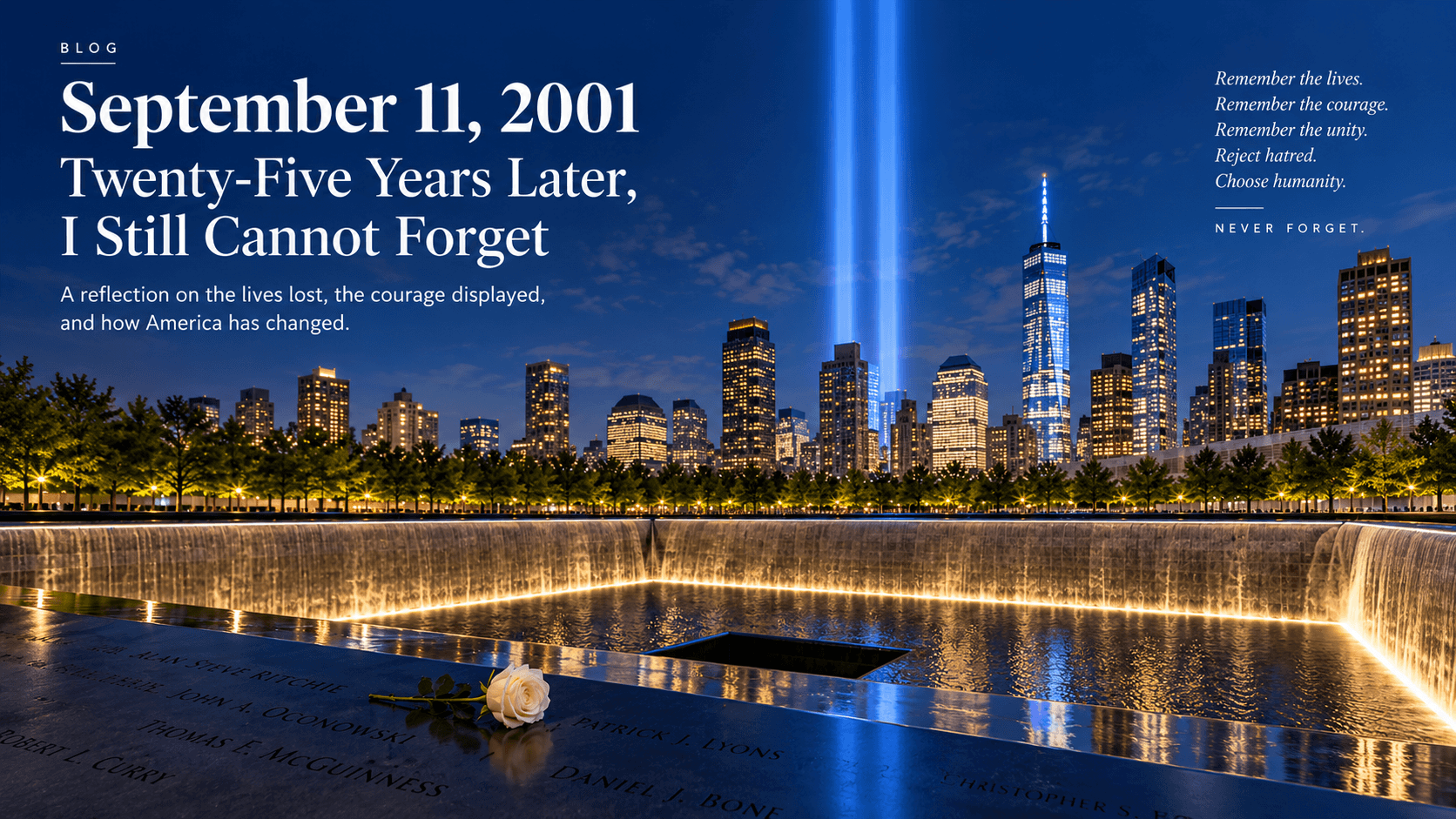
The names are inscribed into bronze surrounding the reflecting pools where the Twin Towers once stood. The Memorial honors the 2,977 people killed on September 11, along with the six people killed in the 1993 World Trade Center bombing.
There is something profound about a name.
Numbers tell us the scale of tragedy. Names remind us that every number was a person.
A person laughed. A person loved someone. A person worried about something. A person had plans for next weekend. A person had a favorite song. A person was expected home that evening.
And someone waited for a door that would never open again.
That is the human cost of terrorism.
What Should We Teach Our Children?
Twenty-five years later, perhaps the most important question is not only, "What happened on September 11?"
The more important question may be: what should September 11 teach us?
Teach children that freedom is precious. Teach them that democracy requires responsibility. Teach them to respect first responders and those who serve others. Teach them that courage does not mean absence of fear; sometimes courage means moving forward despite fear. Teach them that religious fanaticism and violent extremism can destroy societies.
But also teach them not to judge millions of innocent people because of the crimes of a few. Teach them to question ideologies that demand hatred. Teach them that disagreement does not require dehumanization. Teach them that patriotism and compassion can coexist.
And above everything else, teach them that human life has value.
Every human life.
Twenty-Five Years Later
Today, September 11, 2026, America marks twenty-five years since that terrible morning.
At the National September 11 Memorial in New York, families once again gather and the names of the victims are read aloud. Moments of silence mark the attacks and the collapse of the towers.
Twenty-five years have passed.
Children born after the attacks have become adults. New buildings have risen. New generations have arrived. Technology has transformed our lives. The world has moved forward.
But some memories should not disappear simply because time passes.
I still remember sitting in front of the television. I still remember the disbelief. I still remember wondering how something like this could happen in America.
And even today, one thought remains difficult to comprehend: how much hatred must a person carry inside to knowingly take the lives of thousands of innocent strangers?
Perhaps we will never fully understand that.
But we can choose what we do with the memory.
We can remember the victims without perpetuating hatred. We can honor the firefighters, police officers, medical personnel, passengers and ordinary citizens who demonstrated extraordinary courage. We can teach younger generations what happened. And perhaps most importantly, we can remind ourselves that no ideology, political cause, religious interpretation or grievance should ever become more valuable than innocent human life.
The towers fell twenty-five years ago.
But America stood back up.
And the responsibility of remembrance now belongs to all of us.
Remember the lives. Remember the courage. Remember the unity. Reject hatred. Choose humanity.
Never forget September 11, 2001.