The Warning Signs of Suicide: Recognizing the Silent Cry for Help Before It’s Too Late
Suicide Prevention Begins With Awareness, Compassion, Conversation, and the Willingness to Take Warning Signs Seriously
There are moments in healthcare when recognizing a warning sign can change the course of a person’s life.
We routinely educate people about the warning signs of a heart attack.
Stroke.
Cancer.
And other potentially life-threatening conditions.
Yet one of the most serious emergencies can be much harder to see.
A person experiencing suicidal thoughts may be sitting beside us at dinner.
Working alongside us.
Attending school.
Caring for a family.
Posting photographs on social media.
Or carrying on an apparently normal conversation.
Their struggle may not be visible.
That is why understanding the warning signs of suicide matters.
Suicide is not simply a mental-health statistic.
Behind every number is a human being.
A parent.
Child.
Spouse.
Sibling.
Friend.
Colleague.
Student.
Patient.
Neighbor.
And behind every death are families and communities left asking painful questions:
Did we miss something?
Was there a warning sign?
Could we have done something differently?
We must be careful here.
We cannot assume that every suicide can be predicted or prevented.
Human behavior is far too complex for that.
But we can become better at recognizing distress.
Asking difficult questions.
Listening without judgment.
And helping people connect with appropriate support.
Sometimes that intervention may save a life.
Suicide Is a Major Public-Health Challenge
Suicide remains a serious public-health problem around the world.
The original article notes that more than 700,000 people die by suicide globally each year, with many more experiencing suicidal thoughts or attempting suicide.
In the United States, suicide also affects people across ages, professions, socioeconomic backgrounds, cultures, families, and communities.
But numbers tell only part of the story.
One death can affect an enormous circle of people.
Parents lose children.
Children lose parents.
Friends lose friends.
Schools lose students.
Workplaces lose colleagues.
Communities experience grief.
And families may be left carrying confusion, guilt, anger, and unanswered questions.
That is why suicide prevention cannot belong exclusively to psychiatrists, psychologists, or emergency departments.
It requires awareness throughout society.
Warning Signs and Risk Factors Are Not the Same
This distinction is extremely important.
A risk factor is something associated with an increased likelihood of suicide over time.
Risk factors can include:
Previous suicide attempts.
Certain mental-health conditions.
Substance-use disorders.
Chronic pain or serious medical illness.
Exposure to violence or trauma.
Social isolation.
Significant financial or legal difficulties.
Relationship breakdown.
Family history of suicide.
Recent major loss.
A warning sign, however, may indicate that someone is experiencing an acute or escalating crisis.
Warning signs are often changes in what someone:
Says.
Does.
Feels.
Neither warning signs nor risk factors allow us to predict suicide with certainty.
But when several concerning changes appear together—or when someone's behavior changes significantly—we should pay attention rather than wait for absolute proof that something is wrong.
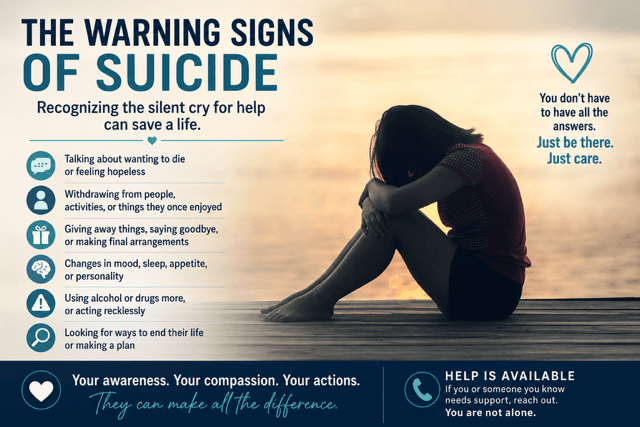
1. Talking About Wanting to Die
One of the clearest warning signs is when someone talks or writes about death, suicide, or not wanting to live.
Sometimes the statement is direct:
“I want to die.”
“I’m thinking about killing myself.”
Other times, it may be less explicit:
“Everyone would be better off without me.”
“There is no reason for me to be here anymore.”
“I wish I could go to sleep and never wake up.”
“You won’t have to worry about me much longer.”
Statements like these should not automatically be dismissed as drama, manipulation, or attention-seeking.
Even when we are uncertain about someone's intention, expressions of hopelessness or a desire to die deserve compassionate attention.
It is better to take distress seriously than to assume someone does not mean what they are saying.
2. Feeling Hopeless or Trapped
Hopelessness can be particularly concerning.
A person in severe distress may begin believing:
Their situation will never improve.
Their emotional pain will never end.
They have destroyed their future.
Nobody can help them.
There are no meaningful options left.
Someone looking from the outside may see possible solutions.
But the person experiencing the crisis may not.
Severe emotional distress can narrow perspective until a temporary problem begins to feel permanent.
Statements such as:
“Nothing is ever going to get better.”
or
“There is no way out of this.”
deserve attention—especially when they appear alongside withdrawal, major loss, substance misuse, significant mood changes, or other warning signs.
3. Feeling Like a Burden
Another concerning theme is believing that other people would somehow be better off without you.
Someone may say:
“I’m just causing problems for everyone.”
“My family would be better without me.”
“I’m nothing but a burden.”
These beliefs may not reflect reality.
But severe emotional suffering can distort how people perceive their own worth and relationships.
Our first instinct may be to immediately argue:
“That's ridiculous. Everyone loves you.”
But listening may be more helpful than debating.
A gentler response might be:
“It sounds like you’re carrying an enormous amount right now. Tell me what’s been happening.”
Sometimes people need to feel heard before they are ready to hear reassurance.
Listening creates connection.
4. Withdrawal From Family and Friends
Social withdrawal can occur for many reasons.
By itself, it does not prove that someone is suicidal.
But sudden or significant isolation can be concerning—particularly when it represents a major change from someone's usual behavior.
A previously engaged person may begin:
Avoiding friends.
Missing family gatherings.
Ignoring messages.
Spending unusually long periods alone.
Losing interest in hobbies.
Missing school or work.
Avoiding activities they once enjoyed.
This becomes more concerning when withdrawal appears alongside hopelessness, major loss, depression, substance misuse, or conversations about death.
Sometimes the person who most needs connection is the person quietly disappearing from it.
Reach out.
A simple message can matter:
“I haven’t heard from you lately. I’ve been thinking about you. How are you really doing?”
5. Giving Away Meaningful Possessions or Saying Goodbye
Unusual preparations for death deserve serious attention.
Someone may unexpectedly:
Give away treasured possessions.
Contact people they have not spoken with in years.
Write unusual farewell messages.
Apologize for past events.
Settle personal affairs unexpectedly.
Make arrangements that resemble a final goodbye.
Of course, context matters.
Any one of these behaviors can have an innocent explanation.
But when several appear suddenly alongside emotional distress, hopelessness, or suicidal statements, intervention may be necessary.
We should look at patterns rather than interpreting every behavior in isolation.
6. Significant Changes in Mood or Personality
Sometimes friends and relatives cannot identify one specific symptom.
They simply say:
“Something is different.”
Or:
“They don't seem like themselves anymore.”
Possible changes can include:
Persistent sadness.
Irritability.
Rage.
Anxiety.
Emotional numbness.
Shame.
Unusual impulsivity.
Severe agitation.
Loss of interest in previously meaningful activities.
The change itself may sometimes be more informative than any single emotion.
When someone's personality or behavior changes significantly, we should ask what is happening rather than automatically assuming it will pass.
7. Significant Changes in Sleep or Appetite
Emotional distress often affects basic biological functions.
Someone may begin sleeping almost constantly.
Another person may barely sleep at all.
Appetite may change.
Weight may change.
Energy may decline.
These symptoms are common in many physical and psychological conditions and should never be interpreted as proof of suicidal intent.
But context matters.
When major sleep or appetite changes appear alongside hopelessness, withdrawal, substance misuse, or suicidal statements, they deserve additional attention.
The goal is not to diagnose someone based on one symptom.
The goal is to notice meaningful changes and ask what may be happening underneath them.
8. Increasing Alcohol or Drug Use
Some people attempt to escape emotional pain through alcohol or other substances.
This can become particularly dangerous during a suicidal crisis.
Intoxication may:
Reduce inhibition.
Increase impulsivity.
Intensify depression.
Impair judgment.
Increase risk-taking.
Someone who might normally reconsider a dangerous decision may be less able to do so while intoxicated.
A sudden escalation in alcohol or drug use during a period of severe emotional distress should therefore not simply be dismissed as “coping badly.”
It may indicate that the person needs additional support and professional attention.
9. Reckless or Self-Destructive Behavior
Suicidal distress does not always begin with a direct statement about death.
Sometimes it appears through behavior.
A person may engage in:
Extreme risk-taking.
Dangerous driving.
Serious self-neglect.
Repeated self-harm.
Behavior suggesting that personal safety no longer matters.
The underlying message may sometimes be:
“I don’t care what happens to me.”
That deserves attention.
Not every reckless action indicates suicidal intent.
But a major change toward self-destructive behavior—especially when combined with hopelessness, withdrawal, substance misuse, or other warning signs—should prompt concern.
10. Signs of Active Preparation Require Urgent Action
When there is evidence that someone may be actively preparing to act on suicidal thoughts, the situation becomes an urgent safety concern.
At that point, the priority is not debating.
Lecturing.
Trying to solve every problem.
Or finding the perfect words.
The priority is:
Immediate safety and professional evaluation.
If you believe someone is in imminent danger, do not leave them alone. Seek urgent professional or emergency assistance and involve trusted people who can help maintain safety.
A crisis requires action—not certainty.
11. Sudden Calm After Severe Distress
This warning sign requires nuance.
When someone who has been profoundly distressed suddenly appears calmer, improvement may be genuine.
And we should not automatically interpret calmness as danger.
However, an abrupt and unexplained change following intense suicidal distress can sometimes be concerning—particularly if it occurs alongside farewell behavior or other warning signs.
Rather than making assumptions, ask.
“You seem very different today. How are you feeling?”
And if you are genuinely concerned about suicide, it is appropriate to ask directly.
That leads to one of the most important lessons in suicide prevention:
Talking about suicide does not create suicidal thoughts.
Avoiding the conversation may leave suffering hidden.
Asking About Suicide Directly Can Open the Door to Help
One of the most persistent myths surrounding suicide prevention is the fear that asking someone about suicide might somehow place the idea in their mind.
That fear can prevent important conversations.
If you are genuinely concerned about someone, it is appropriate to ask clearly and calmly:
“Are you thinking about suicide?”
or
“Are you thinking about killing yourself?”
When safety is at stake, clarity matters.
For someone who has been desperately hiding their suffering, a direct but compassionate question may communicate something powerful:
I see that you are hurting.
I am willing to hear the truth.
You do not have to hide this from me.
The purpose of asking is not to interrogate.
It is to create an opening for honesty, connection, and appropriate help.
What Should You Do If Someone Says Yes?
First:
Listen.
You do not suddenly need to become their therapist.
You do not need to deliver the perfect inspirational speech.
And you do not need to solve every problem in their life during one conversation.
Be present.
Take what they are saying seriously.
You might say:
“Thank you for telling me.”
“I’m here with you.”
“I want to help you stay safe.”
“Let’s get some help together.”
If you believe the person is in immediate danger, seek urgent professional or emergency assistance rather than leaving them alone.
Whenever possible, involve trained mental-health professionals and trusted people who can provide appropriate support.
Sometimes the most important thing we can do is not have all the answers.
It is help someone reach people who do.
Immediate Safety Matters
During an acute suicidal crisis, creating time and distance between the person and potentially lethal means can be an important component of safety.
A crisis can fluctuate.
What feels unbearable in one moment may not remain at the same intensity indefinitely.
Creating a safer environment can provide crucial time for the crisis to change and for professional help to arrive.
Families and loved ones should work with healthcare or crisis professionals to determine appropriate safety measures for the individual's circumstances.
The objective is simple:
Help the person survive the crisis long enough for additional support and treatment to become possible.
What Not to Say
When someone reveals severe emotional suffering, our words matter.
Certain responses can unintentionally make a person feel even more isolated.
Avoid statements such as:
“Other people have it much worse.”
“You have everything. Why would you be depressed?”
“Think about what this would do to your family.”
“Just be positive.”
“You need to be stronger.”
Mental suffering does not disappear because someone is reminded that other people are also suffering.
Instead, try:
“I may not completely understand what you’re going through, but I want to understand.”
That sentence communicates something important.
You are not judging.
You are listening.
You are staying.
Sometimes compassion begins not with advice—but with presence.
Social Media Can Contain Warning Signs
Today, emotional distress may appear online before it appears in a face-to-face conversation.
Concerning posts may communicate:
Hopelessness.
Worthlessness.
Farewell messages.
Preoccupation with death.
Feeling like a burden.
Statements suggesting there is no future.
We should be careful about dismissing these messages as attempts to attract attention.
And even when someone is seeking attention, perhaps we should ask:
Why?
A person seeking attention may actually be seeking:
Connection.
Reassurance.
Understanding.
Or help.
Reach out privately.
Ask how they are doing.
And if you believe the danger is immediate, involve people who can physically reach the individual and seek appropriate emergency assistance.
A digital warning sign can represent very real suffering.
Suicide Does Not Have a Single “Type”
We also need to challenge our assumptions about what a suicidal person looks like.
A professionally successful person can experience suicidal thoughts.
A teenager with supportive parents can struggle.
A healthcare professional can struggle.
A business owner can struggle.
An athlete can struggle.
A parent surrounded by family can struggle.
Someone smiling in photographs can struggle.
External success does not provide immunity from emotional suffering.
This is why statements such as:
“But they seemed so happy.”
can be misleading.
We often see only the portion of another person's life they are able—or willing—to show us.
Pain does not always look like pain.
Sometimes it goes to work.
Answers emails.
Smiles for photographs.
Takes care of children.
And tells everyone:
“I’m fine.”
Major Life Events Can Increase Vulnerability
Periods of significant transition, loss, or stress can intensify psychological distress.
Examples may include:
Death of someone close.
Divorce or separation.
Relationship conflict.
Job loss.
Financial crisis.
Legal difficulties.
Serious illness.
Chronic pain.
Academic failure.
Bullying.
Public humiliation.
Social isolation.
Major professional setbacks.
Most people experiencing these circumstances will not attempt suicide.
That distinction is important.
But when someone experiencing a major stressor also begins showing significant warning signs, we should pay attention.
Sometimes what appears manageable from the outside can feel unbearable to the person living through it.
We should never assume we know the weight of another person's burden simply because we can see the circumstances from a distance.
Children and Teenagers Need Adults Who Listen
Young people may express distress differently from adults.
Parents, teachers, coaches, counselors, and healthcare professionals should pay attention to major changes such as:
Withdrawal.
Sudden decline in school performance.
Severe mood changes.
Loss of interest in friends or activities.
Increased substance use.
Self-harm.
Statements about death or worthlessness.
Giving away possessions.
Significant sleep changes.
Persistent hopelessness.
Young people may hesitate to disclose emotional distress because they fear punishment.
Embarrassment.
Being judged.
Or simply not being taken seriously.
That makes our first response extremely important.
When a young person reveals significant emotional distress, the goal should not immediately become interrogation.
The first priorities should be connection, listening, safety, and appropriate support.
Men and the Culture of Silence
Another challenge in suicide prevention is the cultural expectation that people—particularly men—should remain silent about emotional pain.
Many people grow up hearing:
“Be strong.”
“Don’t complain.”
“Handle your problems yourself.”
But strength should not be confused with silence.
Seeking help requires courage.
Talking with a therapist is not weakness.
Calling a friend is not weakness.
Telling a physician that you are struggling is not weakness.
Human beings are social creatures.
We are not designed to carry every burden alone.
Perhaps one of the most important cultural changes we can make is redefining strength.
Strength is not pretending nothing hurts.
Sometimes strength is being willing to say:
“I need help.”
Healthcare Professionals Must Ask Difficult Questions
Healthcare professionals occupy an important position in suicide prevention.
A patient may arrive because of:
Headaches.
Chronic pain.
Insomnia.
Fatigue.
Injury.
Medication concerns.
Or another physical complaint.
Yet underneath that complaint may be significant psychological distress.
Healthcare professionals must remember to see the whole person.
When clinical circumstances raise concern, asking about emotional well-being and suicidal thoughts may uncover suffering that otherwise remains hidden.
Mental health is not an optional addition to physical healthcare.
Mental health is health.
Prevention Begins Long Before the Crisis
Suicide prevention cannot begin only when someone reaches an emergency department.
We need families, schools, workplaces, healthcare systems, and communities where asking for help becomes normal.
That includes improving:
Access to mental-health care.
Early identification and treatment.
Substance-use treatment.
Social connection.
School-based support.
Workplace mental-health programs.
Primary-care screening when appropriate.
Community education.
Crisis-response systems.
Follow-up after suicidal crises.
But access alone is not enough.
We must also reduce stigma.
We cannot repeatedly tell people:
“Ask for help.”
while simultaneously making them ashamed of needing it.
A healthier culture recognizes psychological suffering as something deserving the same compassion and seriousness we would extend to physical illness.
Check on the People Who Become Quiet
Sometimes there are obvious warning signs.
Sometimes there are not.
That is why ordinary human connection matters.
Call the friend you have not heard from.
Check on the coworker who suddenly stopped joining everyone for lunch.
Ask your teenager something deeper than:
“How was school?”
Sit beside the family member who has been struggling.
Ask the second question.
Not merely:
“Are you okay?”
But:
“How are you really doing?”
Then give them enough time to answer.
We live in a world filled with communication.
Messages.
Notifications.
Emails.
Social media.
Video calls.
Yet people can still feel profoundly alone.
Being connected technologically is not the same as feeling connected emotionally.
A Conversation Can Become a Bridge
We should never imply that every suicide could have been prevented if a family member or friend had simply noticed the right warning sign or said the perfect sentence.
That would place an unfair and painful burden on people already experiencing grief.
There is no perfect sentence.
There is no perfect intervention.
And ordinary people cannot predict every human action.
But there are opportunities to:
Notice.
Connect.
Ask.
Listen.
And act.
That is why suicide prevention belongs not only in psychiatric clinics.
It belongs in homes.
Schools.
Workplaces.
Healthcare facilities.
Community organizations.
And everyday conversations.
If you notice concerning warning signs, you do not need absolute proof before expressing concern.
You do not need a diagnosis to say:
“I’m worried about you.”
You do not need professional credentials to listen.
And you do not need all the answers to help someone connect with someone who does.
Sometimes a conversation becomes the bridge between suffering alone and receiving help.
Final Reflection: Take the Signs Seriously
A person experiencing suicidal thoughts may not necessarily want life itself to end.
Sometimes what they desperately want is for their suffering to end, and they cannot see another path forward.
That distinction gives us reason for hope.
Circumstances can change.
Depression can be treated.
Substance-use disorders can be treated.
Relationships can be repaired—or survived.
Financial crises can evolve.
Grief can become more bearable.
Pain can be managed.
Isolation can become connection.
And a moment of unbearable despair does not have to determine the rest of someone's life.
The challenge is helping someone survive that moment long enough to discover what can change.
So learn the warning signs.
Take conversations about suicide seriously.
Ask the difficult question.
Listen without judgment.
Stay connected.
Help the person reach appropriate professional support.
And when there is immediate danger, treat it as the emergency it is.
Sometimes helping to save a life begins not with an extraordinary act, but with one human being noticing another human being's pain and saying:
“I see you. I’m concerned about you. I’m here, and we’re going to find help together.”
Words of Appreciation
“Vijay, you are truly a gem. Your kindness and generosity mean more than you know. Your willingness to support my classroom and the work I do with my students reflects your genuine belief in children and their future.
Teaching can be challenging and, at times, thankless, but I truly feel that God made this my mission field. I still love being a teacher, being a small part of my students’ journeys, and encouraging each of them to ‘Go BE Great!’
Thank you, Vijay, for believing in what I do, for supporting my students, and for your incredible generosity. May you always be blessed for your kindness.”
— Kelly
Educator & Teacher
Medical Disclaimer
This article is intended for general education and suicide-prevention awareness and is not a substitute for evaluation, diagnosis, or treatment by a qualified healthcare or mental-health professional.
Anyone who may be in immediate danger or at imminent risk of suicide should receive urgent professional or emergency assistance.
“Sometimes the most important thing we can do for another human being is notice when they have become quiet, ask the question others are afraid to ask, listen without judgment, and stay beside them while helping them find the support they need.” — Dr. Vijay Kumar