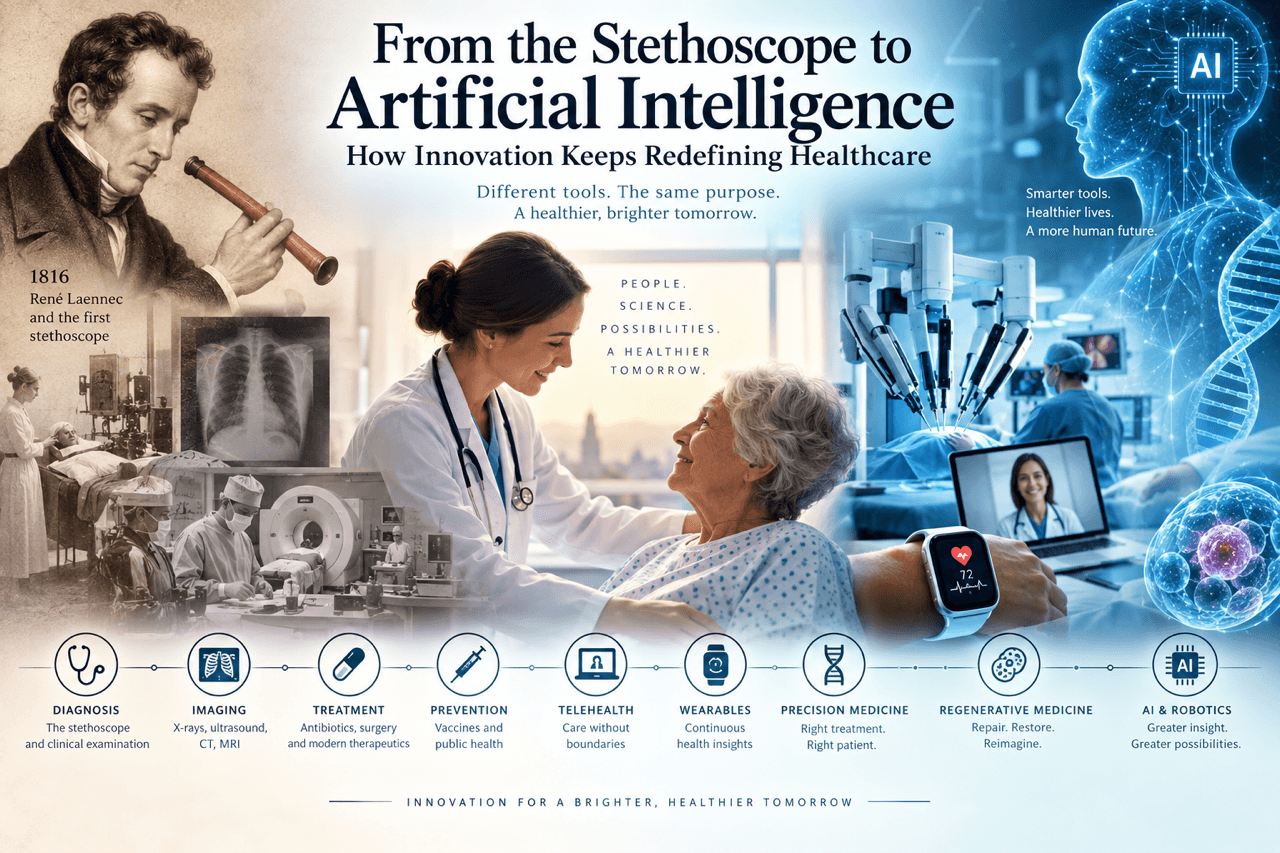
From the Stethoscope to Artificial Intelligence: How Innovation Keeps Redefining Healthcare
A Journey Through Two Centuries of Medical Innovation — and What Comes Next
There is something almost poetic about the stethoscope.
It is simple, inexpensive and instantly recognizable. For generations, it has hung around the neck of physicians, nurses and other healthcare professionals as a symbol of medicine itself.
Yet when the stethoscope was introduced in the early nineteenth century, it represented cutting-edge medical technology.
Before it, physicians largely depended on what patients told them, what they could observe, what they could feel with their hands and, when necessary, placing an ear directly against the patient's chest.
Then medicine learned to listen differently.
Two centuries later, we stand at another remarkable point in medical history. Artificial intelligence can assist clinicians in interpreting images and recognizing complex patterns in enormous datasets. Robotic systems can extend a surgeon's dexterity. Wearable devices can gather physiological information while people sleep, exercise and work. Telehealth can bring portions of healthcare into a patient's home. Genomic and molecular information is helping make treatment increasingly individualized. Regenerative medicine is exploring whether damaged tissues might one day be repaired or rebuilt rather than simply compensated for.
At first glance, the wooden stethoscope and artificial intelligence seem to belong to completely different worlds.
They do not.
They are chapters in the same story: human beings developing better ways to observe, measure, understand, prevent and treat disease.
And behind every successful innovation lies the same fundamental question: can we use what we have learned to help another human being live a healthier and better life?
1816: When Medicine Learned to Listen
In 1816, French physician René Laennec developed the instrument that would become the stethoscope.
His early device was very different from the familiar binaural stethoscope used today. It was essentially a hollow wooden tube.
The concept was remarkably simple: transmit and amplify sounds from inside the chest so that the physician could hear them more clearly.
Its significance, however, was enormous.
The stethoscope allowed physicians to connect particular internal sounds with diseases affecting the heart and lungs. Suddenly, information that had previously been hidden inside the body became more accessible.
That concept would become one of the great themes of modern medicine.
Make the invisible visible. Make the inaudible audible. Make the unmeasurable measurable.
The electrocardiogram would translate electrical activity into lines on paper. X-rays would reveal structures beneath the skin. Laboratory medicine would transform blood and other biological specimens into measurable information. Ultrasound would convert reflected sound waves into images. CT and MRI would produce increasingly detailed pictures of internal anatomy. Genomic sequencing would reveal biological information written in DNA. Wearable sensors would collect physiological information outside the clinic. And artificial intelligence would begin searching enormous amounts of medical information for patterns humans might otherwise overlook.
Different technologies. The same human ambition: to understand the body more deeply so that we can care for it more effectively.
The X-Ray: Medicine Learns to See Through the Body
Another extraordinary moment arrived in 1895 when Wilhelm Conrad Röntgen discovered X-rays.
The implications were immediate.
For most of human history, physicians could examine the outside of the body, but understanding what was happening inside it was far more difficult.
X-rays changed that.
A fractured bone could be seen rather than merely suspected. The chest could be examined for abnormalities without surgery. Foreign objects could be located inside the body.
A new era of diagnostic medicine had begun.
And the technology kept advancing. Ultrasound used sound waves to visualize internal structures. Computed tomography, or CT, generated detailed cross-sectional images. Magnetic resonance imaging, or MRI, provided extraordinary visualization of soft tissues without using ionizing radiation. PET imaging added functional and metabolic information.
Today, medical imaging is essential to almost every major area of healthcare — from emergency medicine and oncology to cardiology, neurology, orthopedics and rehabilitation.
But imaging is now undergoing another transformation.
For the first century of radiology, the major challenge was producing better images. Increasingly, the challenge is extracting more information from those images.
That is where artificial intelligence enters the story.
Laboratory Medicine: Turning the Body Into Data
Another revolution was taking place quietly in laboratories.
Blood, urine, tissue and other specimens began revealing information that neither the physician's eyes nor the stethoscope could detect.
Blood glucose could be measured. Cholesterol could be quantified. Kidney and liver function could be assessed. Hormones could be analyzed. Microorganisms could be cultured. Tumor markers and molecular abnormalities could be investigated.
Medicine gradually became increasingly quantitative.
A physician no longer had only symptoms and physical findings. There were numbers. And numbers could be compared over time.
A rising creatinine could signal worsening kidney function. An elevated hemoglobin A1c could reveal chronic glucose dysregulation. Abnormal thyroid hormone levels could explain symptoms that otherwise appeared vague. Troponin measurements could help evaluate myocardial injury.
Laboratory medicine transformed the body into biological information. That development laid another piece of the foundation for today's data-driven healthcare.
Vaccines: The Revolutionary Idea of Preventing Disease
Some of the greatest innovations in medicine do not treat disease at all. They prevent it.
Vaccination represents one of the most important public-health achievements in human history.
The principle is powerful: expose the immune system to information about a pathogen in a controlled way so that it is better prepared when the real threat appears.
Vaccination programs dramatically reduced the burden of numerous infectious diseases. Smallpox was ultimately eradicated globally. Polio has been pushed close to eradication. Diseases that once terrified families can now often be prevented.
Vaccines changed the philosophy of medicine. Instead of asking only "how do we treat this disease?", medicine could increasingly ask "how do we prevent this disease from occurring?"
That philosophical change remains extremely relevant today. Wearable technology, predictive analytics, genetic risk assessment and AI-assisted screening are all, in different ways, attempting to move healthcare farther upstream.
The ideal medical intervention may not be the one that saves someone after catastrophic illness. It may be the one that prevents that catastrophe from happening.
Antibiotics: Changing the Balance Between Humans and Infection
Before modern antibiotics, bacterial infection was a constant threat.
A wound could become infected. Pneumonia could become fatal. Surgery could succeed technically and still end in death from postoperative infection. Childbirth carried risks that today can be difficult to imagine.
The antibiotic era dramatically changed medicine.
But antibiotics did something else that is sometimes overlooked: they helped make many other medical advances possible.
Complex surgery becomes considerably more dangerous when bacterial infections cannot be treated. Cancer chemotherapy suppresses immune defenses and therefore depends partly on our ability to manage infections. Organ transplantation would be far more difficult without antimicrobial therapy. Modern intensive care relies heavily on the ability to diagnose and treat infection.
One innovation enabled others. That is a recurring pattern throughout medical history.
But antibiotics also teach us another lesson.
Technology does not permanently conquer biology. Bacteria evolve. Antimicrobial resistance develops. Powerful innovations can lose their effectiveness when they are overused or misused.
Innovation therefore requires stewardship. That lesson is particularly relevant as we enter an age of AI, genomics and biological engineering.
Surgery: From the Scalpel to the Robot
Few areas demonstrate medical progress as dramatically as surgery.
For much of history, surgery was constrained by three enormous problems: pain, infection, and bleeding.
Advances in anesthesia, antiseptic technique, blood transfusion, antibiotics and surgical instrumentation transformed what was possible. Operations that would once have been unimaginable became routine.
Then came minimally invasive surgery. Instead of making large incisions, surgeons could perform many procedures through small openings using cameras and specialized instruments. For appropriately selected procedures, minimally invasive approaches can reduce tissue trauma, shorten recovery and decrease postoperative discomfort.
Then surgery entered the robotic era. Robotic-assisted surgical systems can provide magnified visualization, sophisticated instrumentation and precise translation of the surgeon's hand movements.
An important distinction often gets lost in public discussions: the robot is generally not replacing the surgeon. It is extending the surgeon's capabilities.
This may become one of the defining relationships between humans and technology throughout healthcare. The most productive question may not be "can technology replace the healthcare professional?" It may be "how can technology make a skilled healthcare professional even more capable?"
Artificial Intelligence: A New Kind of Medical Instrument
Now we arrive at perhaps the most discussed healthcare technology of our time: artificial intelligence.
The phrase sometimes creates the impression that healthcare suddenly entered the computer age. In reality, AI is the continuation of a much longer transformation.
Healthcare has been creating increasingly large amounts of data for decades: medical images, laboratory results, ECGs, pathology slides, electronic medical records, prescriptions, vital signs, genomic information, clinical notes, and now information generated by wearable and home-monitoring devices.
The human brain is extraordinary. But no physician can simultaneously analyze millions of comparable images, thousands of variables and decades of population-level medical data while evaluating one patient.
Computers can help identify patterns at a scale humans cannot.
The FDA describes AI applications in medical devices that include image acquisition and processing, earlier disease detection, diagnosis, prognosis, risk assessment and personalized diagnostics. The agency also maintains a public list of AI-enabled medical devices authorized for marketing in the United States, while emphasizing that safety, effectiveness, transparency and lifecycle monitoring remain important.
That distinction matters. AI in healthcare is no longer merely science fiction. It is already entering regulated medical practice.
AI in Radiology: Helping Find What the Eye Might Miss
Radiology has become one of the most visible areas of medical AI.
Consider the workload involved in modern imaging. A single CT scan can contain hundreds or even thousands of images. Radiologists may interpret large volumes of studies while simultaneously integrating clinical history and prior imaging.
AI systems can potentially assist by identifying suspicious findings, quantifying abnormalities, prioritizing urgent examinations and comparing patterns across large datasets.
That does not mean an algorithm understands a patient in the way a physician does. It means AI may serve as another analytical tool.
In some situations, the future workflow may resemble aviation. Modern aircraft use sophisticated automation, but trained pilots remain responsible for understanding the entire situation.
Healthcare may increasingly develop similar partnerships.
AI detects. The clinician interprets. AI calculates. The clinician contextualizes. AI suggests. The clinician decides.
AI Beyond Imaging
Artificial intelligence is not limited to radiology. Potential and emerging applications span many specialties.
In pathology, computational tools can analyze digitized tissue slides. In cardiology, algorithms can examine ECGs and physiological signals. In ophthalmology, image-analysis systems can help identify certain retinal abnormalities. In hospital care, predictive models may estimate deterioration or other risks. In medical documentation, generative AI may help clinicians summarize information or reduce administrative burden. In drug discovery, computational systems can help researchers explore potential molecular targets and candidate compounds.
But there is an essential caveat.
AI is not inherently correct simply because it is sophisticated. Algorithms can be wrong. Training data can contain bias. A system performing well in one population may perform differently in another. Software can change. Clinical environments can change.
That is why the FDA has increasingly emphasized lifecycle management, transparency, bias considerations and real-world performance for AI-enabled medical devices.
Healthcare cannot accept an algorithm merely because it is impressive. The standard must remain: does it improve care safely and reliably?
The Stethoscope Itself Is Becoming Digital
Perhaps one of the most beautiful examples of medical continuity is that the stethoscope itself is evolving.
Traditional stethoscopes transmit sound mechanically. Digital stethoscopes can amplify and record sounds. Connected devices can transmit them remotely. Software can analyze acoustic characteristics. Artificial intelligence may assist with recognizing certain patterns in heart or lung sounds.
Think about that progression.
The instrument invented more than two centuries ago to help one physician listen to one patient can now potentially produce digital information that can be stored, transmitted and computationally analyzed.
The stethoscope and artificial intelligence are therefore not competing symbols of old and new medicine. They may ultimately become partners.
Telehealth: Healthcare Escapes the Walls of the Clinic
For most of medical history, healthcare depended on physical proximity. Either the patient traveled to the clinician or the clinician traveled to the patient.
Telemedicine challenged that assumption.
The World Health Organization describes telemedicine as healthcare delivered over distance and notes its potential to extend service coverage and improve clinical management when appropriately implemented.
This can be particularly meaningful for rural communities.
Consider a patient living hours from a major medical center. A specialist consultation may require driving several hours, missing work, arranging transportation, possibly staying overnight, and sometimes repeating the journey for a relatively short appointment.
Telehealth cannot eliminate every one of these barriers, but it can reduce some of them.
A follow-up appointment might occur by video. A clinician may review home blood-pressure readings remotely. A rehabilitation professional may monitor selected exercises. A specialist may consult with a patient without requiring immediate long-distance travel.
Telehealth does not replace physical healthcare. There are examinations that require hands. There are procedures that require facilities. There are situations where direct observation is essential. The WHO itself cautions that digital health interventions are not substitutes for functioning health systems.
The goal is not to replace the clinic. It is to make the boundaries of the clinic more flexible.
Wearables: Healthcare Between Doctor Visits
Traditional healthcare provides snapshots.
Your blood pressure is measured during an appointment. Your pulse is recorded. Your weight is documented. Perhaps an ECG is performed. Then you leave.
But human biology continues twenty-four hours a day.
Wearable and sensor-based technologies create the possibility of observing portions of that biology between appointments.
Smartwatches can measure heart rate and activity. Some devices can record single-lead ECGs. Continuous glucose monitors can provide repeated glucose measurements. Other sensors may monitor sleep, movement, oxygen saturation or other physiological variables depending on the device.
The FDA describes digital health technologies as including computing platforms, connectivity, software and sensors, and notes that they can help move aspects of healthcare outside traditional clinical settings.
This represents a profound shift: from episodic medicine toward continuous medicine.
But there is a challenge.
More data is not automatically better healthcare. Thousands of measurements can create thousands of opportunities for false alarms, unnecessary anxiety or meaningless information.
The challenge of wearable medicine is therefore not merely collecting information. It is determining which information matters and what should be done with it.
Precision Medicine: The Right Treatment for the Right Patient
Traditional evidence-based medicine often asks: what treatment works best for patients with this disease?
Precision medicine adds another question: which treatment is most appropriate for this particular patient?
Human beings differ enormously. We differ genetically. We metabolize medications differently. Our environments differ. Our diets differ. Our medical histories differ. Even diseases that share the same name can have very different molecular characteristics.
Cancer provides one of the clearest examples. Historically, tumors were categorized largely by where they occurred — lung cancer, breast cancer, colon cancer and so forth.
Today, molecular and genetic characteristics of tumors can sometimes provide information that influences prognosis or treatment selection. The disease is no longer defined only by its location. Its biology matters.
As genomic sequencing becomes more accessible and biological databases become larger, medicine may increasingly combine clinical information, genetics, biomarkers and environmental factors.
The long-term aspiration is straightforward: treat the person, not merely the diagnostic label.
Regenerative Medicine: From Managing Damage to Repairing It
For much of medical history, we have compensated for damaged biological systems.
When a joint becomes severely damaged, we may replace it. When kidneys fail, dialysis can replace some of their function. When a limb is lost, a prosthesis can restore part of its function.
Regenerative medicine asks a fundamentally different question: can damaged biology itself be repaired or regenerated?
The National Institutes of Health describes regenerative medicine as a developing field that can involve stem cells, engineered biomaterials, tissue engineering and gene editing to repair or replace damaged cells, tissues or organs.
Tissue engineering may combine cells, scaffolds and biologically active molecules in attempts to restore damaged tissues. Engineered skin and cartilage are examples that have reached FDA-approved use, although their applications remain limited.
Stem-cell science is also enabling researchers to create organoids and tissue models that can be used to study disease and test potential therapies.
The possibilities are extraordinary. But regenerative medicine also requires caution.
Promising research is not synonymous with proven therapy. A treatment being investigated in a clinical trial is not automatically established medical care. Patients should be cautious about commercial claims promising miraculous regeneration without rigorous scientific evidence and appropriate regulatory oversight.
Innovation should give people hope. It should never exploit hope.
Rehabilitation and Physical Therapy in the Technology Revolution
Innovation is not limited to operating rooms and research laboratories. Rehabilitation is also becoming increasingly technological.
Movement can now be quantified in ways that were previously difficult. Wearable motion sensors can track activity. Force platforms can measure balance and loading. Computerized systems can evaluate aspects of gait. Virtual reality can create controlled environments for rehabilitation. Robotic devices and exoskeletons are being investigated and used in selected neurological and mobility applications. Tele-rehabilitation can extend certain components of therapy beyond the clinic. Artificial intelligence may eventually help clinicians recognize movement patterns and monitor functional progression.
But physical therapy also illustrates something technology cannot easily replicate.
A patient's goal is rarely simply "increase quadriceps strength by 20 percent." The real goal may be: I want to climb the stairs again. I want to return to work. I want to walk without being afraid of falling. I want to play with my grandchildren. I want my independence back.
Technology can measure movement. The clinician must understand why that movement matters.
What Comes Next? Predictive Healthcare
Much of traditional medicine is reactive. A symptom appears. The patient seeks help. Testing begins. A diagnosis is made. Treatment follows.
The next generation of healthcare may become increasingly predictive.
Imagine combining genetic information, laboratory trends, medical imaging, electronic health records, medication history, lifestyle factors, and wearable sensor data.
AI systems may be able to identify combinations of subtle changes indicating that disease risk is increasing before obvious symptoms develop. The FDA is already exploring digital health technologies that may capture early manifestations of chronic disease and acquire health information remotely.
This could gradually shift medicine from "diagnose and treat" toward "predict, prevent and personalize."
That does not mean every disease will become predictable. Human biology is extraordinarily complex. But even modest improvements in early detection could have enormous consequences.
The Ethical Challenge: Just Because We Can, Should We?
Every medical revolution creates ethical questions. AI and digital medicine are no exception.
Who owns the data collected by a wearable device? Who can access genetic information? How should sensitive medical information be protected? If an AI system recommends the wrong diagnosis, who is responsible? How can we detect algorithmic bias? How do we ensure that technologies trained on one population work safely in others? How do clinicians explain an algorithmic recommendation to a patient?
And perhaps one of the most important questions: will technological medicine decrease health disparities — or widen them?
A sophisticated telehealth platform means little to a patient without reliable internet. A genomic treatment means little if it is financially inaccessible. A revolutionary diagnostic system cannot improve public health if only a privileged minority can use it.
Innovation must therefore be measured not only by technological sophistication. It must also be measured by accessibility, affordability, safety and equity.
Will Artificial Intelligence Replace Doctors?
This is probably the wrong question.
Calculators did not eliminate mathematicians. Airplane automation did not eliminate pilots. Medical imaging did not eliminate physical examination. The stethoscope did not replace the physician's ear.
Each technology changed how professionals worked. AI will likely do the same.
Some repetitive tasks may become automated. Some diagnoses may become faster. Some documentation may become easier. Some patterns may be identified earlier.
But medicine involves something algorithms do not possess: human responsibility.
A patient is not merely a collection of laboratory values. A patient may be frightened. A patient may have cultural beliefs affecting a decision. A patient may prefer quality of life over another aggressive treatment. A patient may need reassurance rather than another test. A family may need someone to explain that medicine has reached its limits.
Those moments require judgment, ethics, communication and compassion.
The Future Hospital May Look Very Different
Imagine healthcare several decades from now.
A person's wearable device notices subtle physiological changes. An AI system identifies an abnormal pattern. The patient's clinician receives an alert. A telehealth consultation occurs. Advanced imaging confirms a problem. Genomic information helps determine which therapy is most likely to work. A robotic system assists the surgeon. Sensors monitor recovery at home. Rehabilitation data are transmitted to the therapy team. Perhaps regenerative treatment eventually helps repair damaged tissue.
Much of this sounds futuristic. Pieces of it already exist.
The future rarely arrives all at once. It arrives one innovation at a time.
But One Thing Must Never Change
Imagine that futuristic hospital again.
AI has analyzed the scans. Algorithms have calculated risk. Genomics has helped select therapy. Robotic technology has assisted surgery. Wearable sensors are monitoring recovery.
The technology is extraordinary.
Then a physician, nurse or therapist sits beside the patient. The patient asks: "Am I going to be okay?"
At that moment, healthcare becomes profoundly human again.
No algorithm can completely replace the meaning of one human being taking responsibility for caring for another.
Technology may process information. Compassion interprets what that information means to a life.
From Listening to Understanding
The history of healthcare can be viewed as an extraordinary progression.
The stethoscope allowed us to hear. X-rays allowed us to see. Laboratory medicine allowed us to measure. Vaccines allowed us to prevent. Antibiotics allowed us to fight infection. Modern surgery allowed us to repair. Genomics allowed us to read biological instructions. Telehealth allowed us to cross distance. Wearables allowed us to monitor continuously. Artificial intelligence is helping us recognize patterns at enormous scale. And regenerative medicine is asking whether we can increasingly rebuild what disease or injury has damaged.
Each advance expands what medicine can know or do. But each also expands our responsibility to use that knowledge wisely.
The future of healthcare should not be defined by technology alone. It should be defined by what technology makes possible for patients: earlier answers, safer treatments, fewer barriers, more personalized care and greater independence. Innovation matters most when it reaches the people who need it — not only those with the resources, geography or digital access to benefit first.
That means designing systems that are transparent, affordable and inclusive. It means testing new tools across diverse populations, protecting privacy, listening to patients and ensuring that algorithms support — not replace — clinical judgment. It means remembering that efficiency is valuable, but dignity is essential.
The stethoscope changed medicine because it helped clinicians listen more closely. Artificial intelligence may change medicine by helping us understand more deeply. Yet the purpose remains the same: to relieve suffering, protect health and care for each person as a whole human being.
The tools will continue to change. The mission must not.
The best healthcare of the future will unite precision with empathy, innovation with accountability and advanced technology with human presence. It will use every available instrument to see more clearly, act more wisely and reach more people — while never losing sight of the individual whose life gives the data meaning.
From the stethoscope to artificial intelligence, progress is not measured only by how far medicine can go.
It is measured by how compassionately, safely and equitably we bring that progress to everyone.
Author Note
"I still carry a stethoscope, and I probably always will — not out of nostalgia, but because it reminds me what the whole enterprise is actually for. Every algorithm, sensor and scan we add is only worth something if it eventually helps someone sit beside a frightened patient and answer honestly. Innovation is a tool. Care is still the point." — Vijay Kumar