Standing Before the White House: A Reflection on Dreams, Democracy, and the Journey Forward
There are photographs that capture a place, and then there are photographs that capture a feeling.
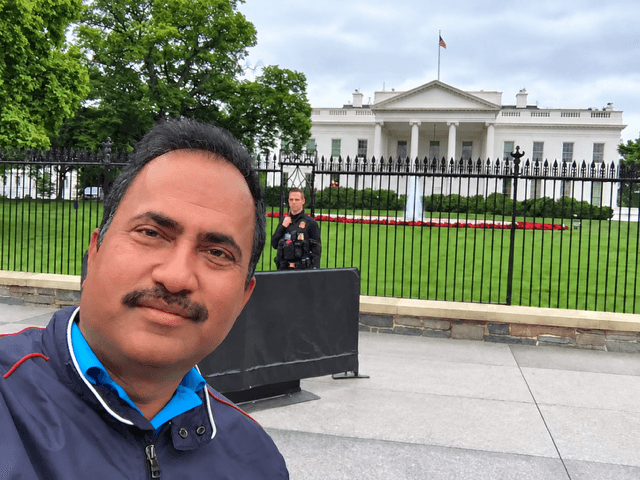
Standing in front of the White House in Washington, D.C., I found myself thinking about much more than the historic building behind me. I thought about journeys — the miles we travel geographically, the obstacles we overcome personally, and the distance between where our dreams begin and where life eventually takes us.
For me, this photograph represents one of those reflective moments.
The White House is recognized throughout the world as a symbol of the American presidency and the institutions of American democracy. Yet standing outside its gates, my thoughts were not primarily about politics. They were about possibility.
They were about the remarkable idea that our beginnings do not have to determine our destinations.
From Bihar to America: A Journey I Could Not Have Imagined
I was born and raised in Bihar, India.
When I think about those early years and compare them with the experiences life has given me since then, I sometimes wonder whether the younger version of myself could ever have imagined the journey ahead.
Education became one of the bridges that carried me forward.
Medicine, public health, research, physical therapy, healthcare leadership, entrepreneurship, and community service have each become chapters in my life. None of those chapters developed exactly according to a master plan. Opportunities appeared, difficulties arose, plans changed, and sometimes entirely new roads opened.
That is one of life's most important lessons:
You do not need to see the entire road before beginning the journey. You simply need enough courage to take the next meaningful step.
The American Dream Is More Than Material Success
The phrase "American Dream" is often associated with professional achievement, financial prosperity, owning a home, or building a business.
Those things can certainly be meaningful.
But after living and working in America, I have come to see the American Dream in a broader way.
To me, it is fundamentally about opportunity — the opportunity to learn, to work, to contribute, to reinvent yourself, and to participate in your community.
Success is not merely what we accumulate. It is also what we contribute.
A successful physician who never helps another person has missed something important. A successful entrepreneur who never creates opportunities for others has left part of the journey unfinished. A person with knowledge who refuses to share it has limited the value of that knowledge.
The most meaningful success creates ripples beyond ourselves.
Democracy Is Both a Privilege and a Responsibility
Standing near the White House also reminded me that democracy should never be taken for granted.
Buildings and monuments do not preserve democracy by themselves. Institutions matter enormously, but ultimately democratic societies depend upon people — citizens who participate, communities that remain engaged, journalists who ask questions, public servants who perform their duties, and individuals who are willing to disagree without losing respect for one another.
Democracy is sometimes noisy. It can be frustrating. It can be imperfect.
But the ability of ordinary citizens to express opinions, challenge authority, participate in elections, advocate for their communities, and seek change through peaceful civic engagement remains extraordinarily valuable.
My own experiences with public service and civic involvement have strengthened my appreciation for that responsibility.
Leadership does not belong exclusively to people holding elected office.
Teachers are leaders. Healthcare professionals are leaders. Parents are leaders. Volunteers are leaders. Small-business owners are leaders.
And sometimes leadership simply means being the person willing to stand up and say, "How can I help?"
Never Allow Your Starting Point to Define Your Finish Line
One reason I share personal stories on this website is not simply to document where I have traveled or what I have accomplished.
I share them because someone's story may encourage another person who is still standing at the beginning of his or her journey.
Perhaps you are a student from a small village wondering whether you belong at a great university. Perhaps you are an immigrant trying to establish yourself in a new country. Perhaps you are changing careers at an age when other people tell you it is too late. Perhaps you have experienced failure and are wondering whether you should try again. Perhaps life has taken an unexpected turn and the future looks uncertain.
Remember this: your current circumstances are a chapter. They are not necessarily the conclusion.
Where you begin matters far less than the direction in which you continue moving.
Education Can Change Generations
If there is one force that has repeatedly transformed my own life, it is education.
Education is not simply the accumulation of degrees or professional titles. At its best, education changes how we think.
It teaches us to ask better questions. It teaches us to recognize how much we still do not know. It gives people tools to improve their own circumstances and, ideally, to improve the lives of others.
For young people — particularly those growing up in communities where opportunities may seem limited — education can become a passport to possibilities that are difficult to imagine today.
Never underestimate the power of one teacher, one mentor, one scholarship, one book, or one person who tells a young student: "You can do this."
Sometimes that sentence can redirect an entire life.
Success Rarely Travels in a Straight Line
Photographs tend to show destinations. They rarely show the difficult miles that came before them.
Behind almost every successful person are disappointments that never made it into photographs: applications that were rejected, opportunities that disappeared, mistakes, criticism, financial uncertainty, professional setbacks, sleepless nights, and moments of self-doubt.
That is why we should be careful when comparing our lives with the visible achievements of others. We usually see someone's highlight. We do not see the hundreds of ordinary days that created it.
My own journey has certainly included unexpected turns. Some experiences strengthened me; others humbled me. Some doors opened quickly, while others remained closed no matter how hard I knocked.
Eventually, I learned something important: a closed door does not always mean the journey is over. Sometimes it simply changes the direction of the journey.
Resilience is not pretending that setbacks do not hurt. Resilience is deciding that the setback will not have the final word.
Keep Reinventing Yourself
One of the greatest mistakes we can make is believing that there is an age when growth must stop.
There isn't.
You can learn at 20. You can start over at 40. You can build something new at 50. You can discover another purpose at 60, 70, or beyond.
Life does not require us to remain permanently attached to one professional identity or one definition of success.
A physician can become an entrepreneur. A healthcare professional can become a community advocate. A business owner can become a volunteer. A student can become a teacher — and eventually become a student again.
Reinvention is not evidence that the earlier journey was wasted. Often, every previous chapter prepares us for the next one.
Look Back With Gratitude, But Keep Looking Forward
When I look at this photograph today, I see more than the White House.
I see a reminder of distance traveled.
I see the boy from Bihar. I see the student who believed education could open doors. I see the immigrant learning to navigate another country and culture. I see the healthcare professional. I see the entrepreneur. I see the community volunteer.
And most importantly, I see someone whose journey is still unfinished.
That may be the greatest privilege of all.
As long as we are alive, we still have an opportunity to learn something new, repair something broken, encourage someone struggling, serve our communities, strengthen our relationships, pursue another dream, and become a little wiser than we were yesterday.
We should appreciate our accomplishments, but we should never become prisoners of them.
The question is not only, "How far have I come?"
The more important question is, "What good can I still do with the road ahead?"
The Journey Continues
Standing before one of the world's most recognizable buildings reminded me that institutions may be built from stone, but nations and communities are ultimately built by people.
By people who work. People who serve. People who dream. People who disagree and still find ways to live together. People who educate the next generation. People who refuse to surrender when circumstances become difficult. And people who continue believing that tomorrow can be better than today.
My journey from Bihar to America has taught me that dreams can cross villages, cities, oceans, professions, cultures, and generations.
But dreams alone are not enough.
They require education. They require discipline. They require resilience. They require humility. And above all, they require the courage to continue.
So wherever you are in your own journey today, keep moving.
Your road may not look like anyone else's. It does not need to.
Believe in possibility. Work with purpose. Serve with humility. Learn continuously. And never allow the place where your journey began to determine how far you are capable of going.
The next chapter may be closer than you think.
Author Note
"I didn't plan that photograph as a symbol of anything — I was just a visitor with a camera. It was only later, looking back at it, that I understood what it actually captured: not a monument, but a measurement. A reminder of how far a single decision to keep going can carry a person. I hope whoever reads this is somewhere in the middle of their own version of that walk." — Vijay Kumar