When Every Breath Becomes Work: Smoking, Lung Capacity, and the Reality of COPD
A Medical Professional’s Reflection on What Smoking Can Do to the Lungs—and Why Quitting Still Matters
There are moments in healthcare that stay with you.
For me, one of those moments is watching a patient struggle simply to breathe.
I see patients who become short of breath after walking only a short distance.
Some have to stop in the middle of a conversation to catch their breath.
Some rely on several inhalers or nebulizer treatments.
Others carry portable oxygen or remain connected to supplemental oxygen for much of the day.
You can see the effort in their faces.
Breathing—the most basic function of human life—has become work.
As a healthcare professional, it is difficult to witness.
And when years of cigarette smoking have contributed to that loss of respiratory function, it becomes a powerful reminder that the consequences of tobacco exposure can develop quietly for years before becoming impossible to ignore.
This article is not intended to shame people who smoke.
Nicotine dependence is real.
Quitting can be extraordinarily difficult.
Instead, this is an educational message about what cigarette smoke can do to the lungs, why some smokers eventually feel as though they cannot get enough air, and—most importantly—why quitting still matters.
What Do We Really Mean by “Lung Capacity”?
People often say smoking “reduces lung capacity.”
That is understandable, but medically the story is more complicated.
Our lungs do much more than simply hold air.
They must move air efficiently through the airways.
Exchange oxygen and carbon dioxide across millions of microscopic air sacs called alveoli.
And maintain enough elasticity to expand and recoil with every breath.
One of the most important tools used to evaluate lung function is spirometry.
Spirometry can measure values such as:
FEV1 — Forced Expiratory Volume in One Second
This measures how much air a person can forcefully exhale during the first second of breathing out.
FVC — Forced Vital Capacity
This represents the total amount of air forcefully exhaled after taking a deep breath.
In obstructive lung diseases such as chronic obstructive pulmonary disease (COPD), airflow becomes limited.
So when a patient says:
“I feel like my lungs aren't working anymore.”
they may actually be experiencing several problems at once:
Narrowed airways.
Inflammation.
Excess mucus.
Loss of elastic recoil.
Destruction of alveolar tissue.
Air trapping.
Impaired gas exchange.
The patient's description may not use medical terminology.
But the sensation is very real.
What Cigarette Smoke Does Inside the Lungs
Every cigarette exposes the respiratory system to a complex mixture of chemicals and particulate matter.
The damage does not necessarily happen overnight.
It can accumulate over decades.
Repeated exposure can promote chronic inflammation throughout the respiratory tract.
Airways may become irritated and swollen.
Mucus production can increase.
The mechanisms responsible for clearing mucus and debris can become impaired.
And over time, structural damage can develop.
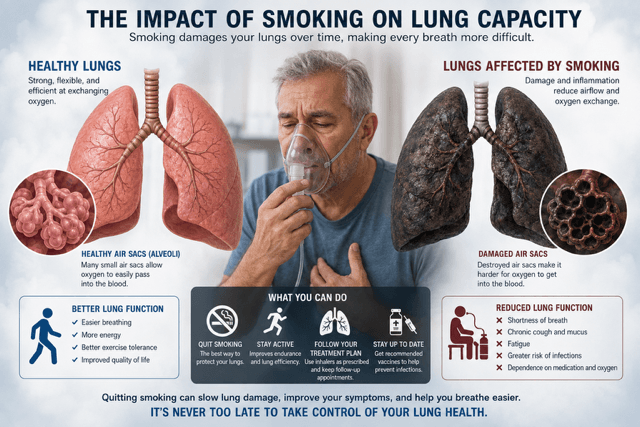
In emphysema, walls separating tiny air sacs are destroyed.
The lungs lose some of their normal elastic recoil, making it increasingly difficult to push air out.
In chronic bronchitis, persistent airway inflammation and mucus production contribute to coughing and airflow obstruction.
Many patients have characteristics of both.
COPD can therefore involve multiple changes simultaneously:
Airways lose elasticity.
Air-sac walls become damaged.
Airway walls become inflamed and thickened.
Excessive mucus further restricts airflow.
Imagine repeatedly damaging millions of microscopic structures responsible for transferring oxygen into the bloodstream.
Eventually, the body's respiratory reserve begins to disappear.
The Tragedy Is That Early Lung Damage Can Be Quiet
One of the most dangerous aspects of smoking-related lung disease is that people may not initially realize what is happening.
The human body has remarkable respiratory reserve.
Someone can lose meaningful pulmonary function while continuing to work, walk, and perform ordinary activities relatively normally.
Then small changes begin appearing.
The stairs become harder.
Walking uphill requires a pause.
The morning cough becomes routine.
Mucus production increases.
Exercise tolerance declines.
Activities that once seemed easy become less appealing.
Eventually, shortness of breath may occur during ordinary activities such as:
Getting dressed.
Bathing.
Walking across a parking lot.
Carrying groceries.
Early COPD may cause no symptoms or only mild symptoms.
As lung damage progresses, however, symptoms can include persistent coughing, mucus production, wheezing, chest tightness, and shortness of breath—particularly during physical activity.
Unfortunately, people often unconsciously adapt.
They stop taking the stairs.
They walk less.
Exercise less.
Avoid hills.
Avoid physically demanding activities.
And eventually they may conclude:
“I'm just getting older.”
But sometimes what appears to be ordinary aging is actually progressive respiratory disease.
Then Comes the Gasping for Air
This is the stage that can be particularly difficult to witness.
Imagine wanting to take a satisfying deep breath—but feeling that you cannot.
Imagine walking twenty feet and needing to stop.
Imagine waking during the night frightened because breathing feels difficult.
Imagine planning your day around where your oxygen equipment can go.
For patients with advanced COPD, respiratory distress can become physically and emotionally exhausting.
Some describe the experience as breathing through a narrow straw.
Others say:
“I can breathe in, but I can't seem to get the air back out.”
That second description can be particularly relevant to emphysema.
Damaged lungs may lose elastic recoil.
Small airways can collapse during expiration.
Air becomes trapped inside the chest.
The patient may technically have plenty of air inside the lungs—but much of that air is trapped and being exchanged inefficiently.
Then the next breath arrives before the previous breath has been adequately exhaled.
Breathing becomes increasingly inefficient.
Why Patients May Need Several Inhalers
People sometimes wonder why someone with COPD may use several respiratory medications.
Different medications serve different purposes.
Depending on the person's diagnosis and disease severity, treatment may include:
Bronchodilators that relax airway smooth muscle.
Long-acting maintenance inhalers.
Short-acting rescue medications.
Inhaled corticosteroids for selected patients.
Combination therapies.
These treatments can help reduce symptoms and exacerbations and improve functional capacity.
But there is an important distinction:
An inhaler can help open an airway. It cannot recreate destroyed alveoli.
Medication can help manage COPD—sometimes very effectively.
But after substantial structural lung damage has occurred, treatment cannot simply restore the lungs to their original condition.
That is one reason prevention and smoking cessation remain so important.
When Oxygen Becomes Part of Daily Life
Some people with advanced chronic lung disease develop hypoxemia, meaning abnormally low oxygen levels in the blood.
Supplemental oxygen may then become medically necessary.
Patients may use a nasal cannula connected to an oxygen concentrator at home or carry portable oxygen equipment when they leave the house.
Importantly, oxygen is not prescribed simply because someone feels short of breath.
Its use depends on clinical evaluation and evidence of inadequate oxygenation.
For some patients, however, oxygen eventually becomes part of everyday life.
Sleeping with oxygen.
Eating with oxygen.
Walking with oxygen.
Traveling with oxygen.
Visiting family with oxygen.
And sometimes simply sitting quietly with oxygen.
When I see this, I often think about how effortless breathing once was for that individual.
Something they never needed to think about has become something they must plan their entire day around.
Smoking and COPD: The Numbers Matter
Smoking is not the only cause of COPD.
Other contributing factors can include occupational exposures, environmental pollutants, secondhand smoke, asthma, and genetic conditions such as alpha-1 antitrypsin deficiency.
We should therefore never assume that every person with COPD has smoked.
However, the relationship between cigarette smoking and COPD is extremely strong.
According to the figures cited in the source article, cigarette smoking contributes to as many as 8 out of 10 COPD-related deaths, while as many as one-quarter of Americans with COPD have never smoked cigarettes.
Nearly 16 million American adults have been diagnosed with COPD, and additional people may have the disease without knowing it.
But these numbers represent much more than statistics.
They represent millions of people who may gradually lose the ability to perform activities most of us take for granted.
“I Have Smoked for 30 Years. What’s the Point of Quitting Now?”
This may be one of the most important misconceptions to challenge.
There is a point.
There is almost always a point.
Stopping smoking cannot necessarily reverse structural lung damage that has already occurred.
But quitting can slow additional damage and provide meaningful health benefits even after decades of smoking.
For people with COPD, smoking cessation can slow disease progression and reduce the loss of lung function over time.
It can also help reduce respiratory symptoms such as coughing, sputum production, and wheezing and reduce the risk of respiratory infections.
And the benefits extend far beyond the lungs.
Stopping smoking also reduces cardiovascular risk and the risk of numerous cancers.
Most importantly, the potential health benefits of quitting are not limited only to young people or those who recently started smoking.
It is not too late simply because you have smoked for many years.
The Body Begins Responding After the Last Cigarette
One of the most encouraging aspects of smoking cessation is that the body begins responding remarkably quickly.
Heart rate begins falling within minutes after the last cigarette.
Within several days, carbon monoxide levels in the blood can fall toward those seen in someone who does not smoke.
Over the following months, coughing and shortness of breath may decrease.
Cardiovascular and cancer risks continue declining over subsequent years.
Not every damaged lung structure will regenerate.
That distinction is important.
Quitting should never be presented as though decades of exposure can simply be erased.
But stopping continued exposure gives the body an opportunity to function without being repeatedly exposed to cigarette smoke.
You cannot rewrite every chapter already written in the lungs—but you can influence what happens in the chapters ahead.
Pulmonary Rehabilitation: An Underappreciated Treatment
Another important component of COPD management is pulmonary rehabilitation.
Pulmonary rehabilitation is much more than simply exercise for people with lung disease.
A comprehensive program may include:
Supervised exercise.
Breathing strategies.
Education.
Energy-conservation techniques.
Nutritional guidance.
Disease-management strategies.
For someone who becomes breathless easily, avoiding activity may seem logical.
Unfortunately, inactivity creates another problem.
Muscles become weaker.
Cardiovascular conditioning declines.
Ordinary activities begin requiring a greater percentage of the person's available physical capacity.
The person becomes even more breathless.
This can create a damaging cycle:
Breathlessness → fear of activity → inactivity → weakness and deconditioning → greater effort during activity → more breathlessness.
Breaking this cycle can improve function and quality of life.
Current COPD management guidance emphasizes smoking cessation, physical activity, and pulmonary rehabilitation as important non-pharmacological components of care.
As a Rehabilitation Professional, This Matters to Me
In rehabilitation, our goal is not simply to treat a diagnosis.
Our goal is to help people live.
We want patients to walk farther.
Climb stairs.
Dress independently.
Go shopping.
Play with grandchildren.
Attend family events.
Travel.
Return to hobbies.
Remain in their homes.
And maintain dignity and independence.
When respiratory disease begins limiting these abilities, its consequences extend far beyond the lungs.
A person who cannot breathe comfortably cannot move comfortably.
And when someone stops moving, another cycle can begin.
Strength declines.
Endurance decreases.
Balance may deteriorate.
Confidence disappears.
Independence becomes harder to maintain.
This is why respiratory health and physical function are inseparable.
For someone living with COPD, improving quality of life is not necessarily about returning lung function to what it was decades earlier.
Sometimes success means something much more practical:
Walking farther without stopping.
Climbing the stairs safely.
Getting dressed without becoming exhausted.
Participating in family life again.
Those improvements matter.
Smoking Doesn’t Affect Only the Smoker
There is another important dimension to smoking that deserves attention:
Secondhand smoke.
Children.
Spouses.
Family members.
Coworkers.
And other people nearby may be exposed to tobacco smoke despite never choosing to smoke themselves.
Secondhand smoke is associated with serious health consequences.
In adults, exposure can contribute to coronary heart disease, stroke, and lung cancer.
Children exposed to secondhand smoke can face increased risks of respiratory infections, asthma attacks, and other illnesses.
This means the decision to protect your lungs can extend beyond your own health.
Protecting yourself from tobacco smoke can also help protect the people breathing the air around you.
Quitting Is Not Simply About Willpower
We should be very careful about treating nicotine dependence as though it represents a lack of discipline or character.
Nicotine is addictive.
Many people who smoke genuinely want to quit.
Some make several attempts before they are eventually able to stop.
That should not automatically be interpreted as failure.
Smoking cessation can involve evidence-based support, including behavioral counseling, medications, and continued follow-up.
If one strategy does not work, another may.
If relapse occurs, the plan may need to change.
Ask again.
Try again.
Seek support again.
A previous unsuccessful attempt does not mean the next attempt will also be unsuccessful.
Every serious quit attempt matters.
The goal should not be to shame people into stopping.
The goal should be to help them succeed.
A Message to Younger Smokers
When you are 20, 25, or 30 years old, severe COPD can feel impossibly distant.
You may smoke and still run.
Smoke and still play sports.
Smoke and still climb several flights of stairs.
Smoke and still feel completely healthy.
That does not mean the lungs are immune to damage.
Smoking-related disease is often a story written slowly.
The consequences may not become obvious until years later.
That delay creates one of smoking's greatest dangers.
The absence of symptoms today can create the illusion that nothing is happening.
But prevention works precisely because we act before the consequences become obvious.
You do not want to wait until breathing becomes difficult to understand how valuable effortless breathing once was.
The best time to protect future lung function is while breathing still feels completely normal.
A Message to Long-Term Smokers
If you have smoked for decades, this article is not intended as judgment.
It is intended as encouragement.
Talk with your physician or another qualified healthcare professional about quitting.
Ask about smoking-cessation counseling.
Ask whether medications may be appropriate.
And pay attention to respiratory symptoms.
Persistent coughing.
Wheezing.
Excessive mucus.
Declining exercise tolerance.
Unexplained shortness of breath.
These symptoms deserve medical evaluation rather than simply being attributed to age.
Spirometry may help determine whether airflow obstruction is present.
And if COPD has already been diagnosed, continue working with your healthcare team.
Take prescribed medications appropriately.
Learn proper inhaler technique.
Remain physically active within your medical limits.
Consider pulmonary rehabilitation when appropriate.
Stay current with recommended vaccinations.
And if you continue to smoke, keep working toward quitting.
Smoking cessation remains central to COPD management.
Having smoked for decades is not a reason to give up. It is a reason to protect the lung function you still have.
When I See a Patient Struggling to Breathe
There are many things in healthcare that can begin to feel routine.
Breathing difficulty should never become one of them.
When I see someone gasping after only a few steps...
Reaching for an inhaler...
Connected to supplemental oxygen...
Or frightened because they cannot catch their breath...
I am reminded of how precious normal breathing really is.
Most of us woke up this morning and began taking thousands of breaths without consciously thinking about a single one.
No planning.
No medication.
No oxygen tubing.
No fear.
Just breathe in.
Breathe out.
Again.
And again.
We rarely appreciate that freedom until it begins disappearing.
And perhaps that is one of the most important messages I want younger people in particular to understand about smoking.
The cigarette you smoke today may not make you breathless today.
The damage can accumulate quietly.
And years later, the consequences may arrive when you least expect them.
Protect the Breath You Have Today
Modern medicine can accomplish remarkable things.
We have bronchodilators.
Combination inhalers.
Nebulizers.
Pulmonary rehabilitation.
Supplemental oxygen.
Advanced respiratory support.
And treatments continue to improve.
But despite all our medical technology, preventing lung damage remains far better than trying to manage advanced respiratory disease after it develops.
The message therefore changes depending on where someone is in their journey.
If you have never smoked—don't start.
If you smoke occasionally—don't allow occasional smoking to become lifelong dependence.
If you currently smoke—consider quitting now.
If you have smoked for decades—don't assume it is too late.
If you already have COPD—don't give up on protecting the lung function and physical capacity you still have.
Smoking cessation cannot rewrite every chapter already written in the lungs.
But it can influence what happens next.
Final Reflection: Never Take an Easy Breath for Granted
I have watched patients struggle for something most of us receive freely every second of every day:
One comfortable breath.
Watching someone fight for air changes your perspective.
It reminds you that health is not always measured by sophisticated laboratory tests.
Expensive medications.
Medical technology.
Or complicated procedures.
Sometimes health is much simpler.
It is walking across a room without stopping.
Climbing a flight of stairs without fear.
Sleeping through the night without waking short of breath.
Going outside without thinking about oxygen equipment.
Playing with grandchildren.
Traveling.
Shopping.
Living independently.
And taking a deep, satisfying breath without consciously thinking about the process.
We take thousands of breaths every day.
Most arrive silently.
Automatically.
Effortlessly.
Until one day, for some people, they don't.
That is why smoking prevention and cessation matter.
Not because people who smoke deserve judgment.
Not because every smoker will develop COPD.
And not because every person with COPD has smoked.
They matter because lungs are extraordinary organs, but they are not indestructible.
Once substantial structural damage occurs, medicine can help manage the consequences—but it cannot always restore what has been lost.
So protect the lungs you have today.
If you have never smoked, protect them by not starting.
If you smoke, protect them by working toward quitting.
If lung disease has already developed, protect the function that remains through appropriate medical treatment, physical activity, rehabilitation, and smoking cessation.
Because independence depends on movement.
Movement depends on oxygen.
And every moment of life depends on something so ordinary that we rarely stop to appreciate it:
The next breath.
Protect your lungs.
Protect your independence.
And never underestimate the value of breathing freely.
Medical Disclaimer
This article is intended for general educational and public-health purposes and is not a substitute for individualized medical advice, diagnosis, or treatment.
Anyone experiencing new, severe, or worsening shortness of breath should seek appropriate medical evaluation.
“We rarely appreciate the freedom of breathing until every breath becomes work. Protecting our lungs today is not only about preventing disease—it is about protecting the movement, independence, experiences, and life that every future breath makes possible.” — Dr. Vijay Kumar