Rome, the Eternal City: A Journey Through History, Art, Culture, and the Timeless Spirit of Italy
By Dr. Vijay Kumar, MD, MPH, PhD, DPT
Travel Reflections | Rome, Italy | History, Architecture, and Culture
Introduction: A City Where Every Street Tells a Story
There are some destinations in the world that we visit simply to enjoy a vacation. Others leave a lasting impression on our minds, challenge our understanding of history, and remind us how extraordinary human civilization has been.
Rome, Italy, belongs to the second category.
As someone who has always enjoyed traveling, exploring different cultures, and understanding the historical significance of places, visiting Rome was a remarkable experience. The city offered something beyond beautiful buildings, impressive monuments, and famous tourist attractions. It offered an opportunity to walk through thousands of years of human history.
Standing in front of the magnificent white marble monument known as the Altare della Patria, and later visiting the iconic Trevi Fountain, I found myself reflecting on the incredible achievements of ancient civilizations and how their influence continues to shape our modern world.
Rome is not simply another European capital. It is a living museum, a city where the ancient and modern worlds coexist.
Its streets have witnessed emperors, philosophers, soldiers, artists, religious leaders, and ordinary citizens whose lives collectively shaped the course of history.
For me, exploring Rome was not merely sightseeing. It was an opportunity to appreciate history, architecture, culture, and the remarkable human desire to create something that will survive long after its creators are gone.
The Eternal City: Why Rome Holds Such a Special Place in History
Rome is often called the Eternal City, a title that reflects its remarkable historical continuity and enduring cultural influence.
According to Roman tradition, the city was founded in 753 BCE by Romulus, one of the legendary twin brothers Romulus and Remus. Whether we examine Rome through mythology, archaeology, or historical scholarship, one fact remains undeniable: this city became the center of one of the most influential civilizations in human history.
The Roman Republic and later the Roman Empire shaped political institutions, legal systems, engineering practices, military organization, architecture, language, and urban development across vast territories.
Even today, we encounter Roman influence in everyday life. Many European languages evolved from Latin, legal terminology contains Latin expressions, and architectural designs around the world incorporate Roman columns, arches, and domes.
Roads, bridges, aqueducts, and public infrastructure developed by Roman engineers demonstrate extraordinary technical knowledge for their time.
As I explored Rome, I could not help thinking about how many generations had walked through these same streets before me. Emperors, soldiers, merchants, artists, pilgrims, and travelers had all contributed to the city's remarkable story.
History suddenly felt less like something written in textbooks and more like something alive around me.
Standing Before the Altare della Patria: A Monument to Italian Unity
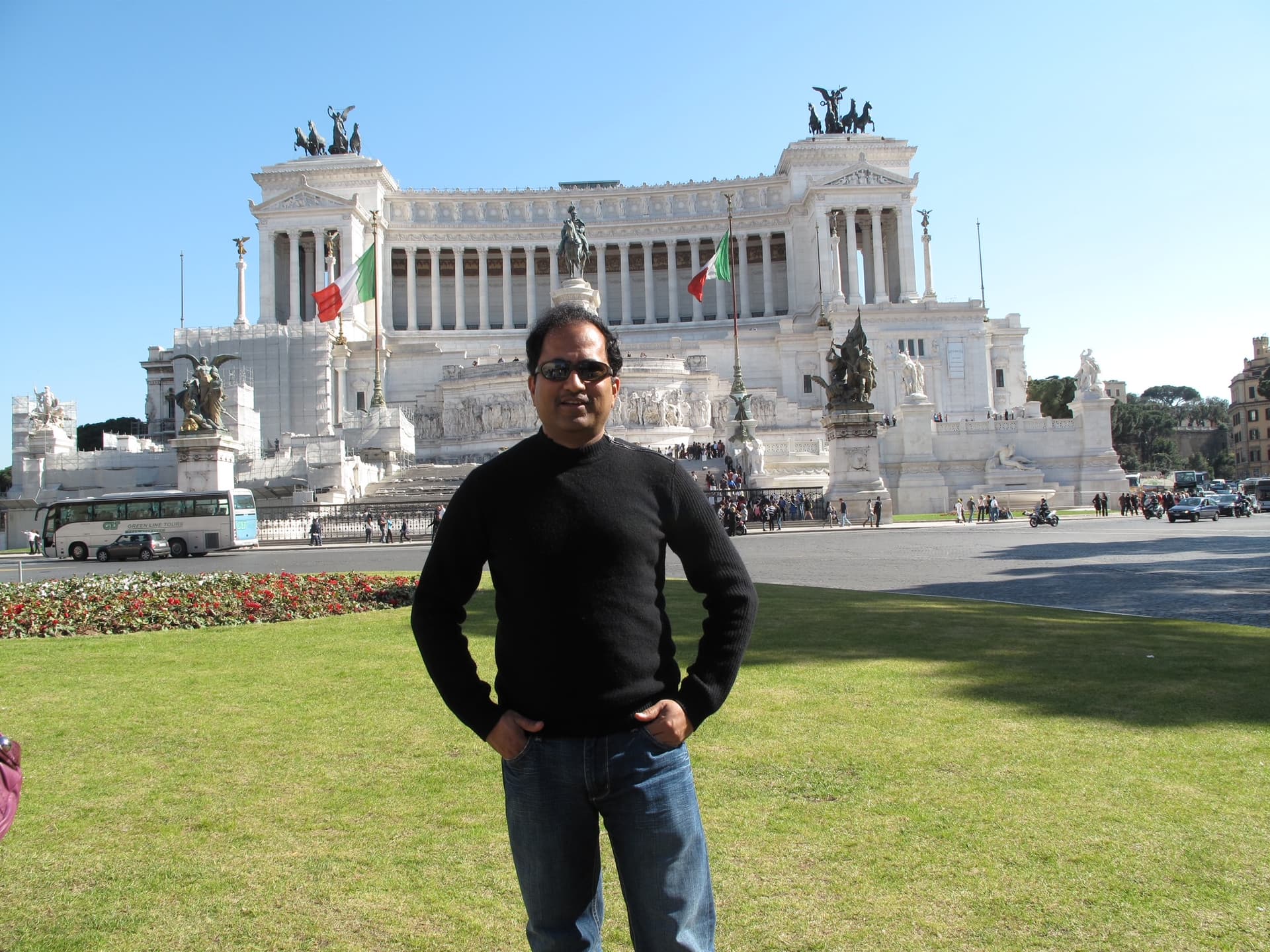
One of my most memorable photographs from Rome was taken in front of the magnificent Altare della Patria, also known as the Vittoriano or Monument to Victor Emmanuel II.
Located in Piazza Venezia, this enormous white marble structure is among Rome's most recognizable landmarks.
Looking at my photograph, I am reminded of the beautiful blue sky, the expansive green lawn, the Italian flags, and the imposing monument rising behind me.
The scale of the building is breathtaking. Its grand staircases, towering Corinthian columns, bronze statues, and elaborate sculptures create a powerful visual statement about Italian history and national identity.
The monument honors Victor Emmanuel II, the first king of a unified Italy, and commemorates the country's unification during the nineteenth century. Construction began in 1885, and the monument was inaugurated in 1911, although work continued afterward.
The structure also houses the Tomb of the Unknown Soldier, a solemn memorial dedicated to Italian soldiers who lost their lives in war.
What impressed me most was not simply the monument's enormous size, but the symbolism behind it.
Italy, like many nations, experienced centuries of political division, regional rivalries, and struggles for unity. The Vittoriano represents the aspiration of people to come together under a shared national identity.
Standing there, I thought about the historical struggles that different countries have experienced while seeking independence, unity, and self-determination.
As someone born in India who later built a professional and personal life in the United States, I have always found national history and cultural identity fascinating. India's own journey toward independence and the development of a modern democratic nation provides another powerful example of how history shapes collective identity.
Although the circumstances were different, both countries remind us that national unity is rarely achieved without sacrifice, determination, and a shared vision for the future.
Architecture That Speaks Across Generations
The Altare della Patria also reminded me of the extraordinary power of architecture.
Buildings are more than structures made from stone, marble, steel, or concrete. They communicate the aspirations, values, artistic traditions, and technological abilities of the societies that construct them.
In Rome, architecture is particularly fascinating because different historical periods exist almost side by side. Ancient Roman ruins stand near Renaissance palaces. Baroque churches appear along narrow streets. Modern businesses operate within buildings whose foundations may date back centuries.
This combination creates a unique urban environment.
In many modern cities, older buildings are demolished to make room for new construction. Rome demonstrates the importance of preserving architectural heritage while allowing contemporary life to continue.
I often wonder how future generations will judge the buildings and cities we are constructing today.
Will our modern structures inspire the same admiration centuries from now? Will they tell meaningful stories about our civilization? Or will they be remembered primarily for their technology and economic efficiency?
Rome teaches us that great architecture must serve more than a practical purpose. It should also reflect imagination, beauty, cultural meaning, and human ambition.
The Trevi Fountain: Where Art, Water, and Imagination Meet
Another unforgettable part of my visit was the Trevi Fountain, one of the most famous fountains in the world.
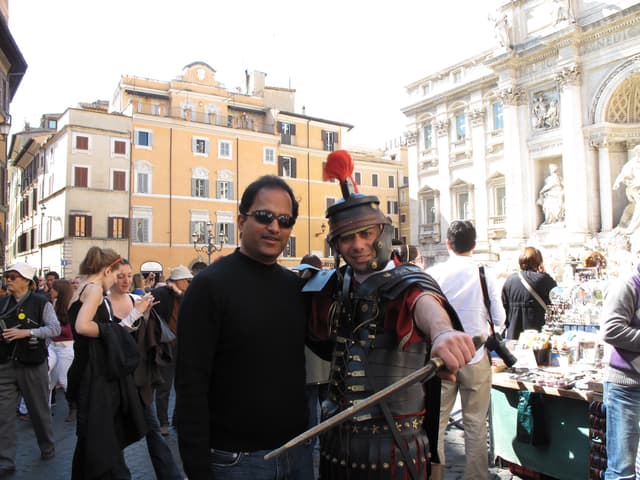
My photograph captures a lively moment near the fountain, where I am standing beside a man dressed as an ancient Roman soldier. He is wearing elaborate armor, a helmet with a red plume, and holding a sword.
The photograph brings a smile to my face because it represents one of the enjoyable aspects of travel: spontaneous encounters that create lasting memories.
Behind us stands the magnificent Baroque architecture associated with the Trevi Fountain.
The fountain is not simply a decorative water feature. It is a masterpiece of artistic imagination, engineering, and historical symbolism.
Designed principally by architect Nicola Salvi, construction began in 1732. The fountain was completed in 1762, after Salvi's death, under Giuseppe Pannini.
At its center stands Oceanus, the mythological personification of the ocean, riding in a shell-shaped chariot pulled by sea horses. The surrounding sculptures represent themes associated with the abundance and beneficial qualities of water.
The fountain's dramatic design combines architecture and sculpture in a way that makes the entire structure appear almost theatrical. Water flows over sculpted rocks into a large basin, creating movement, sound, and visual beauty.
Even among Rome's many extraordinary monuments, the Trevi Fountain possesses a special charm. It is a place where history, romance, mythology, and tourism come together.
The Tradition of Tossing Coins Into the Fountain
One of the best-known traditions associated with the Trevi Fountain is tossing a coin into its water.
According to popular tradition, throwing one coin over your shoulder into the fountain symbolizes the hope of returning to Rome. Other variations associate additional coins with romance or marriage, although these are modern popular customs rather than ancient Roman rituals.
The tradition became internationally famous through cinema and popular culture.
What fascinates me about this custom is how a simple gesture can connect people from different countries, languages, religions, and backgrounds.
Millions of visitors arrive in Rome carrying their own dreams and expectations, yet many participate in the same symbolic act. Some wish to return. Others hope for happiness, love, or good fortune.
The fountain becomes a shared space of human optimism.
The coins collected from the fountain have also been used to support charitable initiatives, giving this popular tourist tradition a meaningful social dimension.
For me, the broader lesson is that travel allows us to experience traditions that may be unfamiliar but still express universal human emotions. Hope, love, curiosity, and the desire to return to beautiful places are not limited by nationality. They belong to all humanity.
Meeting an Ancient Roman Soldier in Modern Rome
One of the lighter moments of my visit was posing for a photograph beside the man dressed in Roman military attire.
Of course, he was a modern performer portraying a soldier from antiquity, but the encounter offered an entertaining reminder of Rome's military history.
Roman soldiers played a central role in the expansion and administration of the Roman state. The Roman legions became famous for their discipline, organization, engineering capabilities, and tactical adaptability.
Their influence extended far beyond the battlefield. Soldiers helped construct roads, bridges, fortifications, and military settlements. Many of these infrastructure projects eventually supported trade, communication, and urban development.
The Roman military also contributed to the spread of language, customs, and administrative practices throughout the empire.
Yet Roman expansion came with enormous human costs, including warfare, enslavement, and the domination of conquered populations. Remembering history responsibly requires acknowledging both its achievements and its darker consequences.
Looking at my photograph beside the costumed soldier, I appreciate the contrast between ancient military symbolism and the peaceful atmosphere of modern tourism.
A uniform once associated with imperial conquest has become part of a cultural experience enjoyed by travelers. That transformation itself says something about how societies reinterpret their past.
Rome and the Extraordinary Engineering Achievements of the Ancient World
As a healthcare professional with a strong interest in science, public health, and human development, I found Rome's engineering history especially interesting.
The ancient Romans were remarkable builders. They constructed roads across difficult terrain, developed extensive aqueduct systems, designed public baths, and created sophisticated drainage infrastructure.
Some Roman aqueducts transported water over considerable distances using carefully calculated gradients and gravity. The engineering principles behind these structures remain impressive even by modern standards.
Water was essential not only for drinking but also for sanitation, public bathing, fountains, agriculture, and economic activity.
The Roman commitment to public infrastructure offers important lessons for contemporary societies. Clean water, sanitation, transportation, and urban planning are fundamental components of population health.
Although ancient Rome did not possess modern germ theory or contemporary public health science, its infrastructure demonstrated an understanding that organized cities require reliable systems to support large populations.
Of course, Roman sanitation was far from perfect, and disease remained a major problem. Nevertheless, the investment in infrastructure demonstrated the importance of public works in supporting urban life.
Standing near Rome's great fountains and monuments, I was reminded that public health is not confined to hospitals and clinics. It begins with the environments in which people live.
Safe water, functional transportation, clean surroundings, and well-designed public spaces all contribute to healthier communities.
The Connection Between Rome and Modern Healthcare
Rome's historical contributions to medicine are another fascinating subject.
Roman medicine was strongly influenced by earlier Greek medical traditions. Physicians such as Galen, who practiced in the Roman Empire during the second century CE, shaped medical thought for many centuries.
Although numerous ancient medical theories were later proven incorrect, the systematic observation of patients and efforts to understand anatomy and physiology contributed to the long evolution of medicine.
Roman military medicine also developed organized approaches to caring for wounded soldiers. Medical facilities associated with military installations provide historical examples of structured healthcare delivery.
As someone who has devoted much of my professional life to healthcare, rehabilitation, physical therapy, and public health, I find it inspiring to consider how medical knowledge develops over generations.
Today's hospitals, rehabilitation centers, diagnostic technologies, and evidence-based treatments are products of centuries of inquiry, experimentation, correction, and innovation.
Progress rarely occurs overnight. It builds upon the work of countless individuals, including those whose names have disappeared from history.
Rome offers a powerful reminder that scientific advancement is a continuous human journey.
The Beauty of Walking Through Rome
One of the greatest pleasures of exploring Rome is simply walking.
Unlike destinations where visitors move quickly from one attraction to another, Rome encourages a slower pace. Its narrow streets, open piazzas, historic fountains, neighborhood cafés, and architectural surprises make walking an experience in itself.
Every corner seems to reveal something unexpected. A small church may contain extraordinary artwork. A modest street may lead toward a magnificent square. A centuries-old building may house a modern restaurant or shop.
This blending of everyday life and historical surroundings gives Rome a distinctive personality.
I have always enjoyed physical activity, whether walking, running, trekking, or exploring new destinations on foot. Travel provides an excellent opportunity to combine physical movement with intellectual curiosity.
Walking through a historic city engages the body and mind simultaneously. We observe our surroundings, learn about unfamiliar places, interact with different cultures, and experience the natural rhythm of urban life.
From a health perspective, walking can support cardiovascular fitness, metabolic health, mobility, and psychological well-being when incorporated appropriately into everyday life.
Rome demonstrates that an enjoyable travel experience does not always require elaborate activities. Sometimes, a comfortable pair of walking shoes and a willingness to explore are enough.
Italian Culture: A Celebration of Life
Beyond its monuments and historical significance, Rome offers visitors an opportunity to experience Italian culture.
Italy is known internationally for its art, music, architecture, cuisine, fashion, and strong cultural traditions.
What appeals to me about Italian culture is its visible appreciation for social interaction and everyday experiences. Public squares become gathering places. Families and friends spend time together. Restaurants and cafés encourage conversation. Historic neighborhoods remain active parts of community life.
There is something refreshing about a society that places value on enjoying ordinary moments.
In our increasingly fast-paced world, many people become so focused on professional responsibilities and financial goals that they forget to appreciate the present.
Travel can interrupt that routine. It reminds us that happiness often comes from simple experiences: a meaningful conversation, a beautiful view, a memorable meal, or an afternoon spent exploring an unfamiliar neighborhood.
For vegetarian travelers like me, Italian cuisine also offers appealing possibilities, including pasta with tomato-based sauces, vegetable dishes, pizza, salads, and other regional specialties.
Food is an important part of cultural discovery, even when our dietary preferences require some planning.
Rome and India: Two Ancient Civilizational Traditions
Traveling through Rome naturally encouraged me to think about India's own extraordinary historical and cultural heritage.
Although Roman and Indian civilizations developed through different political, social, and religious traditions, both contributed enormously to world history.
India's ancient centers of learning, philosophical traditions, mathematical developments, medical knowledge, literature, and architecture reflect a similarly rich civilizational journey.
Roman monuments reminded me of India's magnificent temples, forts, palaces, and historical cities. From Varanasi to Delhi, from the temples of South India to the architectural treasures of Rajasthan, India also preserves layers of history that connect contemporary society with earlier generations.
Both countries demonstrate how cultural identity survives through language, art, religious traditions, architecture, and collective memory.
Ancient Rome and the Indian subcontinent were also connected through long-distance trade networks. Goods such as spices, textiles, precious stones, and other commodities moved between the Mediterranean world and South Asia through maritime and overland routes.
These exchanges remind us that globalization is not entirely a modern phenomenon. Human societies have traded goods, exchanged ideas, and influenced one another for thousands of years.
Modern transportation and digital communication have accelerated these connections, but the human desire to explore and exchange knowledge is ancient.
The Importance of Preserving Historical Heritage
One of the strongest impressions I carried from Rome was the importance of protecting historical landmarks.
Preservation is not simply about maintaining old buildings. It is about protecting cultural memory.
When a historic monument disappears, future generations lose an opportunity to understand the people, ideas, and events associated with it.
Rome faces the difficult challenge of maintaining ancient structures while accommodating residents and visitors. Pollution, weathering, overcrowding, and the costs of restoration create continuing concerns.
Nevertheless, the city's monuments remain an extraordinary educational resource.
Countries throughout the world can learn from the importance placed on cultural preservation. In India, the United States, and elsewhere, historical buildings deserve thoughtful protection.
Economic development and heritage conservation should not automatically be viewed as opposing goals. With responsible planning, communities can pursue progress while preserving the architectural and cultural treasures that make them unique.
Travel as an Education Beyond the Classroom
Throughout my life, education has remained one of my strongest interests.
Formal education provides knowledge, professional skills, and intellectual discipline. But travel offers another form of education that cannot be fully reproduced in a classroom.
When we visit historical places, we encounter geography, architecture, culture, politics, religion, and human behavior in their real-world settings.
A photograph of the Altare della Patria can communicate its beauty. Standing in front of the monument, however, provides an entirely different appreciation of its scale and presence.
Similarly, reading about the Trevi Fountain offers valuable information, but seeing the sculptures, hearing the flowing water, and experiencing the surrounding atmosphere adds an emotional dimension to that knowledge.
Travel also encourages humility. The more places we visit, the more we realize how much remains to be learned.
Every society has its achievements, struggles, traditions, and contradictions. Understanding these differences helps us become more thoughtful global citizens.
Looking Back at Two Photographs
Years after a journey, photographs often become our strongest connections to particular moments.
The two pictures from my visit to Rome capture different aspects of the experience.
In the first, I am standing in front of the imposing Altare della Patria, surrounded by open space, sunshine, and extraordinary architecture. It represents the grandeur of history and the accomplishments of human civilization.
In the second, I am standing beside a costumed Roman soldier near the Trevi Fountain, surrounded by visitors and the lively atmosphere of a popular tourist destination. It represents the enjoyable, spontaneous, and human side of travel.
Together, the photographs tell a larger story.
One reminds me of history's seriousness. The other reminds me of the importance of enjoying life.
Both are essential.
We should learn from the past, appreciate the present, and remain curious about the future.
That, to me, is one of the most valuable lessons travel can teach.
Final Reflections: Rome Is More Than a Destination
When I think about Rome, I do not remember only its monuments, fountains, or architecture.
I remember the feeling of standing in a city that has influenced human civilization for more than two thousand years.
I remember the impressive white marble of the Vittoriano, the artistic beauty of the Trevi Fountain, and the energy of the people moving through its historic streets.
Most importantly, I remember the thoughts these experiences inspired.
Rome reminded me that civilizations are built through generations of human effort. It reminded me that art, engineering, science, and culture are deeply interconnected. It reinforced my belief that traveling is one of the most meaningful investments we can make in our personal growth.
We may forget the details of a hotel room or the exact sequence of a sightseeing itinerary. But we rarely forget how a remarkable place made us feel.
For me, Rome was a destination that brought together history, imagination, culture, and reflection.
The Eternal City continues to inspire people because its greatest achievements belong not only to Italy but also to the broader story of humanity.
And perhaps that is the true beauty of travel.
We leave home to discover the world, but often return with a deeper understanding of ourselves.
Rome is not simply a place I visited. It is a place that reminded me why I love traveling, learning, and experiencing the extraordinary diversity of our world.
Travel opens our eyes to places we have never seen, but its greatest gift is opening our minds to perspectives we have never considered.
Author Note
Dr. Vijay Kumar, MD, MPH, PhD, DPT, shares reflections on travel, healthcare, science, leadership, culture, and lifelong learning. Through his journeys, he explores the connections between historical heritage, human creativity, and the experiences that broaden our understanding of the world.