Preventive Healthcare: Early Detection Can Save Lives — But Why Do Healthy People Sometimes Die Suddenly?
Understanding the power and limitations of preventive medicine, the importance of early diagnosis, and why even normal medical reports cannot guarantee a healthy future.
By Dr. Vijay Kumar, MD, MPH, PhD, DPT
Introduction: Are We Waiting Too Long to Take Care of Our Health?
Modern healthcare has made remarkable progress. Advanced diagnostic imaging, laboratory testing, innovative medications, minimally invasive procedures, and artificial intelligence are helping healthcare professionals detect and manage many diseases more effectively than ever before.
Yet an important question remains: Why do so many people wait until they become seriously ill before seeking medical attention?
We maintain our vehicles, protect our homes, and plan our finances, but we sometimes postpone medical appointments, ignore warning signs, or assume that feeling healthy means everything inside our bodies is functioning normally.
Unfortunately, that assumption can be dangerous.
High blood pressure may damage blood vessels for years without noticeable symptoms. Type 2 diabetes can develop gradually. Some cancers remain undetected until they progress, and osteoporosis may not become apparent until a fracture occurs.
Preventive healthcare offers an opportunity to identify certain risks earlier, manage treatable conditions, and protect long-term health.
But it raises another difficult question: Why do some people experience a heart attack, stroke, or sudden death shortly after receiving reassuring medical reports?
The answer lies in understanding both the power and the limitations of modern medicine.
Preventive healthcare can reduce risk and save lives, but no checkup can guarantee that a person will never experience a sudden medical emergency.
1. What Is Preventive Healthcare?
Preventive healthcare focuses on reducing the risk of disease, identifying health problems early, and limiting complications.
It includes three main levels.
Primary prevention
Primary prevention aims to prevent diseases before they develop. Examples include vaccination, nutritious eating, regular physical activity, smoking cessation, and managing cardiovascular risk factors.
Secondary prevention
Secondary prevention involves detecting diseases or precancerous changes early, sometimes before symptoms appear. Blood pressure checks, appropriate diabetes screening, and recommended cancer screening are examples.
Tertiary prevention
Tertiary prevention helps people who already have medical conditions reduce complications and maintain their quality of life. Examples include cardiac rehabilitation, stroke rehabilitation, diabetes management, and physical therapy.
All three approaches matter. The goal is not merely to increase lifespan but also to improve healthspan—the years a person spends in good health and functional independence.
2. Silent Diseases: Why Feeling Healthy Is Not Enough
Some medical conditions can progress without obvious warning signs.
High blood pressure, for example, may remain undetected for years while increasing the risk of heart disease, stroke, kidney damage, and heart failure.
Type 2 diabetes can also develop gradually, while chronic kidney disease may progress silently, particularly among people with diabetes or hypertension.
Appropriate screening helps identify these conditions when intervention may reduce future complications.
However, screening should be based on evidence, age, medical history, and individual risk. Testing everyone for everything is not necessarily safer or more effective.
The absence of symptoms does not always mean the absence of disease—but the best screening strategy is a targeted one.
3. Cancer Screening: Finding Disease Earlier
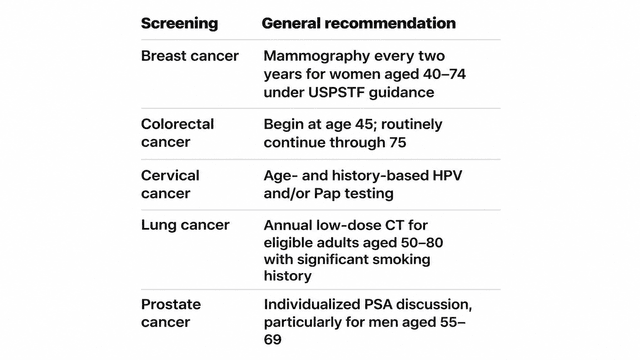
Cancer screening can identify certain cancers at earlier, potentially more treatable stages. Some screening tests can also detect precancerous changes that can be treated before cancer develops.
Depending on age, sex, personal history, and local guidelines, recommended screening may include:
Breast cancer: Mammography for eligible individuals.
Cervical cancer: Recommended screening tests for eligible individuals.
Colorectal cancer: Stool-based tests or visual examinations, such as colonoscopy, according to applicable guidelines.
Lung cancer: Low-dose CT screening for selected people who meet specific smoking-history and risk criteria.
These are general examples, not a complete personal screening schedule. Family history, inherited risk, previous findings, and other medical factors can change recommendations.
Screening also has limitations. False-positive results, unnecessary follow-up procedures, overdiagnosis, and anxiety can occur.
The objective is not to perform the greatest number of tests. It is to choose tests whose expected benefits outweigh their potential harms for the individual.
4. Why Can Sudden Medical Emergencies Happen After Normal Checkups?
This is one of the most difficult questions families face after losing a loved one unexpectedly.
Someone may have undergone a routine examination, received normal blood test results, and been told that everything looked reassuring. Days or weeks later, they may experience a heart attack, stroke, cardiac arrest, or another serious emergency.
Several explanations are possible.
Routine blood tests cannot detect every dangerous condition
Normal cholesterol, blood glucose, kidney function, and other laboratory results do not rule out every cardiovascular problem.
Atherosclerosis occurs when plaque builds up in artery walls. Some plaques remain silent for years, while plaque disruption can trigger blood clot formation that suddenly blocks blood flow to the heart.
Normal cholesterol results do not prove that coronary arteries are free of plaque. Likewise, routine blood tests cannot reliably exclude every dangerous rhythm disturbance or structural cardiovascular abnormality.
A normal ECG does not guarantee a healthy heart
An electrocardiogram (ECG) records the heart's electrical activity over a short period. It can reveal certain rhythm abnormalities and other findings, but a normal resting ECG cannot reliably exclude all coronary artery disease or predict every future heart attack.
Some rhythm disturbances occur intermittently and may not be present during the test. When symptoms or clinical risk warrant it, a healthcare professional may recommend additional monitoring or investigations.
Heart attacks can occur without obvious warning symptoms
Not everyone experiences progressively worsening chest pain before a heart attack. Some people have previously unrecognized coronary disease, and an acute event may occur when a clot blocks blood flow to the heart muscle.
A person may exercise regularly, maintain a healthy weight, and appear physically fit while still having cardiovascular risk.
Healthy habits reduce risk, but they do not eliminate it.
Strokes can also occur unexpectedly
Strokes usually result from blocked blood flow to the brain or bleeding within or around the brain.
High blood pressure, atrial fibrillation, diabetes, smoking, and vascular disease are important risk factors. Nevertheless, some people experience a stroke without having a previously recognized risk factor.
A normal blood pressure reading during one appointment does not guarantee that a person will never experience a stroke.
Medical examinations are snapshots, not lifetime guarantees
A medical examination provides information about a person's health at a particular time. Health can change, diseases can develop, and tests have limitations.
A negative result may be reassuring without completely excluding a condition. Even advanced diagnostic technology cannot predict every future emergency.
5. Could a Physician Have Missed Something?
Sometimes, diagnostic errors occur, and an opportunity for prevention may be missed. However, a sudden death following a reassuring checkup does not automatically establish that a physician was negligent.
A fair assessment must consider the person's symptoms, family history, medical records, physical examination, tests performed, clinical decisions, and the eventual cause of the event.
Some emergencies may have been reasonably predictable or preventable. Others occur despite appropriate medical evaluation and treatment.
The answer is neither to blame healthcare professionals automatically nor to dismiss families' concerns.
Healthcare systems should encourage accurate diagnosis, clear communication, appropriate follow-up, and compassionate explanations. When concerns arise, families deserve a careful review of the circumstances.
6. What Does a “Complete Medical Checkup” Actually Mean?
The phrase complete checkup can create a false sense of security.
One examination may include a brief consultation and routine laboratory tests. Another may involve a detailed cardiovascular risk assessment, medication review, recommended screening, and investigations prompted by specific symptoms.
These are not equivalent evaluations.
Patients should understand what their examination covered, what the results mean, and what was not assessed.
For example:
A routine blood test cannot exclude every cancer.
A normal resting ECG cannot exclude all coronary artery disease.
A normal blood pressure reading cannot guarantee protection from a future stroke.
A recent normal checkup does not mean that new symptoms can safely be ignored.
At the same time, advanced cardiac imaging, whole-body scans, and extensive laboratory panels are not automatically beneficial for every healthy person. Unnecessary testing may lead to false alarms, incidental findings, additional procedures, radiation exposure, and avoidable expense.
Good preventive medicine means appropriate testing—not unlimited testing.
7. Cardiovascular Prevention: Know Your Personal Risk
Cardiovascular disease remains a major cause of death worldwide, but many important risk factors can be identified and managed.
A preventive assessment may consider:
Blood pressure and cholesterol levels.
Diabetes and blood glucose.
Tobacco use and exposure.
Family history of premature cardiovascular disease.
Nutrition, physical activity, and sleep.
Existing medical conditions and overall cardiovascular risk.
Some individuals benefit from medication to lower cholesterol or blood pressure. Others may primarily need lifestyle changes and periodic reassessment. Additional testing may be appropriate for selected patients.
These decisions should be individualized with a qualified healthcare professional.
Healthy habits are valuable, but they should not replace appropriate medical care. Similarly, reassuring laboratory results should never be used as a reason to ignore persistent or concerning symptoms.
8. Physical Activity: A Powerful Tool for Prevention
Regular physical activity is associated with lower risks of cardiovascular disease, type 2 diabetes, certain cancers, and premature mortality. It can also improve strength, balance, mobility, sleep, and psychological well-being.
For most adults, general activity guidance recommends at least 150 minutes of moderate-intensity aerobic activity each week, or an equivalent amount of vigorous activity, alongside muscle-strengthening activities on at least two days per week. Individual needs and abilities vary.
Walking is a practical way to begin because it can be adapted to different fitness levels and incorporated into everyday routines.
Strength training is also important, particularly as people age. Maintaining muscle strength can help with climbing stairs, rising from a chair, carrying groceries, and preserving independence.
Exercise should be appropriate for a person's health and capabilities. New chest discomfort, unexplained fainting, or significant shortness of breath requires medical evaluation rather than simply increasing exercise intensity.
9. Physical Therapy: Prevention Beyond Rehabilitation
Physical therapy is often associated with recovery after injury, surgery, or a neurological event. It also has an important role in maintaining function and reducing the risk of certain injuries.
Physical therapists can assess strength, flexibility, balance, gait, posture, and movement.
Fall prevention
Falls can lead to fractures, hospitalization, loss of confidence, and reduced independence, particularly among older adults. Suitable balance and strengthening programs can help reduce fall risk in appropriate populations.
Prehabilitation
Prehabilitation aims to improve physical readiness before planned surgery. For selected patients, conditioning, strengthening, and education may support recovery.
Aquatic therapy
Aquatic therapy may help some people with joint pain, limited mobility, or difficulty tolerating land-based exercise. Water buoyancy reduces weight-bearing demands and allows controlled movement.
Preserving independence
A central contribution of physical therapy is helping people maintain mobility and participate in daily life as they age.
Prevention should include protecting movement—not merely treating disease after it develops.
10. Nutrition, Sleep, and Metabolic Health
Healthy nutrition supports long-term health. A balanced eating pattern can emphasize vegetables, fruits, whole grains, legumes, nuts, adequate protein, and appropriate sources of healthy fats.
Reducing excessive sodium, added sugars, and highly processed foods can support important health outcomes.
Adequate protein, together with resistance exercise, helps support muscle maintenance, especially as people grow older.
Sleep matters too. Poor sleep can affect concentration, mood, metabolic regulation, and cardiovascular health. Persistent loud snoring, observed pauses in breathing during sleep, or excessive daytime sleepiness may warrant evaluation for obstructive sleep apnea.
Preventive healthcare works best when nutrition, physical activity, sleep, and medical risk factors are considered together.
11. Mental Health Is Part of Preventive Healthcare
Physical and mental health are closely connected.
Depression, anxiety, chronic stress, social isolation, and sleep disturbances can affect daily functioning and quality of life. They may also influence physical activity, medication adherence, and chronic disease management.
Mental health screening and timely access to appropriate support are important parts of comprehensive healthcare.
Social connection, meaningful activities, regular movement, and healthy sleep can support psychological well-being, but they do not replace professional care when a mental health condition requires treatment.
Preventive healthcare should address the whole person.
12. The Economics of Prevention
Serious illness can bring significant financial and personal burdens, including hospital stays, procedures, medication, rehabilitation, caregiving, travel, and lost income.
Preventing a stroke, reducing the risk of a disabling fall, or detecting a cancer through an appropriate screening program can reduce suffering and may lessen some of these costs.
However, not every preventive intervention saves money. Some improve health at an additional cost and are considered worthwhile because the benefits justify the resources used.
The goal should be better health outcomes and responsible use of healthcare resources—not the assumption that every test automatically reduces spending.
13. Rural Communities and Access to Preventive Care
Preventive healthcare should be accessible regardless of income or geography.
Rural communities may face limited specialist services, long travel distances, transportation difficulties, and shortages of healthcare professionals. These barriers can delay screening, diagnosis, and treatment.
Improving access requires accessible primary care, community education, coordinated referrals, appropriate telehealth services, and local rehabilitation resources.
Encouraging people to seek preventive care is not enough if the services they need remain difficult to reach.
Prevention should be a realistic opportunity for every community.
14. Artificial Intelligence and the Future of Early Detection
Artificial intelligence is increasingly being explored for medical imaging, risk prediction, clinical decision support, and identifying patterns that may require further investigation.
Electronic health records can help identify overdue screenings, while wearable devices and remote monitoring may provide useful information for selected patients.
However, these technologies also have limitations. False alerts, inaccurate measurements, algorithmic bias, privacy concerns, and excessive reliance on automated systems can create new challenges.
AI should support—not replace—professional judgment.
The future of preventive healthcare will depend on combining technological advances with evidence-based medicine, human compassion, and clear communication.
15. Why Do People Avoid Preventive Care?
Despite its benefits, many people delay routine healthcare.
Some believe that having no symptoms means they are healthy. Others fear discovering a serious diagnosis. Financial concerns, busy schedules, transportation barriers, cultural beliefs, and previous negative healthcare experiences may also discourage preventive visits.
Healthcare professionals can help by explaining why a screening test is recommended, what it can and cannot detect, and what follow-up might involve.
Patients should feel comfortable asking questions and participating in decisions.
Preventive healthcare is most effective when it becomes a partnership built on trust and understanding.
16. How Families Can Build a Culture of Prevention
Health decisions affect entire families. When someone experiences a major stroke, heart attack, or disabling fracture, the consequences often extend to spouses, children, and other relatives.
Families can encourage one another to attend appropriate medical appointments, remain physically active, eat nutritious meals, and address concerning symptoms promptly.
Adult children can help aging parents understand recommended screening and navigate healthcare services. Parents can model healthy habits for their children, and partners can support one another in managing cardiovascular risks.
Knowing family medical history is especially important. A strong family history of premature cardiovascular disease, certain cancers, or sudden unexplained death may warrant additional clinical assessment.
When a young or apparently healthy relative dies unexpectedly, surviving family members should discuss with a healthcare professional whether the circumstances suggest a hereditary cardiac or other condition that warrants evaluation.
17. A Practical Preventive Healthcare Plan
Preventive care does not require every person to undergo extensive testing. A sensible plan begins with understanding personal and family medical history and establishing a relationship with a qualified healthcare professional.
Consider these practical steps:
Schedule appropriate preventive visits. Discuss checkups based on your age, history, and risk factors.
Know your key health measurements. Ask about blood pressure, cholesterol, blood glucose, and other assessments relevant to you.
Keep recommended screenings up to date. Follow current guidance for your circumstances.
Review medications and vaccinations. Ask whether anything needs updating.
Build sustainable habits. Prioritize regular movement, balanced nutrition, adequate sleep, and avoiding tobacco.
Understand your results. Ask what was tested, what the findings mean, and whether follow-up is necessary.
Take new symptoms seriously. A recent normal checkup is not a reason to dismiss new or worsening symptoms.
Sudden facial drooping, arm weakness, speech difficulty, severe chest discomfort, collapse, or other potentially life-threatening symptoms require emergency evaluation. Contact your local emergency service immediately when a medical emergency is suspected.
Preventive screening is designed primarily for people without symptoms. New symptoms may require diagnostic assessment, which is different from routine screening.
18. My Perspective: Prevention, Responsibility, and Medical Reality
Throughout my professional journey in medicine, public health, and physical therapy, I have come to appreciate that maintaining health requires personal responsibility, professional guidance, and realistic expectations.
Regular physical activity, walking, strength training, nutritious food, and preserving mobility can all contribute to better health.
Yet healthy habits do not provide absolute protection against illness.
A person who runs marathons can still develop coronary artery disease. Someone who follows a balanced diet can still receive a cancer diagnosis. An individual with normal routine laboratory results can still experience a sudden cardiovascular event.
These realities should not discourage us from preventive care. Instead, they should help us understand its purpose.
Preventive medicine reduces risks, identifies treatable conditions, and improves the likelihood of healthier outcomes. It does not promise immortality or eliminate uncertainty.
The objective is to make informed decisions using the best available evidence while recognizing that human biology remains complex.
19. What Should We Tell Families Who Lose Someone Despite Normal Medical Reports?
When a loved one dies unexpectedly, families may experience profound grief, confusion, and frustration. They may wonder whether an additional test could have prevented the tragedy or whether an important warning sign was missed.
These questions deserve respectful attention.
Sometimes a careful review identifies a missed diagnosis or an opportunity for earlier intervention. In other situations, an event may not have been reasonably foreseeable.
Medicine cannot offer absolute certainty. Unexpected events can occur even when healthcare professionals follow established guidance and patients maintain healthy lifestyles.
We must continue improving diagnostic accuracy, cardiovascular risk assessment, communication, and follow-up systems. At the same time, patients should never be led to believe that a normal medical report guarantees future health.
A normal report is reassuring information—not a certificate of lifelong protection.
That distinction is essential for patients, families, and healthcare professionals alike.
Conclusion: Prevention Reduces Risk, but Cannot Eliminate Uncertainty
Preventive healthcare remains one of the most important investments individuals and societies can make.
Appropriate screening can identify certain diseases early. Vaccinations prevent serious infections. Healthy habits can reduce cardiovascular and metabolic risks. Physical therapy can help preserve strength, balance, and independence.
Yet no screening program, physician, laboratory test, or advanced technology can predict or prevent every sudden medical event.
The answer is not to abandon preventive care. It is to make it more thoughtful, individualized, accessible, and evidence-based.
We should not wait for a heart attack before paying attention to cardiovascular health, a disabling fracture before addressing balance, or advanced symptoms before discussing recommended cancer screening.
And we should never assume that a normal medical examination means future symptoms can safely be ignored.
Early detection can save lives. Prevention can reduce suffering. Healthy living can improve quality of life. Responsible medicine must also acknowledge its limitations.
Ultimately, our goal should not simply be to live longer. It should be to live healthier, remain independent, preserve dignity, and spend meaningful years with the people we love.
Because the greatest investment we can make is not merely in the number of years we live, but in the health and quality of those years.
Medical disclaimer: This article is for general educational purposes only and does not replace individualized medical advice, diagnosis, or treatment. Screening recommendations vary by age, medical history, risk factors, and country. Consult a qualified healthcare professional about your personal preventive care. Seek emergency assistance for symptoms that may indicate a heart attack, stroke, or another medical emergency.