A Memorable Encounter at Oswald’s Bear Ranch: Lessons in Nature, Compassion, and Respect
A personal reflection from Michigan’s Upper Peninsula on wildlife, compassion, second chances, and what nature can teach us about life.
There are moments during our travels that remain with us long after the journey has ended.
Sometimes it is a breathtaking landscape. Sometimes it is a conversation with a stranger. And sometimes it is an unexpected encounter with an animal that reminds us how closely our lives are connected with the natural world.
My visit to Oswald’s Bear Ranch in Michigan’s Upper Peninsula was one of those experiences.
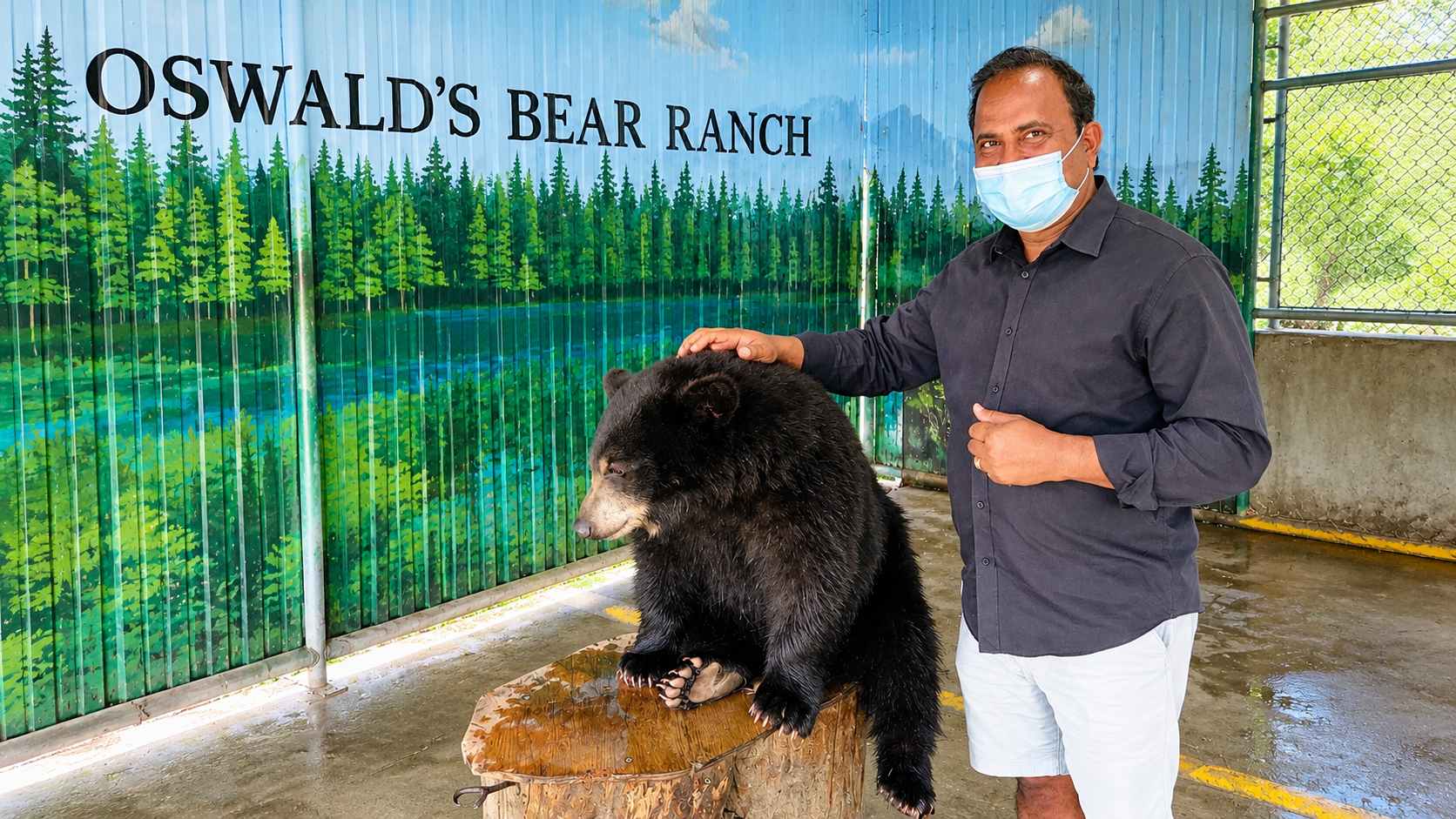
Standing beside a magnificent American black bear and gently placing my hand on its head was certainly memorable. But looking back at the photograph today, I realize that the experience represented something much larger to me:
Respect for wildlife. Responsibility toward the environment. And the importance of giving vulnerable creatures another chance.
A Special Place in Michigan’s Upper Peninsula
Located just north of Newberry, Michigan, Oswald’s Bear Ranch describes itself as a rescue refuge for American black bears. The ranch says it encompasses approximately 240 acres and cares for about 40 bears in large natural habitats.
Founded by Dean and Jewel Oswald, the ranch opened to the public in 1997. Its stated mission includes caring for rescued, orphaned, abandoned, and distressed bears while educating visitors about black bears and their environment.
Michigan’s Upper Peninsula already has a special character.
Its forests, lakes, long stretches of wilderness, and abundant wildlife make it feel very different from much of the Lower Peninsula.
A visit to this part of Michigan can quickly remind us that the state's identity is tied not only to its cities and Great Lakes, but also to its extraordinary natural heritage.
Coming Face-to-Face With a Bear
Most of us understand intellectually that black bears are powerful animals.
But seeing one from only a short distance gives that understanding an entirely different meaning.
Their size, paws, thick coat, and sheer physical presence command respect.
Yet what struck me most during this experience was not simply the strength of the animal.
It was the contrast between strength and vulnerability.
An animal can be physically powerful and still depend upon human beings to make responsible decisions about its welfare and habitat.
That thought stayed with me.
We often think of compassion as something we extend primarily to other people. But compassion can also be reflected in how we treat animals, forests, rivers, and the environment we will leave behind for future generations.
Respect, Rather Than Fear
Wild animals should never be romanticized as pets.
Bears are powerful wildlife, and encounters with them outside professionally managed environments require distance, knowledge, and caution.
That distinction is important.
The lesson I carried away from my visit was not that we should become comfortable approaching wild bears.
Quite the opposite.
True appreciation of wildlife begins with respecting its wildness.
Sometimes respect means observing from a distance.
Sometimes it means protecting habitat.
Sometimes it means supporting responsible conservation and rescue efforts.
And sometimes it simply means recognizing that nature does not exist solely for our convenience.
What Nature Can Teach Us About Strength
When I look at this photograph today, I also see a metaphor for life.
A bear represents strength, but genuine strength is not merely physical.
Throughout our lives, we encounter challenges that require different kinds of strength:
The courage to begin again
The patience to endure uncertainty
The humility to learn
The compassion to help someone—or something—that cannot help itself
There is a tendency in society to associate strength with dominance.
Nature teaches us something different.
Strength and gentleness can coexist.
We can be ambitious without losing compassion.
We can be successful without becoming indifferent.
We can be strong enough to protect rather than powerful enough to control.
Those principles apply to leadership, healthcare, business, family, and almost every aspect of human life.
The Importance of Second Chances
Perhaps the most meaningful aspect of animal rescue is the idea of a second chance.
The ranch states that many of the bears in its care came through rescue circumstances and are provided space to live within large habitats.
Second chances are powerful because they are not limited to wildlife.
Human beings need them too.
A career can take an unexpected turn.
A business can fail.
A relationship can change.
Health can challenge us.
Dreams can be delayed.
Life can place obstacles in front of us that we never anticipated.
But a difficult chapter does not necessarily determine how the story ends.
Sometimes the most meaningful chapters begin after something did not go according to plan.
That is why I have always believed that our journey is defined less by where we started—or even by the obstacles we encountered—and more by where we decide to go next.
Conservation Begins With Awareness
Protecting wildlife is not solely the responsibility of scientists, conservation organizations, or government agencies.
Every generation has a role.
Children who learn to appreciate wildlife today may become the adults who protect forests tomorrow.
Families who visit places dedicated to wildlife education may leave with greater awareness of habitat conservation.
Travelers who experience Michigan’s wilderness may become stronger advocates for preserving it.
According to the ranch, educational activities include teaching young visitors about rescued cubs, raising bears, and protecting black bears and their environment.
Education matters because people are far more likely to protect something they understand and appreciate.
Awareness is often the first step toward responsibility.
Discovering the Michigan Beyond Our Doorstep
Travel does not always require crossing an ocean.
Some extraordinary experiences may be only a few hours from home.
Michigan offers remarkable diversity—from the shores of the Great Lakes and Mackinac Island to the forests and waterfalls of the Upper Peninsula.
Sometimes we travel thousands of miles searching for adventure while overlooking what exists within our own state.
My visit to Oswald’s Bear Ranch reminded me to continue exploring Michigan with the same curiosity I bring to journeys around the world.
Adventure is not measured by distance.
It is measured by what an experience teaches us.
A Photograph, and a Lasting Memory
Years from now, photographs often become more valuable than they were on the day we took them.
At first, a photograph simply records a moment.
Later, it becomes a doorway back into a memory.
Looking at this picture brings me back to Michigan’s Upper Peninsula—to the forests, the quiet surroundings, and the remarkable experience of standing beside such a powerful animal.
But more importantly, it reminds me of a simple principle:
We share this planet.
Human progress and protection of the natural world should not be opposing goals.
Our intelligence gives us extraordinary power to shape the environment around us, but that power also creates responsibility.
The true measure of our advancement may ultimately be not only what we build, but also what we choose to protect.
The Balance Between Human Progress and Nature
Modern life gives us remarkable opportunities.
We build cities.
We develop technology.
We create businesses.
We discover new medicines.
We travel farther than previous generations could imagine.
But progress should not require us to forget the natural world that sustains us.
The forests, rivers, mountains, oceans, and wildlife around us are not merely scenery.
They are part of the world we inherited—and part of the world we will eventually leave to others.
That creates a responsibility that extends beyond our own lifetime.
What kind of world will future generations inherit from us?
That is a question worth asking.
What the Bear Taught Me
My encounter with the bear lasted only a moment.
But some moments do not need to be long to be meaningful.
The experience reminded me that strength deserves respect.
Compassion should extend beyond ourselves.
Second chances can change lives.
Education can inspire responsibility.
And nature has a way of teaching lessons that no classroom can fully replicate.
Perhaps the greatest lesson was one of balance.
We should continue to build.
We should continue to innovate.
We should continue to pursue our ambitions.
But we should also learn when to pause, observe, appreciate, and protect.
Progress without responsibility is incomplete.
A Journey Worth Remembering
When we travel, we often return home with photographs, souvenirs, and stories.
But the best journeys give us something more.
They change the way we think.
They remind us of what matters.
They introduce us to places and creatures outside our everyday experience.
And sometimes, they leave us with a lesson that stays long after the trip is over.
My visit to Oswald’s Bear Ranch was one of those experiences.
I went to see bears.
I came away thinking about compassion, responsibility, resilience, second chances, and our relationship with nature.
And perhaps that is what meaningful travel is really about.
Not simply seeing something new.
But allowing what we see to change the way we understand the world—and ourselves.
Author Note
“Nature has a quiet way of reminding us that strength and compassion can exist together. My encounter with a rescued bear reminded me that every living being deserves respect, and that the true measure of our progress is not only what we achieve, but what we protect and the second chances we are willing to give.”
— Dr. Vijay Kumar