Niagara Falls: Standing Before the Power and Beauty of Nature
There are some places in the world that photographs can introduce to you, but only experience can truly explain. Niagara Falls is one of those places.
I had seen Niagara Falls countless times in photographs, travel magazines, movies, and television. I knew it was enormous. I knew millions of gallons of water rushed over its edge. I knew it was one of North America's most recognizable natural landmarks.
But knowing something and standing before it are very different experiences.
When I visited Niagara Falls, Canada, and found myself surrounded by the mist and thunder of the falls, I was reminded of something simple: nature has a remarkable ability to put human life into perspective.
The Journey Into the Mist
One of the most memorable parts of experiencing Niagara Falls is getting close to the water.
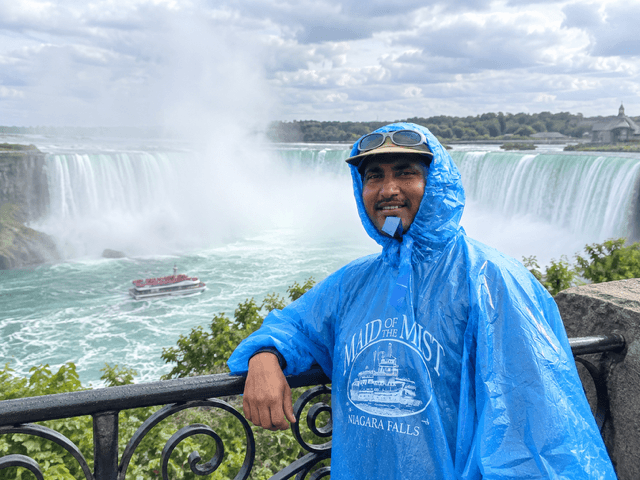
Wearing the familiar blue poncho associated with the Maid of the Mist experience, I quickly understood why visitors need it. As the boat approaches the falls, the atmosphere changes dramatically. The gentle spray becomes mist, the mist becomes almost like rain, and the sound of falling water grows increasingly powerful.
At some point, you stop worrying about staying dry.
You simply look up.
In front of you is an extraordinary wall of moving water.
There is something exhilarating about being so close to a natural force that has been operating for thousands of years. The water does not slow down because people are watching. It does not perform for the cameras. It simply continues its journey — as it has done generation after generation.
That realization stayed with me.
More Than a Tourist Destination
Niagara Falls sits along the international boundary between the United States and Canada, with the Niagara River connecting Lake Erie and Lake Ontario. The famous waterfall complex consists of three falls: Horseshoe Falls, American Falls, and Bridal Veil Falls.
Horseshoe Falls — the great curved waterfall most closely associated with the Canadian view — is the largest of the three.
Yet statistics alone cannot describe Niagara.
You have to hear it. You have to feel the mist touching your face. You have to watch the enormous volume of water approaching the edge almost peacefully before suddenly disappearing into a roaring cloud below.
Standing there, I found myself thinking not only about geography but also about time.
How many people have stood near this same place before us? How many generations have heard this same thunder?
Long before modern cities, highways, hotels, observation towers, cameras, or tour boats existed, the Niagara River was flowing.
And long after our individual journeys are over, it will continue.
That thought is humbling.
A Natural Bridge Between Two Nations
Another aspect of Niagara Falls that I find fascinating is its geography.
The falls belong to a landscape shared by Canada and the United States, two neighboring countries connected by history, commerce, families, tourism, and one magnificent river.
From the Canadian side, the panoramic view is especially striking. Looking across the Niagara Gorge, you are literally looking toward another country.
Yet nature recognizes no political boundary.
The river flows across the landscape without passports or checkpoints. The mist rises into the same sky. The water connects rather than separates.
In a world where we often focus on borders and differences, Niagara quietly offers another perspective: some of the most beautiful things on Earth are shared.
Lessons From Falling Water
Travel has always been more meaningful to me when a destination leaves behind a lesson.
Niagara Falls certainly did.
Watching the water, I thought about persistence.
Every individual drop of water seems insignificant. But together, countless drops create one of the most powerful spectacles in nature.
There is a lesson there for our own lives.
We often underestimate the importance of small actions because they do not produce immediate dramatic results. One day of exercise may not transform our health. One hour of study may not earn a degree. One act of kindness may not change the world. One difficult decision may not immediately change the direction of our lives.
But repeated consistently, small actions accumulate.
Drops become rivers. And rivers can reshape landscapes.
The same principle applies to education, health, relationships, careers, leadership, and personal growth. Great achievements are rarely created by one extraordinary moment. More often, they are created by ordinary efforts repeated with extraordinary consistency.
Sometimes We Have to Move With Life
There was another message in Niagara's water.
Keep moving.
The river never remains still. It encounters rocks, changes elevation, narrows, widens, accelerates, falls dramatically — and then continues downstream.
Human life is remarkably similar.
Our journeys rarely follow the route we originally imagined. Careers change. Families grow. Children begin journeys of their own. Businesses evolve. Relationships change. We experience successes and disappointments. We lose people we love. We discover new purposes at ages when we once assumed our lives would already be completely settled.
There are moments when the path ahead appears calm and others when we feel as though we are approaching our own waterfall.
Yet life continues asking us to move forward.
Perhaps resilience does not always mean resisting change. Sometimes resilience means learning how to move through change without losing ourselves.
Travel as Education
I have long believed that education doesn't happen only inside classrooms and universities.
Travel is also a classroom.
Every destination teaches something different. Historical places teach us about civilization and human ambition. Sacred places encourage reflection. Mountains teach humility and endurance. Oceans remind us of scale. Different cultures challenge our assumptions about what is "normal."
And places such as Niagara Falls teach us about power, persistence, and time.
Travel also reminds us how enormous the world is — and simultaneously how connected humanity has become.
People standing beside you at a famous destination may have traveled from India, Europe, Africa, Asia, Canada, or another part of the United States. They may speak different languages and come from entirely different backgrounds.
But when something magnificent appears before everyone, the reactions are remarkably similar.
People smile. They point. They take pictures. Children become excited. Adults briefly become children again.
Wonder is one of the few languages that requires no translation.
The Importance of Making Memories
As we grow older, I think we begin to understand the value of experiences differently.
Material possessions have their place, but many of the things we treasure most cannot be stored in a garage, bank account, or closet.
They are memories.
A family trip. A difficult mountain climbed. A meal in an unfamiliar city. A conversation with someone from another culture. A sunrise witnessed thousands of miles from home. Or standing in a blue poncho, getting soaked by Niagara's mist and laughing because staying dry has suddenly become completely irrelevant.
These moments become chapters in our personal histories.
Years later, a photograph can bring them back instantly. You remember not only what you saw, but how you felt.
That is one of travel's greatest gifts.
Niagara and the Perspective of Time
Standing near the falls also makes our daily worries seem smaller.
We spend so much of our lives concerned about schedules, deadlines, disagreements, responsibilities, and things that seem urgent at the moment.
Then you stand beside something ancient and enormous.
The perspective changes.
The waterfall was there before today's problem existed. It will likely be there long after the problem has been forgotten.
That doesn't mean our responsibilities are unimportant. It simply reminds us to distinguish between what is urgent and what is meaningful.
Health is meaningful. Family is meaningful. Integrity is meaningful. Friendship is meaningful. Service to others is meaningful. Continuing to learn is meaningful. Experiencing this extraordinary world while we have the opportunity is meaningful.
Many other things occupying our minds today will eventually become footnotes.
Never Stop Exploring
One lesson I continue to take from traveling is that curiosity should never have an expiration date.
We sometimes associate exploration with youth. I disagree.
There is no age at which we should stop discovering new places, meeting new people, learning new subjects, challenging ourselves physically, or becoming interested in something unfamiliar.
The destination may change. The pace may change. But curiosity can remain.
In fact, continuing to explore may be one of the best ways to remain mentally young.
Every journey tells us that there is still something we haven't seen. Every conversation tells us that there is still something we don't know. Every destination reminds us that our own corner of the world represents only a tiny portion of the human experience.
That realization doesn't diminish us.
It expands us.
A Photograph, a Memory, a Message
Looking back at photographs from Niagara Falls, I see much more than a tourist attraction.
I see a moment in life's journey.
I see the mist, the blue poncho, the rushing river, and the enormous landscape surrounding me. But behind the photograph is something a camera cannot fully capture — the feeling of standing close to one of nature's great spectacles.
And perhaps that is why we travel.
Not simply to say, "I was there."
But to return home slightly different from the person who left.
Niagara Falls reminded me that strength and beauty can exist together. That movement is essential. That persistence compounds. That borders can divide maps without dividing nature. And that despite all of our technology and accomplishments, humanity remains very small beside the forces that created and continue to shape this planet.
Most importantly, it reminded me to remain curious.
There are still roads to travel. There are still mountains to climb. There are still cultures to experience, people to meet, lessons to learn, and places capable of leaving us speechless.
Keep moving. Keep learning. Keep exploring.
Because sometimes the greatest lesson from a journey is not found in where we arrive.
It is found in who we become along the way.
Author Note
"I remember the exact moment I stopped trying to stay dry under that poncho and just let the mist hit my face. It's a small thing, but it's stayed with me longer than most of the 'bigger' moments from that trip. Sometimes the lesson isn't in the landmark — it's in the instant you stop resisting and just let the experience happen to you." — Dr. Vijay Kumar