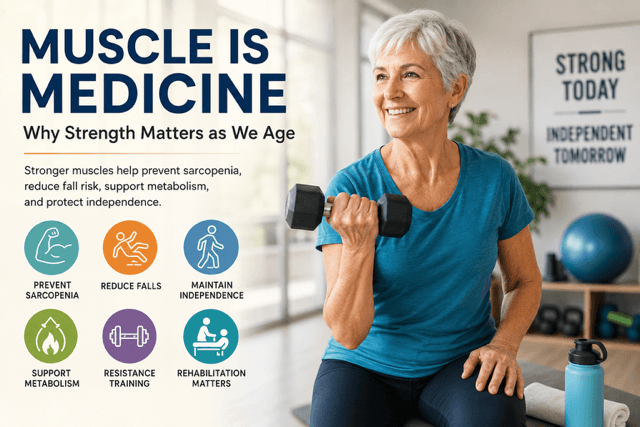
Muscle Is Medicine: Why Strength Matters as We Age
Sarcopenia, Falls, Independence, Metabolism, Resistance Training, and the Role of Rehabilitation
For decades, conversations about healthy aging have focused heavily on the heart, blood pressure, cholesterol, body weight, and blood sugar.
These are unquestionably important.
But another organ system deserves far more attention in the conversation about longevity:
Skeletal muscle.
Muscle is not simply something we build for appearance or athletic performance.
It allows us to stand.
Walk.
Climb stairs.
Carry groceries.
Recover from illness.
Maintain balance.
Regulate glucose.
And remain independent.
That is why I increasingly believe we should think about muscle almost as we think about medicine.
Muscle is medicine.
As we grow older, maintaining strength may become one of the most important investments we can make in our future health.
The objective isn't necessarily to become a bodybuilder or lift enormous amounts of weight.
The objective is much more practical:
Can you continue doing the things that make your life your own?
Can you rise from a chair without assistance?
Climb stairs?
Carry your luggage?
Get up from the floor?
Recover your balance when you stumble?
Continue traveling, gardening, working, exercising, and playing with your grandchildren?
These ordinary abilities depend heavily on strength.
And when muscle disappears, independence can disappear with it.
The Quiet Loss of Muscle With Aging
One of the most important conditions associated with aging is sarcopenia.
Sarcopenia is a progressive skeletal-muscle disorder involving declines in muscle strength, muscle quantity or quality, and physical performance.
The concerning part is that it often develops quietly.
There is rarely a dramatic moment when someone suddenly realizes:
"I am losing muscle."
Instead, small changes begin appearing.
Stairs become less appealing.
Getting out of a low chair becomes harder.
Walking speed decreases.
Grocery bags feel heavier.
The handrail becomes increasingly necessary.
Getting up from the floor becomes difficult.
Eventually, activities that once happened automatically begin requiring planning or assistance.
These changes are often dismissed as simply “getting old.”
But aging and physical decline are not exactly the same thing.
Age changes our physiology, but physical activity, resistance training, nutrition, medical conditions, and rehabilitation can significantly influence the rate and severity of functional decline.
Recent research reinforces this.
A 2024 systematic review and meta-analysis involving more than 2,000 adults over age 70 with sarcopenia found that resistance-training interventions lasting more than 10 weeks improved measures including grip strength, isometric strength, chair-stand performance, and skeletal muscle mass index.
The message is encouraging:
Muscle loss may accompany aging, but meaningful physical decline is not necessarily inevitable.
Strength Matters More Than Appearance
When people hear the words strength training, they often imagine young athletes lifting heavy weights in a gym.
That image is incomplete.
For an older adult, strength training may mean:
Practicing standing from a chair.
Using resistance bands.
Lifting light dumbbells.
Performing supported squats.
Doing heel raises.
Practicing step-ups.
Or progressively loading everyday movements.
The objective is not primarily cosmetic.
The objective is capacity.
Strength creates physical reserve.
Think of that reserve like money in a savings account.
If illness, surgery, hospitalization, or prolonged inactivity suddenly occurs, a stronger person may have more physiological reserve available during recovery.
Someone already beginning from a fragile level has much less function available to lose.
That is why we should not wait until someone can barely walk before becoming concerned about strength.
Building physical reserve before a crisis occurs may help us face that crisis more effectively.
Muscle Protects Independence
Independence is one of the greatest concerns people have as they age.
Most of us want to remain in our homes.
Travel.
Shop.
Cook.
Dress ourselves.
Use the bathroom independently.
And participate in our communities.
Yet many of these abilities depend upon surprisingly basic physical capacities.
Consider standing from a chair.
It requires leg strength, trunk control, balance, coordination, and adequate mobility.
The same applies to getting off a toilet, climbing stairs, or stepping over the edge of a bathtub.
When strength declines beyond a certain point, everyday environments can suddenly become obstacles.
This is why rehabilitation professionals evaluate functional measures such as gait speed, sit-to-stand ability, balance, walking tolerance, and the Timed Up and Go test.
These assessments answer a question that body weight alone cannot:
How well can this person function in the real world?
A person can have an “acceptable” weight while lacking adequate strength.
Someone else may weigh more than society considers ideal while maintaining excellent functional capacity.
Healthy aging therefore requires us to look beyond weight.
We need to measure function.
Muscle, Balance, and Falls
Falls are among the greatest threats to independence in older adults.
One fall can initiate a damaging cycle:
Fall → injury → hospitalization → inactivity → muscle loss → weakness → fear of falling → more inactivity → another fall.
Breaking that cycle requires more than telling someone:
"Be careful."
The body needs enough physical capacity to respond when balance is unexpectedly disturbed.
Imagine stepping onto an uneven surface.
The nervous system detects the change.
Muscles around the ankle, knee, hip, and trunk must respond rapidly enough to prevent a fall.
That response requires:
Strength.
Power.
Coordination.
Sensation.
Balance.
When these systems deteriorate, the margin for error becomes smaller.
This is why physical-activity guidance for older adults emphasizes multicomponent exercise, combining aerobic activity, muscle strengthening, and balance work.
A 2026 umbrella review cited in the original article reported high-certainty evidence that balance and multicomponent exercise programs reduced fall rates by approximately 23% to 34% across the evidence reviewed.
That is clinically meaningful.
Falls should not simply be accepted as an unavoidable consequence of growing older.
In many cases, fall prevention can be trained.
Why Walking Alone May Not Be Enough
Walking is excellent exercise.
It supports cardiovascular health.
Endurance.
Mood.
Circulation.
Mobility.
And overall well-being.
But there is an important distinction:
Walking and strength training are not interchangeable.
Walking primarily provides an endurance stimulus.
Resistance exercise provides a stronger stimulus for maintaining or increasing muscular strength and muscle mass.
That means someone who walks every day may still benefit from strength training.
Ideally, healthy aging includes several components:
Aerobic activity
Resistance training
Balance training
Mobility and flexibility
Functional movement
Each provides something different.
Walking should generally complement strength training rather than replace it.
Muscle Is a Metabolic Organ
Muscle also deserves attention because of its role in metabolism.
Skeletal muscle is one of the body's major sites for glucose disposal.
When carbohydrates are consumed, glucose enters the bloodstream. Insulin helps move much of that glucose into tissues—including skeletal muscle—where it can be used or stored.
Muscle therefore isn't merely machinery for movement.
It participates actively in metabolic health.
Resistance exercise can improve insulin sensitivity and glucose utilization, which becomes particularly relevant as the prevalence of insulin resistance and type 2 diabetes increases with age.
This also creates an important distinction between weight loss and healthy body composition.
Suppose someone loses 20 pounds but a substantial portion comes from muscle.
The scale may celebrate.
The body may become weaker.
For older adults especially, the better objective is not simply:
Lose weight.
It is:
Reduce excess body fat while preserving as much muscle and strength as possible.
Nutrition and resistance exercise become particularly important in achieving that goal.
Strength and Muscle Size Are Not the Same
Another common misconception is that getting stronger always requires building visibly larger muscles.
Strength and muscle size are related.
But they are not identical.
Aging also affects neuromuscular function—the nervous system's ability to recruit and coordinate muscle fibers.
This means someone can become stronger even before dramatic changes in muscle size become visible.
For older adults, that is encouraging.
You do not need enormous muscles to create meaningful improvements in function.
A relatively small increase in strength may determine whether someone can stand from a chair independently.
A modest improvement in a functional test may translate into greater confidence at home.
In rehabilitation, these changes matter enormously.
The goal is not necessarily bigger muscles. The goal is a more capable human being.
Resistance Training Is One of Our Most Powerful Tools
Research increasingly supports resistance exercise as a central strategy for addressing sarcopenia.
The article cites a network meta-analysis involving 50 randomized controlled trials and more than 4,000 participants, which found that resistance training—with or without nutritional interventions—was associated with improvements in strength and physical performance among older adults with sarcopenia.
Measures showing improvement included chair stands, gait speed, grip strength, and leg-press strength.
More recent evidence cited in the article points in the same direction, with resistance training improving measures such as knee-extension strength, walking speed, Timed Up and Go performance, and repeated sit-to-stand ability.
We have spent enormous resources searching for ways to help people age better.
Some of the most powerful interventions may already be available.
We need people to move—and we need them to move against resistance.
How Much Strength Training Do We Need?
There is no single exercise program appropriate for everyone.
A healthy 65-year-old who has exercised for decades should not necessarily receive the same program as an 85-year-old recovering from a hip fracture.
Exercise should be individualized.
However, broad public-health guidance provides a useful starting point.
Adults are generally encouraged to perform muscle-strengthening activities involving the major muscle groups on at least two days per week, alongside appropriate aerobic activity.
Older adults should additionally incorporate balance and multicomponent exercise.
Resistance can come from many sources:
Body weight.
Resistance bands.
Free weights.
Machines.
Cable systems.
Water resistance.
Household objects.
The equipment is secondary.
Progressive challenge is what matters.
As the body adapts, resistance, repetitions, complexity, or volume can gradually increase.
This principle is called progressive overload.
But progression must remain appropriate to the individual.
People with osteoporosis, cardiovascular disease, joint replacements, neurological conditions, significant balance problems, recent surgery, or other medical concerns may require professional guidance before beginning or substantially advancing an exercise program.
Train Movements That Matter
A good exercise program should ultimately improve life outside the gym.
For older adults, this means training movements that support everyday independence.
Sit-to-stand movements strengthen the muscles needed to rise from chairs, cars, and toilets.
Squatting patterns develop lower-body strength and control.
Step-ups prepare the body for stairs and curbs.
Calf raises support walking and ankle function.
Hip strengthening contributes to gait, balance, and pelvic stability.
Pushing and pulling exercises support everyday upper-body activities.
Carrying exercises, when appropriate, can develop grip strength, trunk stability, and functional capacity.
And balance exercises challenge the sensory and neuromuscular systems that help us remain stable.
The purpose is not to collect exercises.
The better question is:
What do you want your body to remain capable of doing?
Then train for that life.
Strength Is Important—but So Is Power
Strength is our ability to produce force.
Power is our ability to produce that force quickly.
Both become important as we age.
Imagine someone trips on an uneven sidewalk.
The body does not have several seconds to decide how to respond.
It may have only fractions of a second to take a corrective step and regain balance.
That response depends partly on the ability to generate force quickly.
This is why appropriately supervised rehabilitation may sometimes include faster functional movements for selected patients.
Power training does not necessarily mean jumping onto boxes or performing aggressive explosive exercises.
For an older adult, it might simply mean standing from a chair with controlled but deliberate speed.
As always, the exercise must match the individual's abilities and medical circumstances.
The objective is not speed for its own sake. It is developing enough physical capacity to respond when everyday life demands it.
Protein and Muscle Work Together
Exercise provides the stimulus for muscle adaptation.
But the body also needs the nutritional materials required to maintain and rebuild tissue.
Protein supplies amino acids necessary for muscle protein synthesis.
As people age, the muscle-building response to protein may become less efficient—a phenomenon sometimes described as anabolic resistance.
This makes adequate nutrition increasingly important.
Protein-rich foods can include:
Eggs.
Fish.
Poultry.
Lean meats.
Dairy products.
Beans and lentils.
Soy products.
Nuts and seeds.
But there is no universal protein prescription appropriate for everyone.
Requirements can vary according to age, body size, activity, total calorie intake, medical conditions, and kidney function.
The article cites a 2026 umbrella review finding evidence that combining exercise with adequate protein intake can improve muscle-related outcomes in older adults at risk for sarcopenia.
The larger principle is straightforward:
Training tells the body that muscle is needed. Nutrition helps provide the resources to maintain and rebuild it.
Rehabilitation Is About More Than Recovering From Injury
Physical therapy is sometimes viewed as something people need only after surgery or injury.
Its role can be much broader.
Rehabilitation professionals can identify functional problems before they become catastrophic.
A physical therapist may assess:
Strength.
Balance.
Gait.
Joint mobility.
Endurance.
Transfers.
Fall risk.
Functional limitations.
Assistive-device needs.
Home safety.
Exercise tolerance.
But the goal is not simply to make a muscle stronger during an examination.
The real objective is translating physical capacity into meaningful independence.
Can the patient safely enter the shower?
Climb the steps into the home?
Walk through a grocery store?
Get into a vehicle?
Recover after hospitalization?
Remain independent?
Those are the rehabilitation outcomes that matter.
Contemporary approaches to sarcopenia rehabilitation therefore emphasize systematic assessment alongside exercise, nutrition, and individualized rehabilitation strategies rather than treating muscle loss as an isolated problem.
The Hidden Danger of Bed Rest and Inactivity
One of the greatest threats to strength in older adults is prolonged inactivity.
Hospitalization demonstrates this particularly well.
A patient becomes ill and spends several days primarily in bed.
The illness itself creates physiological stress.
Appetite may decline.
Protein intake may decrease.
Physical activity falls dramatically.
Muscles receive very little loading.
Then the patient returns home weaker than before.
Suddenly, walking to the bathroom is exhausting.
Family members become concerned about falls, so they encourage more sitting.
The patient becomes even weaker.
This demonstrates an important principle:
The body adapts to what we ask it to do.
Use muscle, and the body receives a signal that muscle is necessary.
Stop using it, and the stimulus for maintaining that tissue decreases.
This is one reason appropriate early mobility and rehabilitation following illness, injury, or surgery can be so important.
Fear of Exercise Can Become Part of the Problem
Some older adults avoid resistance exercise because they are afraid of getting injured.
That concern should not be dismissed.
Exercise performed incorrectly or without considering medical conditions can create problems.
But complete avoidance also has consequences.
Weakness creates risk.
Poor balance creates risk.
Difficulty climbing stairs creates risk.
Inability to recover from a stumble creates risk.
The answer is not recklessness.
It is appropriate progression.
Begin at the person's current level.
Use support when necessary.
Learn proper technique.
Increase resistance gradually.
Modify exercises around pain or limitations.
Seek professional supervision when appropriate.
A properly designed exercise program should build confidence rather than fear.
Safety should help people move better—not convince them to stop moving altogether.
It Is Never Too Late to Become Stronger
Perhaps one of the most encouraging findings from exercise science is that older adults can still adapt to training.
Muscle does not suddenly lose its ability to respond because someone turns 60, 70, or 80.
The response may differ from that of a younger athlete.
But meaningful improvements remain possible.
The 2024 meta-analysis cited in the article specifically examined adults over age 70 with sarcopenia and found measurable improvements following resistance-training interventions lasting more than 10 weeks.
That means the goal at 75 does not need to be recreating the body someone had at 25.
The better goal is:
Build the strongest, safest, most capable version of the body you have today.
That distinction matters.
Comparison can discourage people.
Progress can motivate them.
Measure What Matters
We measure aging with many numbers.
Age.
Weight.
BMI.
Blood pressure.
Cholesterol.
Blood sugar.
These measurements can be important.
But perhaps healthy-aging conversations should include additional questions.
How fast do you walk?
How strong is your grip?
Can you stand from a chair without using your hands?
Can you climb stairs?
Have you fallen during the past year?
Are you becoming afraid of falling?
Have you stopped doing activities because they have become physically difficult?
These questions can reveal changes that laboratory tests may never capture.
They shift the focus from:
“What are your numbers?”
to:
“What can your body actually do?”
A Practical Framework for Healthy Aging
For many adults, maintaining physical capacity can be viewed through several interconnected pillars.
Move regularly.
Walking, cycling, swimming, and other appropriate aerobic activities support cardiovascular endurance.
Lift something.
Perform resistance exercise regularly according to your abilities and medical status.
Challenge your balance.
Balance generally needs to be challenged safely if we want to maintain or improve it.
Eat to support muscle.
Adequate calories, protein, micronutrients, and hydration matter.
Sleep and recover.
Training provides the stimulus. Recovery allows adaptation.
Stay socially and mentally engaged.
Healthy aging involves much more than muscles.
Address problems early.
Do not wait for repeated falls or severe weakness before seeking help.
And most importantly:
Train for independence.
The purpose of exercise should ultimately be to preserve the ability to live the life you value.
Muscle Connects Lifespan With Healthspan
Modern medicine has become remarkably effective at helping people live longer.
But longevity creates another challenge.
It is possible to add years to life while spending many of those years with weakness, disability, and dependence.
That is why medicine should care not only about lifespan, but also about healthspan—the years lived with meaningful physical, cognitive, and social function.
Muscle sits directly at the intersection of the two.
Strength enables movement.
Movement supports independence.
Independence builds confidence.
Confidence encourages continued participation.
And participation can encourage even more movement.
This creates a positive cycle:
Strength → movement → confidence → activity → greater functional reserve.
That is the opposite of the downward spiral associated with frailty.
Muscle therefore represents much more than physical appearance.
It helps create the capacity required to participate in life.
We Should Prescribe Strength More Often
Imagine if routine healthcare visits for middle-aged and older adults included more conversations about strength.
Not simply:
“What is your weight?”
But:
“What are you doing to maintain your muscle?”
Not simply:
“Are you walking?”
But:
“Are you doing resistance exercise?”
Not simply:
“Have you fallen?”
But:
“Are you becoming weaker or having difficulty getting out of chairs?”
We have become comfortable prescribing medications to manage many health problems associated with aging.
Perhaps we should become equally comfortable prescribing appropriate movement.
Exercise is not a substitute for necessary medication, surgery, or medical treatment.
But it can be one of the most powerful complementary interventions available to us.
Strength deserves a place in preventive healthcare.
Final Reflection: Muscle Is an Investment in Freedom
When people think about retirement planning, they invest money decades in advance because they know they will need financial resources later.
Perhaps we should think about muscle similarly.
Strength is a physical retirement account.
Every appropriate squat.
Every step-up.
Every resistance-band exercise.
Every weight lifted.
Every walk.
Every balance exercise.
Each is a small deposit.
We may not appreciate those deposits immediately.
But years later, we may need them.
To climb stairs.
Recover from surgery.
Catch ourselves during a stumble.
Lift a suitcase.
Play with grandchildren.
Travel.
Continue working.
Get ourselves off the floor.
Or simply rise from a chair without asking someone for help.
Building and preserving muscle after 50, 60, 70, and beyond should therefore not be viewed primarily as fitness culture.
It should be viewed as preventive healthcare.
Muscle influences metabolism.
Muscle protects mobility.
Strength supports balance.
Strength helps reduce vulnerability to falls.
Strength creates reserve during illness.
And perhaps most importantly, strength helps preserve independence.
We cannot stop chronological aging.
But we can influence how we age.
The objective is not to remain young forever.
The objective is to remain capable for as long as possible.
So walk for your heart.
Exercise for your lungs.
Eat well for your metabolism.
Challenge your balance for stability.
And lift something for your future.
Because when we preserve muscle, we are protecting much more than strength.
We are protecting our freedom.
Medical Disclaimer
This article is intended for general education and health awareness and is not a substitute for individualized medical advice, diagnosis, physical therapy evaluation, or treatment. Older adults and individuals with cardiovascular disease, osteoporosis, recent surgery, neurological disorders, significant balance problems, chronic medical conditions, or a history of falls should consult an appropriate healthcare professional before beginning or substantially changing an exercise program.
“Muscle is more than strength. It is mobility, resilience, metabolic health, confidence, and independence. Every appropriate effort we make to preserve it today is an investment in our ability to remain capable tomorrow.” — Dr. Vijay Kumar