Where the Mountains Meet the Soul: A Journey to Inner Peace at Mount Kailash
Reflections on spirituality, gratitude, purpose, and finding inner peace in the Himalayas
There are moments in life that we plan carefully, and there are moments that seem to have been waiting for us long before we knew they existed.
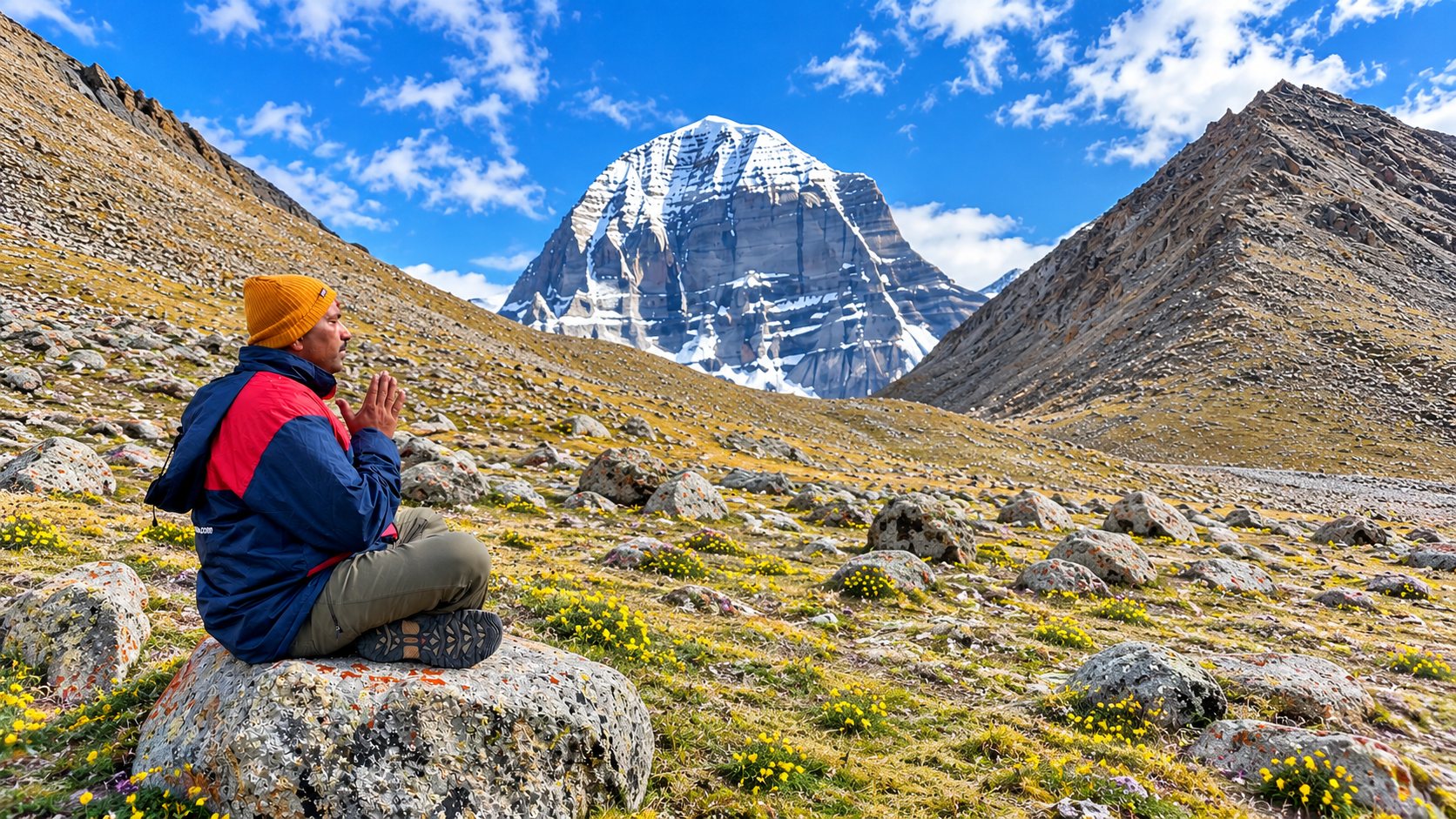
Sitting on a cold rock in the vast Himalayan landscape, with my hands folded in prayer and the magnificent Mount Kailash rising before me, I experienced one of those moments.
There was no stage.
No audience.
No applause.
There was only the mountain, the wind, the sky—and a profound silence.
And somewhere within that silence, I began to hear myself.
For years, life had taught me to keep moving.
Study harder.
Work harder.
Build something.
Achieve something.
Take care of responsibilities.
Travel farther.
Set another goal.
Reach another milestone.
But Mount Kailash seemed to ask a completely different question:
After everything you have spent your life trying to achieve, have you taken the time to understand who you are?
I did not have an immediate answer.
Perhaps that was the purpose of being there.
Mount Kailash: A Mountain of Spiritual Significance
Mount Kailash is unlike most mountains.
For millions of people across Hinduism, Buddhism, Jainism, and the Bon tradition, this extraordinary mountain in Tibet carries profound spiritual significance.
For Hindus, the name Kailash evokes Lord Shiva—the eternal yogi and a symbol associated with stillness, transformation, detachment, and consciousness.
People travel enormous distances to come here.
They endure altitude, cold, physical exhaustion, uncertainty, and discomfort. Some undertake the sacred Kailash Kora or Parikrama. Others simply stand before the mountain with folded hands.
Why?
It is difficult to explain to someone who sees pilgrimage only as travel.
A pilgrimage is not simply about reaching a geographical destination.
It is about what happens inside you while you are trying to reach it.
The mountain does not need us to visit it.
Kailash has stood for ages and will continue standing long after our individual journeys have ended.
Perhaps we are the ones who need the mountain.
We need something greater than ourselves to remind us how small many of our daily worries really are.
Sitting Before Mount Kailash
When I look back at that moment, what stays with me is not simply the spectacular Himalayan landscape.
I remember the feeling.
I was sitting on a rock, surrounded by an enormous and rugged wilderness. Colorful prayer flags lay scattered across the landscape. The air was thin. The terrain was unforgiving.
And in the distance stood the mountain I had heard about since childhood.
I folded my hands.
For a while, there was nothing I wanted to ask for.
That itself surprised me.
Prayer is often associated with asking.
We pray for health.
We pray for success.
We pray for our children.
We pray when someone is suffering.
We pray when we are afraid.
We pray for protection, opportunity, prosperity, forgiveness, or direction.
But sometimes the most beautiful prayer contains no request at all.
It simply says:
Thank you.
Thank you for bringing me this far.
Thank you for the people who walked beside me.
Thank you for the struggles that strengthened me.
Thank you for the opportunities I received.
Thank you for the failures that redirected me.
Thank you for another morning.
Thank you for another breath.
Sitting there, gratitude felt more powerful than desire.
The Higher You Climb, the Less You Need
Mountains have a fascinating way of simplifying life.
At lower elevations, we surround ourselves with possessions and conveniences.
We worry about schedules, appearances, status, messages, meetings, investments, disagreements, and hundreds of things that seem urgent.
High in the mountains, the priorities change quickly.
Can I breathe comfortably?
Do I have enough water?
Am I warm?
Can I safely take the next step?
Suddenly, life becomes beautifully basic.
The mountain strips away unnecessary complications and reminds us of something civilization often makes us forget:
We need much less to live than we think we do.
This lesson extends far beyond trekking.
We accumulate possessions believing they will make us happy.
We accumulate titles believing they will make us important.
We accumulate accomplishments believing they will make us complete.
Yet there comes a point when achievement can no longer answer the deeper questions.
What gives my life meaning?
Whom did I help?
Did I love enough?
Did I forgive?
Did I remain humble?
Did I make someone's journey easier?
Did I leave something meaningful behind?
No résumé can answer those questions for us.
Success Is Wonderful—but It Is Not the Destination
I believe in ambition.
I believe in education, discipline, entrepreneurship, hard work, service, and striving to become better.
There is nothing wrong with wanting to succeed.
But success becomes dangerous when we confuse it with our identity.
A degree is something we earn.
A business is something we build.
Money is something we manage.
A position is something we occupy temporarily.
None of these things completely defines who we are.
Life eventually teaches us that almost everything we spend years acquiring is temporary.
Our titles will belong to someone else.
Our offices will be occupied by someone else.
Our possessions will eventually change hands.
What remains is the effect we had on other human beings.
The greatest measure of success may not be how much we accumulated, but how much goodness passed through us while we were here.
That realization changes ambition.
Instead of asking:
How much can I achieve?
We begin asking:
How much can I contribute?
Silence Is Not Empty
Modern life has made silence uncomfortable.
We wake up and reach for our phones.
We fill our cars with music or news.
We fill our homes with television.
We fill quiet moments with social media.
We are constantly consuming somebody else's thoughts.
And then we wonder why we cannot hear our own.
In the Himalayas, silence has a different quality.
It is not empty.
It is alive.
When the distractions disappear, things we have avoided sometimes rise to the surface—regrets, questions, gratitude, memories, fears, dreams, people we miss, people we need to forgive, and decisions we have postponed.
That can be uncomfortable.
But spiritual growth is not always comfortable.
Sometimes silence shows us the parts of ourselves that noise helped us avoid.
This is one reason meditation can be so powerful.
Meditation is not necessarily about stopping thoughts. It can be about learning not to be controlled by every thought that enters the mind.
You watch.
You breathe.
You become aware.
Slowly, you begin to understand that you are more than the constant conversation happening inside your head.
The Spiritual Meaning of the Next Step
Anyone who has trekked at high altitude understands that staring constantly at the destination can become discouraging.
The mountain seems impossibly far away.
Instead, you learn to focus on something much smaller:
the next step.
Then another.
Then another.
Life works the same way.
Sometimes we become overwhelmed because we are trying to solve the next ten years today.
We want certainty about our careers, families, finances, relationships, and future.
But life rarely gives us that certainty.
What it gives us is the present step.
If you are facing a difficult period in your life, you may not need to know how everything will work out.
You may simply need to ask:
What is the right next step?
Make the phone call.
Apologize.
Begin exercising.
Submit the application.
Visit your parents.
Forgive someone.
Ask for help.
Start saving.
Return to prayer.
Walk away from what is harming you.
Begin again.
A thousand-mile journey is still completed one step at a time.
So is healing.
So is success.
So is spiritual growth.
Faith Does Not Remove the Mountain
Sometimes we misunderstand faith.
We think faith means difficulties will disappear.
They do not.
Faith does not necessarily remove the mountain from your path.
Sometimes faith gives you the courage to climb it.
There will be moments when life does not make sense.
Plans fail.
Relationships change.
People disappoint us.
Businesses struggle.
Circumstances change.
Doors close despite our best efforts.
In those moments, spirituality does not promise us a life without pain.
It can offer something deeper:
the strength to walk through pain without losing ourselves.
Faith reminds us that today's chapter is not necessarily the conclusion.
Some endings are redirections.
Some delays teach patience.
Some disappointments teach us discernment.
Some failures remove our arrogance.
Some losses reveal what truly matters.
We may not understand the purpose of every experience while we are living through it.
Sometimes understanding comes years later.
Sometimes it never comes.
Faith means continuing anyway.
Gratitude Changes the Meaning of Enough
There is a strange problem with achievement:
Yesterday's dream quickly becomes today's normal.
Something we desperately wanted five years ago may now barely receive our attention.
We achieve one goal and immediately create another.
There is nothing inherently wrong with that.
Growth requires new goals.
But without gratitude, ambition can become an endless hunger.
There is always another mountain.
Another house.
Another degree.
Another investment.
Another destination.
Another recognition.
Another number.
Gratitude allows us to pursue tomorrow without disrespecting today.
That distinction matters.
You can be ambitious and grateful at the same time.
You can say, “I want to grow,” while also saying, “What I have today is a blessing.”
Perhaps happiness does not come from finally possessing everything we want.
Perhaps happiness begins when we recognize the value of what is already present.
Detachment Is Not Indifference
The symbolism of Lord Shiva has always fascinated spiritual seekers.
Shiva represents, among many profound ideas, stillness amid chaos and freedom from attachment.
Detachment is sometimes misunderstood as not caring.
I see it differently.
Detachment means caring deeply without trying to possess everything.
Love your family deeply—but understand that you cannot control every part of their journey.
Work passionately—but understand that your profession is not your entire identity.
Build wealth responsibly—but understand that money is a tool, not the purpose of existence.
Enjoy recognition—but do not become dependent upon applause.
Have opinions—but remain capable of changing them.
Make plans—but leave room for life to surprise you.
There is tremendous freedom in giving your best effort while accepting that you cannot control every outcome.
We Carry Too Much Invisible Weight
A trekker quickly learns that unnecessary weight makes every uphill step harder.
Life is no different.
Except much of the weight we carry cannot be seen.
Old resentment.
Jealousy.
Guilt.
Comparison.
Anger.
The need to prove ourselves.
Arguments we continue replaying years later.
People we refuse to forgive.
Mistakes we refuse to forgive ourselves for.
Imagine carrying a backpack and adding a stone every time someone disappoints you.
Eventually, the backpack becomes unbearable.
Yet emotionally, many of us do exactly that.
Forgiveness does not mean approving what happened.
It means deciding that yesterday will no longer control today's peace.
Sometimes the most important thing we can leave behind on our spiritual journey is not a possession.
It is resentment.
Stop Comparing Your Mountain
One of the greatest thieves of peace is comparison.
Someone will always have more money.
Someone will have a bigger home.
Someone will travel more.
Someone will appear more successful.
Someone will be younger, stronger, more famous, or more accomplished.
And someone looking at your life may believe that you have everything.
Comparison is a race with no finish line.
Mountains taught me something important about this.
Every person climbs differently.
Some walk quickly.
Some need frequent rest.
Some begin from a different point.
Some carry heavier loads.
Some have walked similar terrain before.
You cannot judge your journey by another person's pace.
Your life is your mountain.
Walk it with dignity.
Spirituality Beyond Religion
For me, spirituality and faith are deeply meaningful, but spirituality should ultimately make us better human beings.
What is the value of prayer if we leave prayer and treat people badly?
What is the value of pilgrimage if it increases our ego?
What is the value of worship if we cannot show compassion?
What is the value of knowing sacred words if our ordinary words wound others?
True spirituality should make us:
Kinder.
More patient.
More forgiving.
More humble.
More grateful.
More willing to serve.
A temple can remind us of God.
A mountain can remind us of God.
But perhaps one of the greatest spiritual practices is learning to recognize dignity in another human being.
Service Is a Form of Prayer
As I have grown older, I have increasingly felt that purpose is connected to service.
Not every act of service needs to be dramatic.
Sometimes service means giving someone an opportunity.
Sometimes it means mentoring a young person.
Sometimes it means listening when someone is lonely.
Sometimes it means helping a patient regain independence.
Sometimes it means supporting a community.
Sometimes it means simply treating a stranger with respect.
We often underestimate small acts because they do not make headlines.
But the person receiving them may remember them for the rest of their life.
If spirituality stays only inside our minds, it remains incomplete.
Eventually, it should reach our hands.
Prayer asks for light. Service becomes that light for someone else.
You Are Allowed to Begin Again
Perhaps someone reading this is going through a difficult chapter.
Maybe something did not work out.
Maybe you trusted the wrong person.
Maybe you made a decision you regret.
Maybe your career did not follow the path you expected.
Maybe age has caused you to question what comes next.
Remember this:
A difficult chapter does not mean the story is over.
Nature understands renewal.
Night becomes morning.
Winter becomes spring.
Storms pass.
Paths change.
Human beings are also allowed to begin again.
You do not have to remain the person you were ten years ago—or even yesterday.
Wisdom gives us permission to change direction.
Coming Down From the Mountain
Eventually, every pilgrimage ends.
We return to airports, traffic, phones, emails, responsibilities, families, businesses, appointments, and ordinary life.
The challenge is not simply reaching a sacred place.
The challenge is bringing something sacred home.
Can we bring home more patience?
Can we complain less?
Can we appreciate our families more?
Can we spend a few minutes each day in silence?
Can we stop postponing happiness?
Can we become more generous?
Can we recognize how extraordinary an ordinary day actually is?
That is when pilgrimage becomes transformation.
Otherwise, we simply visited a mountain.
What Mount Kailash Whispered to Me
Mount Kailash did not speak.
And yet, sitting there, I felt as though it had said everything I needed to hear.
Slow down.
Be grateful.
You do not control everything.
Carry less resentment.
Love your family.
Take care of your body.
Serve others.
Stay curious.
Keep walking.
Do not let success make you arrogant.
Do not let failure make you bitter.
Do not postpone peace until everything is perfect.
And remember that one day, all the things that seem urgent today will belong to the past.
So live accordingly.
The Mountain Within
We spend much of life climbing external mountains.
Education.
Career.
Business.
Money.
Recognition.
Travel.
Achievement.
Those mountains matter.
They challenge us and help us discover our abilities.
But eventually another mountain appears.
It cannot be photographed.
There is no map.
No guide can climb it for us.
It is the mountain within.
The climb toward self-understanding.
Toward forgiveness.
Toward gratitude.
Toward humility.
Toward peace.
Toward accepting what we cannot control while courageously changing what we can.
That may be the most difficult mountain of all.
And perhaps the most worthwhile.
A Final Reflection
When I sat before Mount Kailash with folded hands, I was not thinking about conquering a mountain.
Some mountains should never be spoken of in terms of conquest.
I felt fortunate simply to be present.
For a few precious moments, the usual boundaries between achievement and surrender seemed to disappear.
I was simply a human being sitting beneath an enormous sky, breathing thin Himalayan air, looking toward a mountain that had inspired spiritual seekers for generations.
No title mattered there.
No possession mattered.
No résumé mattered.
Only existence.
Only gratitude.
Only the present moment.
Life moves quickly.
We spend years preparing for tomorrow and sometimes forget that today was once the tomorrow we prayed for.
So wherever you are in your journey, keep climbing—but occasionally stop.
Look around.
Look within.
Fold your hands, if that speaks to your heart.
Say thank you.
Forgive.
Love generously.
Help someone.
Take the next step.
And remember:
You do not have to reach the top of every mountain to discover something extraordinary. Sometimes the greatest discovery happens when you become still enough to meet yourself along the way.
Har Har Mahadev.
“The greatest journeys are not always the ones that take us farther in the world. Sometimes they are the journeys that take us deeper within ourselves. Mount Kailash reminded me that when ambition becomes stillness, achievement becomes gratitude, and success becomes service, we begin to discover what truly gives life meaning.” — Dr. Vijay Kumar