Mont-Saint-Michel, France: Where Heaven Meets the Sea — A Journey Through History, Faith, and Timeless Beauty
Discover the medieval wonder of Normandy through a personal journey into history, spirituality, architecture, and the extraordinary beauty of nature.
By Dr. Vijay Kumar
Introduction: A Place Beyond Ordinary Travel
Some places are not merely destinations. They are experiences that remain with us long after the journey ends.
Mont-Saint-Michel, rising majestically above the tidal landscape of Normandy, France, is one such place.
Throughout my travels, I have been fortunate to witness remarkable landscapes, ancient civilizations, magnificent temples, historic monuments, and extraordinary architectural achievements. Yet occasionally, I encounter a destination that makes me stop and wonder how people centuries ago could imagine and construct something so remarkable.
Mont-Saint-Michel was one of those places.
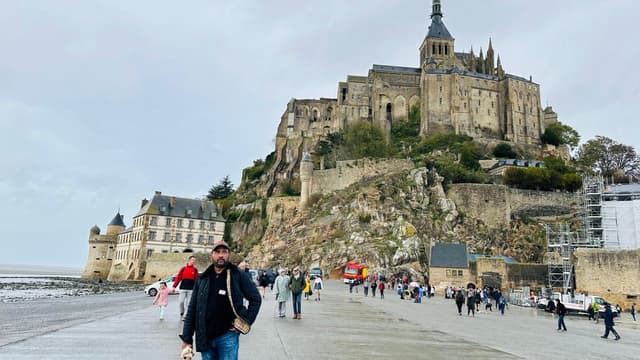
Standing before its magnificent medieval abbey, surrounded by vast stretches of sand and sea, I felt as though I had stepped into another century. Its towering spire, ancient stone walls, winding streets, and dramatic setting create an atmosphere filled with mystery, history, and tranquility.
For me, this was more than a visit to a historic monument. It was an encounter with centuries of human faith, determination, creativity, and resilience.
First Impressions: A Medieval Wonder Rising From the Sea
As I approached Mont-Saint-Michel, the first thing that captured my attention was its extraordinary silhouette against the sky.
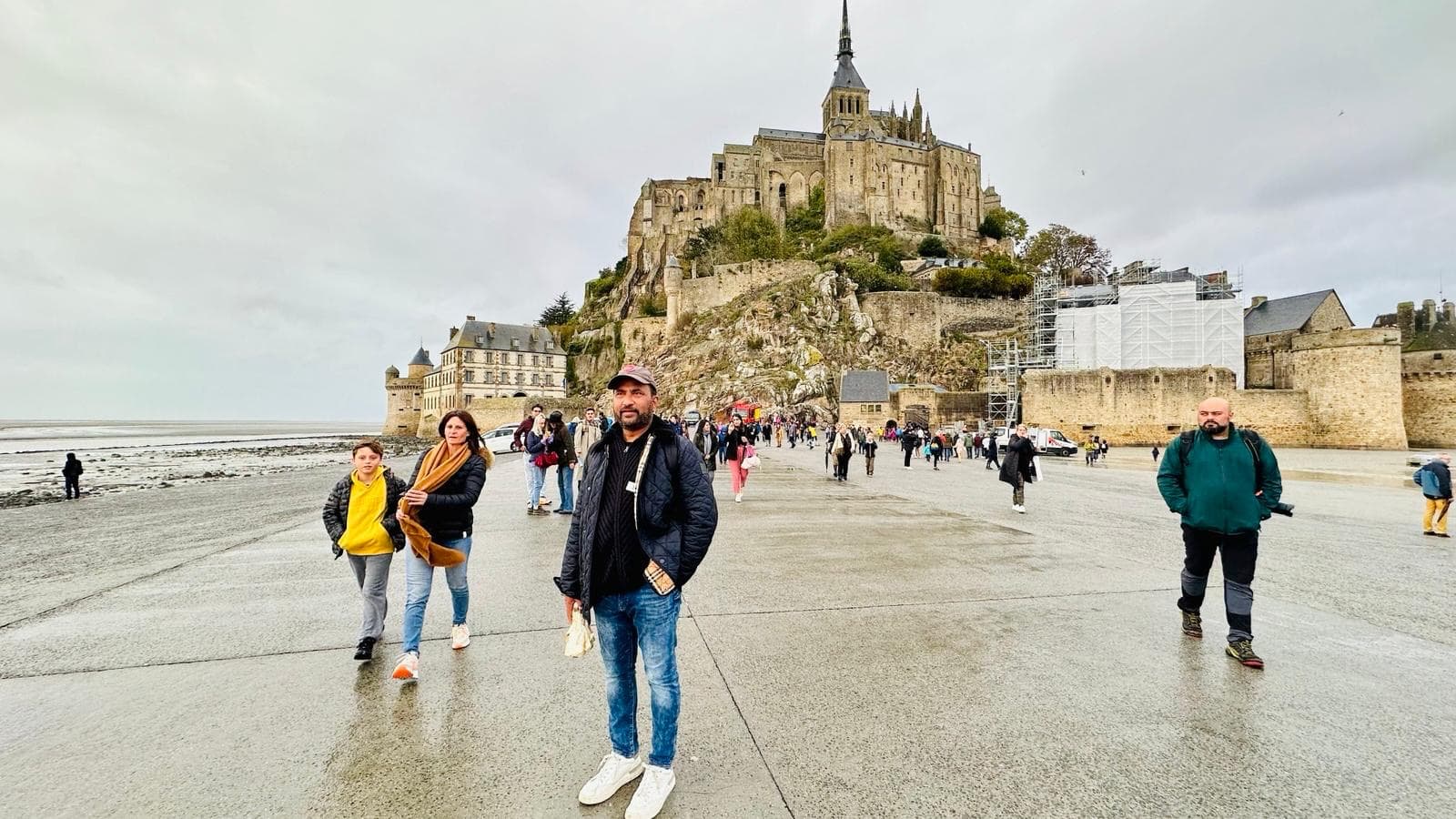
From a distance, the island looked almost unreal. A magnificent medieval structure appeared to rise directly from a rocky island, with stone walls and towers climbing toward an abbey crowned by a slender spire.
The surrounding landscape was equally fascinating. Unlike many historic castles built on hills, Mont-Saint-Michel stands within a vast tidal bay where the scenery changes dramatically with the movement of the sea.
At low tide, expansive stretches of sand and mudflats become visible. At high tide, water can surround the island, creating the impression of a magnificent stone fortress emerging from the sea.
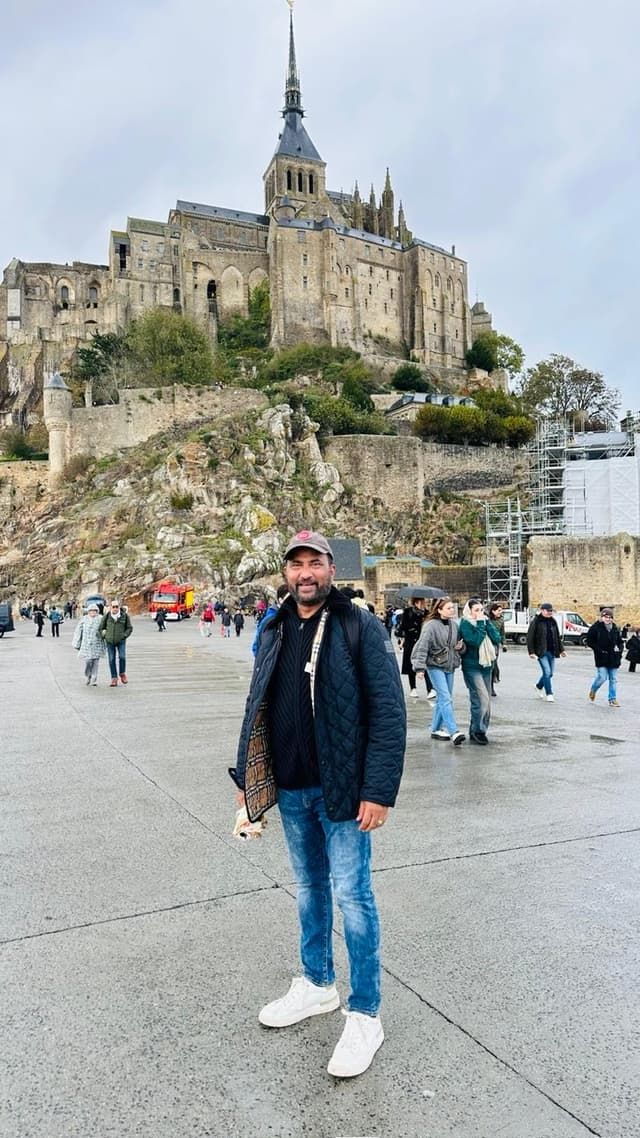
On the day captured in my photographs, the sky was cloudy, the pavement was wet, and the exposed tidal flats stretched into the distance. The weather was not the picture-perfect sunshine often featured in travel advertisements, yet the muted colors of the ancient stone and the dramatic clouds made the experience especially memorable.
As I stood before the abbey, I wondered how many millions of people had approached this island over the centuries: pilgrims seeking spiritual blessings, monks devoted to religious life, soldiers defending the island, merchants, travelers, and ordinary families.
Today, visitors arrive with cameras and smartphones, but the sense of wonder remains.
Some places seem to transcend time. Mont-Saint-Michel is certainly one of them.
A History More Than a Thousand Years in the Making
The story of Mont-Saint-Michel traditionally begins in 708, when Aubert, Bishop of Avranches, is said to have received a vision of the Archangel Michael instructing him to establish a sanctuary on the rocky island then known as Mont Tombe.
According to religious tradition, the archangel appeared repeatedly before the bishop acted upon the instruction. This story became the spiritual foundation of one of Europe's most remarkable religious sites.
In 966, a community of Benedictine monks was established on the island, beginning an important chapter in its religious and architectural development.
The magnificent abbey visible today evolved over several centuries. Its construction required extraordinary engineering skills, particularly given the steep rocky terrain, limited space, challenging weather, and powerful tides.
Imagine transporting massive stones, constructing foundations, and raising towering walls without modern cranes, computers, or hydraulic equipment. The builders relied on human labor, traditional tools, mathematical knowledge, craftsmanship, and determination.
As someone interested in science, history, and human achievement, I found this especially fascinating.
Modern engineering has given us skyscrapers, suspension bridges, and enormous transportation networks. Yet centuries ago, builders were creating architectural masterpieces that continue to challenge our imagination.
Mont-Saint-Michel reminds us that human ingenuity did not begin with modern technology. Innovation and creativity have shaped civilization throughout history.
The Abbey: An Architectural Masterpiece
The Abbey of Mont-Saint-Michel is among Europe's most remarkable examples of medieval religious architecture. Its structures reflect different historical periods and architectural styles, including Romanesque and Gothic elements.
The abbey's position at the summit of the island creates a breathtaking visual effect. Rather than simply occupying the landscape, the structure appears to grow from the rock beneath it.
Stone walls rise above steep cliffs, towers emerge from ancient fortifications, and the church dominates the skyline.
One of its most recognizable features is the spire crowned by a gilded statue of Saint Michael. The archangel is depicted overcoming a dragon, a traditional Christian symbol representing the triumph of good over evil.
Looking upward toward the spire, I reflected on the spiritual meaning behind its design. Religious architecture often seeks to connect the earthly world with something greater. Tall towers, domes, spires, and mountain sanctuaries invite visitors to lift their eyes toward the heavens.
This aspiration is not limited to Christianity. Across civilizations, people have built extraordinary sacred places to express their relationship with the divine. The temples of India, monasteries of Tibet, shrines of Nepal, mosques of the Islamic world, and cathedrals of Europe all reflect different expressions of humanity's search for meaning.
Mont-Saint-Michel reminded me of this shared spiritual heritage.
Faith Across Cultures: A Personal Reflection
Having visited sacred destinations around the world, I often reflect on the similarities between different religious traditions.
I have experienced the spiritual atmosphere of Pashupatinath in Nepal, the sacred landscape of Mount Kailash, and the timeless traditions of Varanasi. Each destination possesses its own history, rituals, and cultural identity.
Yet certain feelings are universal: the silence of contemplation, the humility inspired by nature, and the dedication of generations who preserved sacred places.
Standing before Mont-Saint-Michel, I felt a similar appreciation.
Although the abbey belongs to the Christian monastic tradition, its beauty and history can be appreciated by people of every faith. For me, visiting sacred places is not about comparing religions or deciding which tradition is superior. It is about understanding humanity.
Faith has inspired extraordinary works of architecture, art, literature, music, and community service. It has motivated people to travel great distances, endure hardship, and dedicate their lives to causes greater than themselves.
Mont-Saint-Michel is a remarkable expression of that devotion.
Sometimes, respect and curiosity are enough to create a meaningful spiritual experience.
The Extraordinary Tides of Mont-Saint-Michel
One of the most fascinating features of Mont-Saint-Michel is its relationship with the sea.
The bay experiences some of the greatest tidal ranges in continental Europe, reaching approximately 14 meters during particularly large tides. The landscape can change dramatically as water retreats and returns.
At low tide, vast expanses of sand, channels, and tidal flats become visible. At high tide, water advances across the bay and can surround the island.
These natural forces have influenced the island's history, defense, transportation, and cultural identity.
As I observed the exposed tidal landscape, I found myself thinking about the remarkable relationship between science and natural beauty. The gravitational interactions among the Earth, Moon, and Sun explain the movement of ocean waters, but understanding the physics does not diminish the wonder. In many ways, it makes the experience even more fascinating.
The bay is also environmentally sensitive. Its tidal flats support ecological processes and provide habitats for wildlife.
Visitors should never attempt to cross the surrounding sands without appropriate guidance. Soft sediment, tidal channels, and changing water conditions can be dangerous. Guided crossings are available for those who want to experience the landscape more closely, provided they follow local safety instructions.
Nature deserves admiration, but it also demands respect.
A Fortress That Withstood the Test of Time
Mont-Saint-Michel was not only a religious sanctuary; it also became an important fortified site.
During the Hundred Years' War between England and France, the island's defensive structures played a significant role in protecting it from English attacks. Its natural setting, difficult terrain, surrounding tides, and fortified walls made it extremely challenging to capture.
Over time, Mont-Saint-Michel became associated with French perseverance and resistance.
Walking near its imposing stone walls, I tried to imagine the uncertainty experienced by those who lived there during medieval conflicts. For them, these walls were not simply beautiful architectural features. They represented security, survival, and protection.
The island's history also includes periods of transformation. Following the French Revolution, the abbey was used as a prison, changing its original religious purpose.
During the nineteenth century, recognition of its historical and architectural importance helped inspire preservation efforts. The abbey was classified as a historic monument in 1874, and Mont-Saint-Michel and its bay were inscribed on the UNESCO World Heritage List in 1979.
Today, preserving this remarkable site is an international responsibility. It belongs to France, but its cultural and historical significance extends far beyond national borders.
Walking Through a Living Medieval Village
What makes Mont-Saint-Michel particularly special is that it is more than a single monumental building. It is an entire historic environment.
Below the abbey lies a small medieval village with narrow streets, stone buildings, stairways, shops, and restaurants. The settlement developed over centuries to serve residents, religious communities, pilgrims, and travelers.
Its compact layout reflects the physical limitations of building on a rocky island. Unlike modern cities with broad roads and carefully planned neighborhoods, medieval settlements often evolved according to geography, defense, commerce, and local necessity.
Every corner seems to reveal another architectural detail: a weathered stone doorway, an ancient staircase, a narrow passage between buildings, or a glimpse of the bay beyond the walls.
I have always believed that the most meaningful travel experiences come when we look beyond famous postcard views.
A photograph can capture the exterior of a monument, but a deeper experience comes from understanding the people who lived there, the challenges they faced, and the traditions they preserved.
History becomes more meaningful when we connect it with ordinary human lives.
The Human Story Behind Great Monuments
Whenever I visit an extraordinary historical structure, I think about the countless individuals whose names have disappeared from history.
We often remember kings, religious leaders, architects, and rulers. But what about the stonecutters, laborers, carpenters, cooks, and families who supported the work?
Without their contributions, these monuments would never have existed.
Mont-Saint-Michel represents not only the vision of religious leaders and architects but also the accumulated labor of generations of ordinary people.
This is an important lesson. Great achievements rarely result from one person working alone. They emerge from cooperation, shared purpose, discipline, and persistence.
The same principle applies to modern life. Whether we are building a business, developing a healthcare organization, educating children, conducting scientific research, or serving our communities, meaningful accomplishments depend on many individuals working together.
A monument may bear the name of a king or saint, but its stones also carry the invisible stories of thousands.
Travel as an Education Beyond the Classroom
I have always considered travel an extension of education.
Books, lectures, and documentaries provide valuable information, but visiting a place allows us to experience its geography, atmosphere, architecture, and cultural context directly.
Standing before Mont-Saint-Michel revealed details that photographs alone could never fully communicate: the enormous scale of the abbey, the steepness of the rocky island, the vastness of the bay, and the complexity of its stone construction.
Travel also encourages intellectual curiosity.
Why was the abbey built here? How were construction materials transported? How did the monks obtain food and water? What role did the tides play in protecting the island? How did the structure survive centuries of storms, conflict, and political change?
Each question opens the door to another area of learning.
Geography connects with history. History connects with religion. Religion connects with architecture. Architecture connects with engineering, mathematics, and science.
Suddenly, one destination becomes an entire classroom.
This is why I believe travel is especially valuable for younger generations. It encourages observation, adaptability, cultural understanding, and independent thinking.
A person who travels with curiosity often returns with a broader understanding of the world.
Preserving Our Shared Cultural Heritage
Mont-Saint-Michel is a powerful example of why historic preservation matters.
Around the world, cultural treasures face threats from environmental changes, uncontrolled development, natural disasters, conflict, and neglect. Once an irreplaceable monument is destroyed, rebuilding its physical appearance cannot fully restore its original cultural significance.
Preservation requires ongoing investment, specialized knowledge, scientific research, and public cooperation.
At Mont-Saint-Michel, conservation efforts have addressed both the historic buildings and the surrounding environment. Changes to sediment patterns and the island's maritime setting have been important considerations in efforts to preserve its distinctive relationship with the tides.
Protecting heritage is not simply about maintaining old buildings. It is about understanding the entire environment that gives a place its identity.
The same lesson applies to historic temples in India, ancient monasteries in Nepal, archaeological sites across Asia, and cultural landmarks throughout the world.
Every generation inherits something from the past. We have a responsibility to pass that inheritance to the next generation in the best condition possible.
Responsible Tourism: A Privilege and a Responsibility
Tourism can provide employment, support local businesses, fund preservation, and encourage cultural exchange. However, large visitor numbers can also create challenges, including crowding, waste, environmental damage, and excessive commercialization.
As travelers, we have a responsibility to protect the destinations we enjoy.
Responsible tourism begins with simple actions: respecting local customs and religious practices, avoiding damage to historic structures, following designated pathways, disposing of waste properly, and supporting local communities.
A historic destination is not merely a background for social media photographs. It is a place with cultural, spiritual, and historical meaning.
I enjoy capturing photographs during my travels because they preserve memories and allow me to share experiences with others. But I also believe that occasionally putting the camera away is equally important.
Some moments deserve to be experienced without distraction.
Standing quietly before a centuries-old abbey can be more meaningful than taking dozens of photographs without appreciating what is in front of us.
Travel should enrich our understanding, not merely expand our collection of images.
Practical Tips for Visiting Mont-Saint-Michel
For anyone planning a visit, a little preparation can make the experience more enjoyable.
Location: Mont-Saint-Michel is in Normandy, northwestern France, approximately 360 kilometers by road from Paris, depending on the route.
Getting there: Visitors can travel by car or use combinations of train, bus, and shuttle transportation.
Parking and access: Visitors generally leave vehicles in designated mainland parking areas and continue toward the island on foot or by shuttle.
Footwear: Comfortable walking shoes are essential because the village and abbey include cobblestones, uneven surfaces, slopes, and numerous stairs.
Weather: Coastal conditions can change quickly. A waterproof jacket and suitable clothing are useful.
Tides: Consult official tide schedules if you want to see the island surrounded by water. Tidal conditions vary, and the most dramatic events occur under particular astronomical conditions.
Opening times: Check official abbey opening hours, admission arrangements, transport schedules, and any access restrictions before traveling.
Safety: Never cross the tidal flats without appropriate guidance and local safety advice.
Most importantly, allow enough time to appreciate the experience. Rushing through Mont-Saint-Michel simply to check another destination off a travel list would be unfortunate.
Its greatest rewards come from slowing down, observing, and exploring.
What Mont-Saint-Michel Taught Me About Time
One of the most profound feelings I experienced at Mont-Saint-Michel was an awareness of time.
Human life is relatively brief. We spend much of it occupied with responsibilities, deadlines, professional commitments, financial concerns, and daily routines. These activities are necessary, but they can sometimes make us lose sight of the larger perspective.
Then we stand before a structure that has survived for more than a thousand years.
Generations have come and gone. Kingdoms have risen and fallen. Political boundaries have changed, and technology has transformed civilization. Yet the abbey continues to stand above the bay.
Its existence reminds us that human achievement can extend far beyond an individual lifetime.
It also reminds us that our own contributions need not be enormous to have lasting value. A teacher may influence generations of students. A healthcare professional may improve countless lives. A volunteer may strengthen a community. A parent may pass values to children who carry them forward.
The scale of an achievement matters less than the meaning it creates.
Mont-Saint-Michel was built through generations of effort, and its legacy continues to inspire visitors centuries later. That is a remarkable form of human continuity.
Finding Peace in a Busy World
Modern life is filled with constant activity. Phones ring, messages arrive, news updates compete for attention, and professional responsibilities often extend beyond ordinary working hours.
Even during vacations, many people remain mentally connected to their daily obligations.
Historic and spiritual places offer an opportunity to interrupt that rhythm. They invite us to observe rather than react, reflect rather than rush, and appreciate rather than accumulate.
As I looked toward the abbey and the surrounding landscape, I felt a sense of calm that can sometimes be difficult to find in everyday life.
The ancient walls had witnessed centuries of change. The tides continued their natural rhythm, and clouds moved across the sky. The world seemed to operate according to a much longer timeline than the one governing our daily schedules.
Such moments help us regain perspective.
We may not be able to eliminate every responsibility or concern, but we can create space for reflection. Travel, nature, meditation, and meaningful cultural experiences can all contribute to that process.
Sometimes, a few quiet moments in an extraordinary place can leave a deeper impression than an entire day of hurried sightseeing.
Why I Continue to Explore the World
People sometimes ask why I enjoy traveling to so many different places.
For me, the answer is simple: the world is an extraordinary classroom, and I remain a student.
Every destination introduces me to another chapter of human civilization. Every culture offers a different perspective. Every historical monument reveals something about the creativity and determination of previous generations. Every natural landscape reminds me of the remarkable planet we share.
Travel has also taught me humility. No matter how much we study or how many places we visit, there is always more to learn.
We cannot fully understand the world through the experiences of one community, one country, or one culture. The more we explore, the more we recognize both our differences and our common humanity.
At Mont-Saint-Michel, I saw a magnificent expression of medieval European Christianity. But I also saw universal human qualities: faith, courage, imagination, cooperation, resilience, and the desire to create something meaningful.
Those qualities transcend geography and religion. They belong to all humanity.
Final Reflections: A Place That Stays With You
As I looked back toward Mont-Saint-Michel, its towering abbey rising above the ancient walls and tidal landscape, I felt grateful for the opportunity to witness such an extraordinary place.
Photographs can capture the magnificent architecture, the broad approach, the changing sky, and personal moments from a visit. But they cannot fully reproduce the feeling of standing there, experiencing the scale of the medieval buildings, or realizing that countless generations have admired the same remarkable landmark.
Mont-Saint-Michel is more than a tourist attraction.
It is a meeting point of nature and human imagination, a symbol of spiritual devotion, a masterpiece of medieval engineering, a witness to European history, and a reminder of the importance of protecting our shared cultural heritage.
For me, this visit reinforced a belief I have developed through years of traveling:
The greatest reward of travel is not simply seeing new places. It is returning home with a deeper understanding of the world, greater respect for humanity, and renewed appreciation for life itself.
Centuries ago, people built Mont-Saint-Michel with stone, faith, determination, and extraordinary vision. Today, it continues to inspire visitors from around the world.
Long after its original builders disappeared into history, their work continues to connect people across generations, cultures, and continents.
Standing before that magnificent abbey, I was reminded of something worth carrying into everyday life:
Our time on Earth may be limited, but the beauty, kindness, knowledge, and meaningful contributions we leave behind can endure far beyond us.
Mont-Saint-Michel is not simply a place I visited. It is a place that reminded me why I love to travel.