Metabolic Syndrome: Understanding the Connection Between Blood Sugar, Cholesterol and Blood Pressure
Many people keep track of their blood pressure, blood sugar, cholesterol, and weight as separate numbers.
"My blood pressure is a little high." "My fasting glucose is borderline." "My triglycerides have gone up." "My waistline has increased."
Individually, each abnormality may appear manageable. But when several occur together, they may represent something more important: metabolic syndrome.
Metabolic syndrome is not a single disease. It is a clinical clustering of cardiometabolic risk factors that tend to occur together and are associated with an increased risk of type 2 diabetes and cardiovascular disease.
The terminology can sometimes be confusing. Metabolic syndrome has also been called insulin resistance syndrome or, historically, syndrome X. Insulin resistance is an important underlying mechanism in many people with metabolic syndrome, but the terms are not completely interchangeable. A person can have insulin resistance without meeting the clinical criteria for metabolic syndrome, and insulin resistance itself is not one of the five criteria used to make the diagnosis.
What Exactly Is Metabolic Syndrome?
Several definitions of metabolic syndrome have been proposed over the years, including criteria from the National Cholesterol Education Program Adult Treatment Panel III (ATP III), the American Heart Association/National Heart, Lung, and Blood Institute (AHA/NHLBI), and the International Diabetes Federation (IDF).
This history explains why readers may encounter slightly different definitions in older publications.
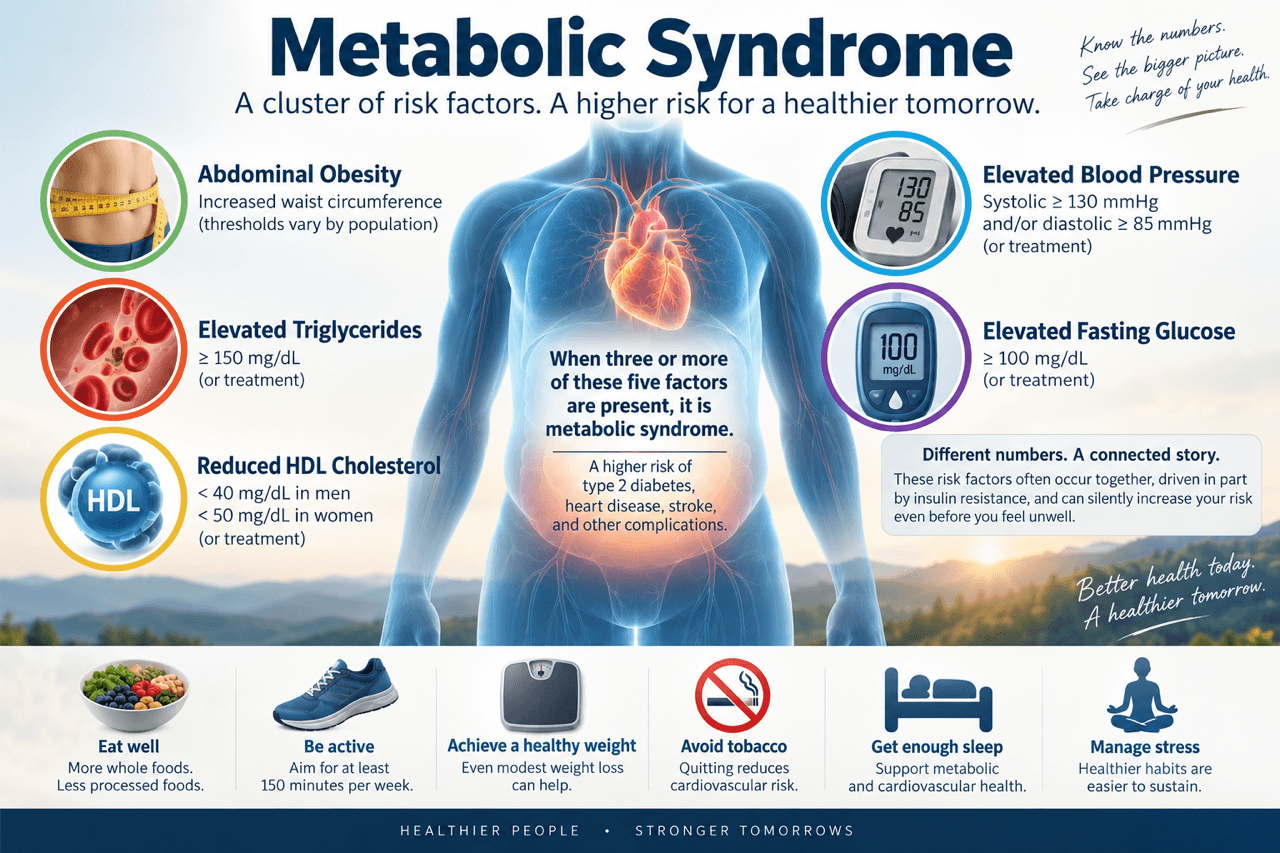
A widely used harmonized definition was developed by major international organizations to reduce these differences. Under this definition, metabolic syndrome is present when any three of the following five criteria are present. Abdominal obesity is one of the five criteria, but it is not mandatory on its own.
Three out of five = metabolic syndrome.
No single component is required under the harmonized definition.
What About Waist Circumference?
Waist circumference deserves special clarification because there is no single universal cutoff appropriate for every population.
Traditional U.S. ATP III/AHA-NHLBI thresholds have commonly used approximately:
- Men: ≥102 cm (40 inches)
- Women: ≥88 cm (35 inches)
However, the harmonized definition recognizes that the relationship between abdominal fat and metabolic risk differs among populations and recommends population- and country-specific thresholds. For example, lower thresholds are commonly used for many Asian populations.
Therefore, waist circumference should be interpreted in the context of sex, ancestry, population-specific recommendations, and the individual's overall metabolic risk.
An Important Distinction: A Metabolic Syndrome Threshold Is Not Necessarily a Disease Diagnosis
This distinction is essential.
The cutoffs used to identify metabolic syndrome are risk-factor thresholds. Crossing one of them does not necessarily mean that a person has independently developed hypertension, diabetes, or another disease.
For example:
Blood pressure ≥130/85 mmHg counts as one metabolic-syndrome component. That does not mean that "130/85" should automatically be interpreted as a complete diagnosis or treatment threshold in every patient. Blood-pressure diagnosis and management depend on repeated measurements, measurement technique, cardiovascular risk, other medical conditions, and the clinical guideline being applied.
Similarly, fasting glucose ≥100 mg/dL counts toward metabolic syndrome — but that is not the diagnostic threshold for diabetes.
This difference is important because otherwise metabolic-syndrome criteria can easily be mistaken for diagnostic criteria for the individual diseases.
The Common Thread: Insulin Resistance
At the center of metabolic syndrome is often insulin resistance.
Insulin is a hormone produced by the pancreas that helps glucose circulating in the bloodstream enter cells, where it can be used for energy.
When muscle, liver, and adipose tissues become less responsive to insulin, the pancreas initially compensates by producing more insulin. Blood glucose may therefore remain relatively normal for some time despite underlying metabolic dysfunction.
As insulin resistance progresses, glucose regulation may deteriorate. Fasting glucose can rise. Prediabetes may develop. In some people, the process eventually progresses to type 2 diabetes.
Insulin resistance is also associated with altered lipid metabolism, increased triglycerides, visceral adiposity, and other metabolic abnormalities. This helps explain why elevated glucose, high triglycerides, low HDL, elevated blood pressure, and abdominal obesity frequently cluster together.
However, metabolic syndrome should not simply be defined as insulin resistance. Insulin resistance is an important biological mechanism; metabolic syndrome is a clinical construct identified from measurable risk factors.
Blood Sugar: Metabolic Syndrome, Prediabetes, and Diabetes Are Different Terms
Blood-sugar terminology is another common source of confusion.
For metabolic syndrome, fasting glucose of 100 mg/dL or higher qualifies as one of the five components. For the diagnosis of prediabetes and diabetes, different criteria are used.
Fasting Plasma Glucose
After an overnight fast:
- Normal: <100 mg/dL
- Prediabetes: 100–125 mg/dL
- Diabetes: ≥126 mg/dL
Hemoglobin A1c
HbA1c reflects average glycemic exposure over approximately the preceding two to three months:
- Normal: <5.7%
- Prediabetes: 5.7–6.4%
- Diabetes: ≥6.5%
Two-Hour Oral Glucose Tolerance Test
After a standard 75-gram oral glucose load:
- Normal: <140 mg/dL
- Prediabetes: 140–199 mg/dL
- Diabetes: ≥200 mg/dL
A random plasma glucose of ≥200 mg/dL in a person with classic symptoms of hyperglycemia can also establish diabetes in the appropriate clinical setting. In the absence of unequivocal hyperglycemia, an abnormal result used to diagnose diabetes generally requires confirmation according to established diagnostic standards.
Why Isn't HbA1c One of the Five Metabolic Syndrome Criteria?
HbA1c is extremely useful for diagnosing and monitoring abnormal glucose metabolism, but it is not one of the five components in the standard harmonized definition of metabolic syndrome. The metabolic-syndrome glucose criterion specifically uses fasting glucose ≥100 mg/dL or treatment for elevated glucose.
This is worth stating explicitly because HbA1c and fasting glucose serve related but distinct purposes.
Cholesterol: Another Terminology Trap
People often use the word "cholesterol" as though it represents a single measurement. It does not.
A standard lipid profile commonly reports several measurements, including:
- LDL cholesterol (LDL-C) — a major atherogenic lipoprotein measure and an important target in cardiovascular prevention.
- HDL cholesterol (HDL-C) — lower concentrations are associated with metabolic and cardiovascular risk.
- Triglycerides — circulating fats that frequently rise in association with insulin resistance and metabolic dysfunction.
- Total cholesterol — a broader measurement that does not, by itself, adequately describe an individual's lipid-related cardiovascular risk.
For diagnosing metabolic syndrome, the lipid components are specifically:
- Triglycerides ≥150 mg/dL
- HDL-C <40 mg/dL in men or <50 mg/dL in women
Treatment for these abnormalities may also count under the harmonized criteria.
LDL Is Important — But It Is Not a Metabolic Syndrome Criterion
This is an especially important distinction.
LDL cholesterol is not one of the five diagnostic components of metabolic syndrome. That does not mean LDL is unimportant. LDL-containing atherogenic particles have a central role in the development of atherosclerotic cardiovascular disease. LDL therefore remains critically important when evaluating cardiovascular risk and determining appropriate preventive treatment.
Metabolic syndrome and LDL-related cardiovascular risk answer somewhat different clinical questions. A person can have:
- High LDL without metabolic syndrome
- Metabolic syndrome without markedly elevated LDL
- Both conditions simultaneously
Therefore, a complete cardiovascular assessment should not stop with the question, "Do I have metabolic syndrome?"
Blood Pressure: The Silent Warning Sign
High blood pressure frequently causes no symptoms. A person can have elevated blood pressure for years and feel completely normal.
For the metabolic-syndrome definition, the threshold is: systolic blood pressure ≥130 mmHg and/or diastolic blood pressure ≥85 mmHg, or treatment for hypertension.
The words "and/or" matter.
A blood pressure of 132/78 meets the metabolic-syndrome blood-pressure criterion because the systolic pressure is elevated. A blood pressure of 124/88 also meets the criterion because the diastolic pressure is elevated.
Again, this criterion identifies a component of metabolic syndrome; it should not be confused with the complete clinical process for diagnosing and treating hypertension.
Putting the Criteria Together
Consider a person with the following measurements:
- Blood pressure: 136/88 mmHg
- Fasting glucose: 108 mg/dL
- Triglycerides: 190 mg/dL
- HDL: 46 mg/dL (in a man)
- Waist circumference: below the applicable threshold
This individual meets four metabolic-syndrome criteria: elevated blood pressure, elevated fasting glucose, elevated triglycerides, and reduced HDL. The person therefore meets the definition of metabolic syndrome even without abdominal obesity.
Now consider someone with abdominal obesity and an LDL cholesterol of 180 mg/dL, but normal fasting glucose, triglycerides, HDL, and blood pressure. That individual has important cardiovascular risk factors requiring evaluation, but does not meet the standard definition of metabolic syndrome simply because obesity and LDL cholesterol are elevated.
This illustrates why terminology matters. Metabolic syndrome is a specific clustering of defined risk factors — not a synonym for obesity, high cholesterol, prediabetes, or poor metabolic health in general.
Abdominal Fat Is Metabolically Active
Weight matters, but where fat is stored matters too.
Visceral adipose tissue — the fat stored within the abdominal cavity around internal organs — is metabolically active and strongly associated with insulin resistance and cardiometabolic abnormalities. That is one reason waist circumference, rather than BMI, appears among the five metabolic-syndrome criteria.
BMI can still provide useful information about body size, but BMI is not one of the five diagnostic criteria for metabolic syndrome. Likewise, a person does not have to meet a BMI definition of obesity to have metabolic syndrome. This is particularly relevant because metabolic risk at a given BMI or waist circumference can differ among populations.
When the Numbers Begin Working Together
The significance of metabolic syndrome is not simply the presence of several abnormal laboratory results. It is their clustering.
- Elevated glucose reflects impaired glucose regulation.
- Elevated blood pressure increases vascular stress.
- High triglycerides and low HDL often accompany insulin resistance and altered lipid metabolism.
- Visceral adiposity contributes to metabolic dysfunction.
Together, these abnormalities identify a cardiometabolic phenotype associated with increased long-term risk.
Metabolic syndrome should therefore be regarded as a risk-identification framework, not as a substitute for assessing and treating each individual risk factor.
Metabolic Syndrome and Heart Disease
Cardiovascular disease is one of the major potential consequences of poor metabolic health.
Atherosclerosis develops over years as cholesterol-containing particles accumulate within arterial walls and contribute to plaque formation. The consequences can include coronary artery disease, heart attack, stroke, and peripheral arterial disease.
Hypertension, diabetes, dyslipidemia, smoking, obesity, chronic kidney disease, and physical inactivity can further influence cardiovascular risk.
This is precisely why prevention should begin before someone experiences chest pain, stroke symptoms, or another cardiovascular event.
The Kidney Connection
Metabolic health, cardiovascular health, and kidney health are deeply interconnected.
High blood pressure can damage the kidney's delicate vascular system. Diabetes can injure the kidney's filtering structures. Obesity and metabolic dysfunction can contribute additional physiologic stress. At the same time, chronic kidney disease substantially influences cardiovascular risk.
Modern medicine increasingly recognizes the interconnected nature of cardiovascular, kidney, and metabolic health, rather than treating these organ systems as entirely separate problems.
Your Numbers Tell a Story
We should become familiar with several basic health measurements long before we become sick.
Blood Pressure — Know your usual blood pressure, not simply the measurement from one stressful doctor's visit.
Fasting Plasma Glucose — Watch the trend over time rather than focusing only on a single result.
HbA1c — Understand your longer-term glucose pattern when testing is appropriate. Remember that HbA1c is important for evaluating prediabetes and diabetes but is not itself one of the traditional five metabolic-syndrome criteria.
LDL Cholesterol — Know your LDL level and discuss your overall atherosclerotic cardiovascular risk with your healthcare professional. LDL is critically important even though it is not part of the metabolic-syndrome definition.
HDL Cholesterol — Low HDL is one of the five metabolic-syndrome components.
Triglycerides — Elevated triglycerides are another component and frequently accompany insulin resistance.
Waist Circumference — Pay attention to abdominal adiposity, recognizing that appropriate thresholds can differ among populations.
And perhaps most importantly: look at these numbers together — but also understand what each number means individually.
Can Metabolic Syndrome Be Improved?
In many people, yes. Metabolic syndrome is not necessarily a one-way road toward diabetes and cardiovascular disease. Lifestyle interventions can improve several components simultaneously.
Physical Activity
Regular exercise improves insulin sensitivity and can favorably affect blood pressure, glucose regulation, triglycerides, and body composition.
Adults should generally aim for at least 150 minutes of moderate-intensity aerobic physical activity each week, together with muscle-strengthening activity as appropriate.
Walking counts. Cycling counts. Swimming counts. Strength training is valuable. The best exercise program is one that is medically appropriate, sustainable, and performed consistently.
Nutrition
Rather than searching for a miracle diet, concentrate on metabolic fundamentals.
- Emphasize vegetables, fruits, legumes, whole grains, nuts, and appropriate sources of protein.
- Increase dietary fiber.
- Limit highly processed foods.
- Reduce excessive added sugar and sugar-sweetened beverages.
- Limit saturated fat as appropriate within the overall dietary pattern.
- Reduce excess sodium, particularly when addressing blood pressure.
A healthy dietary pattern can simultaneously improve several aspects of cardiometabolic health.
Weight Reduction When Appropriate
For someone with excess adiposity, particularly visceral adiposity, modest weight reduction can improve several metabolic parameters. The objective is not cosmetic perfection. The objective is better metabolic health.
Avoid Tobacco
Smoking substantially compounds cardiovascular risk. A person with hypertension, diabetes, dyslipidemia, and tobacco exposure has multiple important vascular risk factors acting simultaneously. Avoiding tobacco is therefore a major component of cardiovascular prevention.
Medication When Necessary
Lifestyle intervention and pharmacologic treatment should not be viewed as competitors. Some people require medications for hypertension. Others need lipid-lowering therapy. Some require treatment for diabetes or obesity. Treatment should be individualized according to the patient's overall cardiovascular and metabolic risk.
Don't Treat the Syndrome — Treat the Person
Metabolic syndrome is useful because it draws attention to a pattern. But the diagnosis should not distract us from the individual risk factors.
A person with very high LDL cholesterol deserves appropriate evaluation even if they do not have metabolic syndrome. A person with diabetes requires appropriate diabetes management regardless of whether they meet three of the five metabolic-syndrome criteria. A person with significant hypertension needs appropriate evaluation and treatment even if glucose, triglycerides, HDL, and waist circumference are normal.
The goal is not merely to make the label "metabolic syndrome" disappear. The goal is to reduce the risk of heart attack, stroke, diabetes, kidney disease, disability, and premature death.
A Health Checkup Should Be a Forecast, Not Just a Report Card
When we receive laboratory results, we naturally ask: "Are my numbers normal?"
Perhaps we should also ask: "Where are these numbers taking me?"
A fasting glucose of 105 mg/dL may not produce symptoms today. A gradually increasing waistline may not interfere with daily life today. A blood pressure of 134/86 mmHg may not cause symptoms today. Triglycerides of 180 mg/dL may not make you feel different today.
But collectively, these measurements may reveal a pattern of increasing cardiometabolic risk. That is the tremendous opportunity of preventive medicine.
We do not have to wait for a heart attack to start protecting the heart. We do not have to wait for diabetes to address impaired glucose regulation. We do not have to wait for kidney disease to address elevated blood pressure.
Final Thoughts
Metabolic syndrome teaches us an important principle in preventive medicine: risk factors rarely exist in isolation.
But terminology matters.
Metabolic syndrome is not simply another name for obesity. It is not synonymous with insulin resistance. It is not the same thing as prediabetes. And it does not mean that every person who meets one of its thresholds has a corresponding disease diagnosis.
It is a defined cluster of cardiometabolic risk factors, generally diagnosed when three of five specified components are present. Those five components are:
Waist circumference. Triglycerides. HDL cholesterol. Blood pressure. Fasting glucose.
LDL cholesterol, HbA1c, BMI, smoking, family history, kidney function, and many other factors remain extremely important to overall health and cardiovascular risk — but they are not part of the five-component definition itself.
That distinction is important because good preventive medicine goes beyond labels.
Know your numbers. Understand what they mean. Watch their direction over time. And most importantly, consider them in the context of your overall health and cardiovascular risk.
The purpose of identifying metabolic syndrome is not simply to give a collection of abnormal numbers a name. It is to recognize a pattern early enough to change its trajectory.
Disclaimer
This article is intended for general educational purposes and does not constitute individualized medical advice. Definitions, diagnostic criteria, and treatment recommendations may vary according to the clinical guideline, population, and individual circumstances. Discuss your personal cardiovascular and metabolic risk with your healthcare professional.