Sometimes, the most meaningful lessons in life are learned not in classrooms, offices, or boardrooms, but around a simple pool table with friends.
A Photograph That Brings Back Memories
Looking at this old photograph, I cannot help but smile.
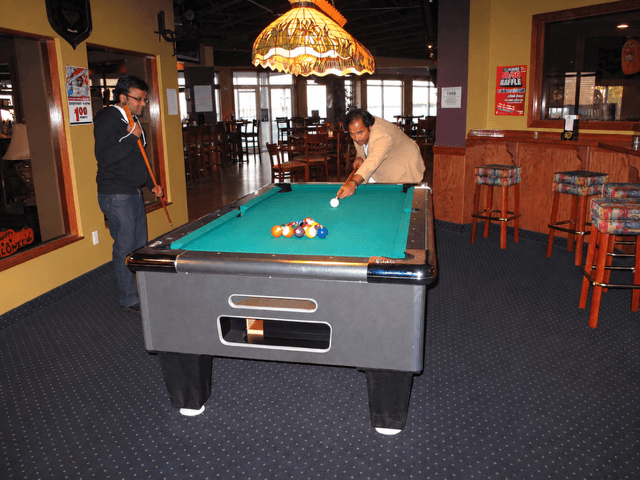
There I am, leaning over a pool table, carefully positioning the white cue ball, while a friend stands nearby holding his cue stick. Above us hangs a beautiful stained-glass billiard lamp, illuminating the green felt. In the background, an almost empty restaurant and bar provide a quiet setting.
Nothing particularly extraordinary is happening.
No major celebration. No professional accomplishment. No award ceremony.
Just two people enjoying a game of pool.
And yet, years later, this ordinary photograph has become something special.
It reminds me that life is not measured only by our achievements, our bank accounts, our professional titles, or the destinations we visit.
Sometimes, life is measured by the moments when we simply allow ourselves to enjoy being alive.
The Beauty of Doing Something Just for Fun
As we grow older, our lives gradually become filled with responsibilities.
During childhood, recreation comes naturally. We play without worrying about productivity. We laugh without checking the time. We compete without expecting financial rewards.
Then adulthood arrives.
Education, careers, marriage, family responsibilities, financial obligations, and professional commitments begin to occupy our schedules.
Somewhere along the way, many of us forget the importance of playing.
We begin to believe that every activity must serve a practical purpose.
If we walk, it must be for exercise.
If we read, it must improve our knowledge.
If we travel, we feel compelled to visit every tourist attraction.
If we spend time with friends, we sometimes feel guilty about the work waiting for us.
But what about doing something simply because it makes us happy?
That afternoon around the pool table was exactly that.
There was no agenda, no deadline, and no pressure to accomplish anything.
Just a game, a little friendly competition, and the pleasure of spending time together.
Looking back, I realize how valuable such moments really are.
Life Is a Lot Like Billiards
The more I think about this photograph, the more I recognize the similarities between a game of pool and life itself.
In billiards, every shot requires some combination of planning, patience, concentration, and judgment.
You examine the position of the balls, consider the angles, estimate the force required, and decide where to aim.
Then you take your shot.
Sometimes everything works exactly as planned.
Other times, despite your best intentions, the ball travels in an unexpected direction.
Does that sound familiar?
Life works much the same way.
We make plans for our education, careers, relationships, businesses, and families. We carefully calculate our next moves, believing we understand the direction in which our lives are heading.
But life does not always follow our calculations.
Opportunities appear unexpectedly. Challenges interrupt our plans. People enter and leave our lives. Circumstances change.
And just like billiards, we must learn to adjust.
The secret is not to expect every shot to be perfect. The secret is to remain prepared for the next one.
You Cannot Control Every Ball on the Table
One of the fascinating aspects of pool is that a single shot can change the position of several balls.
You may intend to move one ball, but the collision creates an entirely different arrangement.
Life also has a way of reminding us that our decisions influence much more than we initially anticipate.
A career decision may take us to another city or country.
A chance meeting may develop into a lifelong friendship.
An unexpected challenge may lead us toward opportunities we never imagined.
I have experienced this throughout my own journey.
Growing up in India, pursuing education, building a professional career, and eventually making a life in the United States have taught me that our paths are rarely straight.
There have been successes, disappointments, surprises, and unexpected turns.
Some of the things I once considered setbacks eventually became valuable lessons.
And some opportunities that seemed small at the time helped shape my future.
Perhaps that is why I appreciate the metaphor of billiards.
We cannot control every movement on the table, but we can control how thoughtfully we approach our next shot.
The Importance of Patience
Anyone who has played pool knows that rushing rarely produces the best results.
You must position yourself properly, steady your hand, focus your eyes, and strike with the appropriate force.
Too much power can ruin an otherwise good shot.
Too little confidence can leave the ball short of its destination.
The same principle applies to life.
We live in an age that celebrates speed.
Fast communication. Fast transportation. Fast results. Instant answers.
Technology has made our lives remarkably efficient, but it has also encouraged impatience.
We expect success quickly. We want problems resolved immediately. We compare our progress with others and sometimes become frustrated when our own journey takes longer.
But some of life’s most meaningful achievements require patience.
Building a career, raising a family, maintaining friendships, developing professional expertise, and earning trust cannot be accomplished overnight.
Just as in billiards, sometimes the smartest move is to slow down, study the situation, and proceed carefully.
Friendship Is More Important Than the Score
There is another reason I treasure photographs like this.
The person standing beside the table is just as important to the memory as the game itself.
We may forget who won or lost.
We may not remember the final score.
We may even forget the exact date or occasion.
But we remember the laughter, the conversation, and the companionship.
As life moves forward, friendships often become casualties of busy schedules.
We tell ourselves that we will call someone next week.
We promise to meet when work slows down.
We postpone a dinner, a coffee, or a casual gathering because something more urgent appears on our calendar.
Then months become years.
One day, we look at an old photograph and wonder how quickly time passed.
I believe friendships deserve the same attention that we give our professional responsibilities.
A successful life should not be so crowded with obligations that there is no room left for people who make us smile.
After all, when we look back at our lives, it is unlikely that we will remember every meeting we attended or every email we answered.
But we will remember the people who shared our journey.
Recreation Is Not a Waste of Time
As someone who has spent much of his life in healthcare, I have always appreciated the connection between physical activity, mental well-being, and quality of life.
Recreation is an important part of that picture.
We often associate healthy living with structured exercise—walking, running, swimming, cycling, yoga, or strength training.
These activities are certainly valuable.
But health is broader than physical fitness alone.
Our emotional and social well-being also matter.
Enjoyable leisure activities can provide opportunities to relax, connect with others, and temporarily step away from everyday stress.
Playing pool may not provide the cardiovascular benefits of running a marathon, but it can involve standing, walking around the table, coordination, concentration, and social interaction.
More importantly, it offers an opportunity to enjoy the present moment.
Research on leisure and psychological well-being suggests that enjoyable activities and supportive social relationships can contribute positively to mental health and life satisfaction.
Of course, one game of billiards is not a medical treatment, and recreation cannot replace necessary healthcare.
But making room for enjoyable activities is a sensible part of a balanced lifestyle.
We should not become so busy making a living that we forget to experience life.
Winning Is Enjoyable, but Losing Teaches Us Something
I have always enjoyed a little friendly competition.
Whether participating in sports, running races, or playing recreational games, competition can bring excitement and motivation.
But competition also teaches us humility.
In pool, even an experienced player can miss a seemingly easy shot.
An inexperienced player can occasionally make an incredible one.
There is always an element of uncertainty.
Life offers similar lessons.
No matter how accomplished we become, there will always be someone who knows something we do not.
No matter how carefully we prepare, mistakes are inevitable.
And no matter how successful we are, we should never lose the ability to laugh at ourselves.
I believe that is one of the healthiest attitudes we can develop.
Celebrate your victories, learn from your mistakes, congratulate others, and keep playing.
The purpose of every game does not have to be proving that you are better than someone else.
Sometimes, the purpose is simply to have a wonderful time together.
The Value of Unplanned Moments
Some of my favorite memories have come from carefully planned experiences—traveling to beautiful destinations, exploring unfamiliar cultures, and accomplishing personal goals.
But many others have emerged from spontaneous moments.
A conversation with a stranger.
An unexpected invitation.
A meal shared with friends.
A leisurely afternoon.
Or a casual game of pool.
We often underestimate these experiences because they seem too ordinary to deserve attention.
Yet photographs have a remarkable ability to change our perspective.
A moment that seemed insignificant when it happened can become deeply meaningful years later.
This particular picture is a perfect example.
At the time, I was simply enjoying myself.
Today, the photograph reminds me of friendship, youthfulness of spirit, and the importance of making time for life’s smaller pleasures.
It also reminds me that we do not need extraordinary circumstances to create extraordinary memories.
Growing Older Should Not Mean Giving Up Playfulness
As the years pass, society sometimes encourages us to behave according to our age.
We are expected to become increasingly serious, reserved, and predictable.
But I have never believed that growing older means abandoning curiosity, adventure, humor, or playfulness.
Age may change our responsibilities and physical capabilities, but it does not have to diminish our enthusiasm for life.
I enjoy physical activity, travel, exploring new places, and challenging myself.
Yet I also appreciate quieter experiences.
A simple game, an interesting conversation, or an evening with friends can be just as rewarding as a major adventure.
The key is to remain engaged with life.
There is a difference between growing older and allowing ourselves to become old in spirit.
I hope that no matter how many birthdays I celebrate, I will continue finding reasons to laugh, learn, explore, and occasionally pick up a cue stick.
What Would I Tell My Younger Self?
If I could step back into this photograph and speak to the person leaning over that pool table, I would offer a few simple thoughts.
Do not worry so much about things you cannot control.
Work hard, but remember to enjoy the rewards of your effort.
Take care of your health.
Stay connected with friends.
Spend meaningful time with family.
Travel when you can.
Do not postpone happiness until retirement or until some distant milestone.
And above all, do not measure your life only by what you accomplish.
Measure it also by how deeply you experience the journey.
Perhaps I would also whisper one practical suggestion:
Make sure you aim carefully before taking that shot!
The Final Shot
Every game of pool eventually comes to an end.
The last ball drops into a pocket, the cue sticks are put away, and the players move on.
Life, too, is a collection of moments that eventually become memories.
We cannot replay every game.
We cannot return to every afternoon.
We cannot always gather the same people around the same table.
But we can appreciate the moments while they are happening.
And we can preserve their meaning through photographs, stories, and gratitude.
When I look at this picture today, I do not wonder whether I won the game.
I wonder about the conversations we had, the laughter we shared, and the simple happiness of that afternoon.
That, to me, is the real victory.
Life is not about pocketing every ball or winning every game. It is about enjoying the people, the experiences, and the journey between the first shot and the last.
So, whenever life becomes overwhelmingly serious, perhaps we should remind ourselves to put aside our responsibilities for a little while.
Call an old friend.
Share a meal.
Play a game.
Laugh at a missed shot.
And make another memory worth remembering.
Because sometimes, the best moments in life happen when we are not trying to accomplish anything at all.
Author Note
Life is made up of more than achievements and responsibilities. Some of its most valuable moments are found in friendship, laughter, recreation, and the simple freedom to enjoy the present.
This photograph reminds me that every shot in life does not have to be perfect. What matters is that we learn from the previous one, remain patient with the next, and continue enjoying the people who share the table with us.
May we always make time for the things that bring us joy—and never become so busy building a life that we forget to live it.
— Dr. Vijay Kumar