The Oil Wells Hidden in the Woods of Northern Michigan
What a Pumpjack Near West Branch Taught Me About the History Beneath Our Feet
Living in northern Michigan, I have learned that some of the most interesting stories are not necessarily found in museums or history books. Sometimes they are sitting quietly beside a rural road, surrounded by trees and fields, waiting for someone curious enough to ask a simple question:
"What is that?"
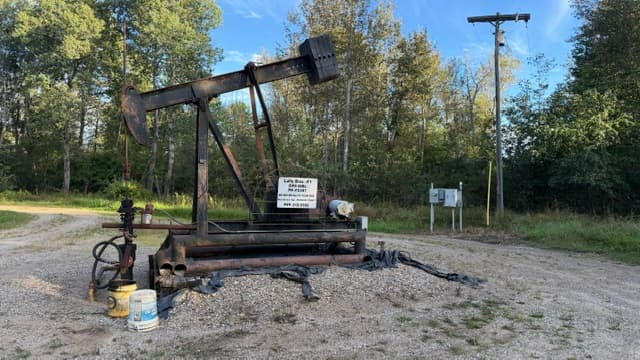
Recently, while traveling around the West Branch area in Ogemaw County, I came across the piece of machinery pictured above. I had seen similar structures before — the large steel arm slowly moving up and down — but I had never really stopped to investigate what they were doing.
At first glance, it almost looks like an aging piece of industrial equipment left behind from another era.
It isn't.
What I was looking at was a pumpjack on an oil well. And after looking more closely at the sign and researching the well, I discovered something even more interesting: this particular well has its own identifiable place in Michigan's petroleum history.
It is known as Lally Brothers No. 1.
A Small Sign With a Much Bigger Story
The sign beside the equipment identifies the site as Lally Bros. #1 and shows Michigan Permit No. 2381.
That number allowed the well to be connected to historical geological records.
Western Michigan University's Michigan Geological Repository for Research and Education maintains a collection of legacy oil-company "scout tickets." Its record for this well identifies it as Lally Brothers No. 1, located in Ogemaw County, Township 22 North, Range 2 East, Section 19. The record gives permit number 2381 and API identifier 21-129-02381.
Even the coordinates in the geological archive — approximately 44.282761, -84.241437 — correspond to this specific well.
Suddenly, the rusty machinery standing among the trees had an identity. And that changed the way I looked at it.
It Apparently Isn't Just an Old Oil Well
Perhaps the biggest surprise came next.
I initially assumed that the equipment might simply be a remnant of Michigan's earlier petroleum industry. But current industry records based on January 2026 data list Lally Brothers No. 1 as a producing well.
The operator is listed as Environmental Soil Recovery Ltd., and the associated lease is identified as Lally Brothers 1.
That means the equipment in these photographs isn't merely an industrial artifact. It represents an operating part of Michigan's energy infrastructure.
There is something remarkable about that.
Most of us associate American oil production with Texas, Oklahoma, North Dakota, Alaska, or offshore platforms in the Gulf of Mexico. Michigan rarely comes immediately to mind.
Yet beneath the forests, farms and small communities of northern Michigan are geological formations that have supported oil and natural-gas production for generations.
What Exactly Is a Pumpjack?
The machine in my photograph is commonly called a pumpjack.
People sometimes give it more colorful names — "nodding donkey," "horsehead pump," or simply an oil pump.
Its movement is surprisingly simple to watch. The large beam rocks slowly upward and downward. But that repetitive motion is doing important work thousands of feet below the surface.
When an oil reservoir has enough natural underground pressure, petroleum may initially move toward the surface without substantial mechanical assistance. Over time, however, reservoir pressure can decline.
That's where artificial-lift systems such as pumpjacks become useful.
An electric motor or engine turns a mechanism that converts rotary motion into the familiar up-and-down movement of the walking beam. That movement operates rods extending into the well, allowing fluids to be lifted toward the surface.
What looks like a slow-moving steel animal in the woods is therefore the visible end of a much larger underground system.
And What Is the Big Green Tank?
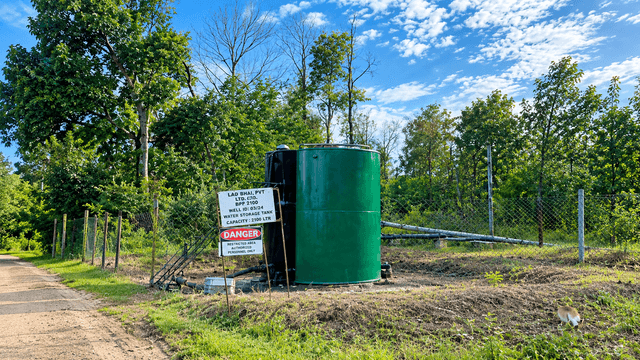
A short distance from the pumpjack I photographed another structure: a large green cylindrical tank.
That is also part of the production operation.
An oil well doesn't necessarily produce a stream of perfectly clean crude oil. Produced fluids can include combinations of oil, formation water and gas. Surface equipment is therefore used to handle, separate and store those fluids appropriately.
The tank at the site provides another clue that this is a functioning petroleum-production location rather than simply abandoned machinery.
The nearby warning sign also makes more sense once you understand what is happening there: no smoking, no matches, no open lights.
Hydrocarbon vapors can be flammable, so these warnings should be taken seriously. Oil-production equipment is industrial infrastructure, not playground equipment, and visitors should remain outside restricted areas and avoid touching valves, tanks, pipes or machinery.
Oil Production in Ogemaw County
What surprised me even more was discovering how much petroleum activity exists around us.
Current industry records list numerous wells in Ogemaw County associated with multiple operators. Environmental Soil Recovery Ltd. alone is associated with several wells in the county, many of which were listed as producing in January 2026.
And oil production in Ogemaw County is not merely historical. Reported countywide production was approximately 127,757 barrels of oil in 2025, along with reported natural-gas production of about 360,121 MCF.
Those numbers made me reconsider the landscape I have driven through countless times.
We see forests. We see lakes. We see farmland. We see deer crossing the road and small northern Michigan communities separated by miles of trees.
But beneath that familiar landscape lies another world — a geological landscape millions of years in the making.
Michigan Has an Oil Story Too
Michigan's identity is usually connected to automobiles, manufacturing, the Great Lakes, agriculture, timber and tourism.
Detroit became synonymous with the automobile. Northern Michigan became known for forests, lakes, recreation and natural beauty.
But Michigan also has a long relationship with oil and natural gas. The reason is geology.
Michigan sits over what geologists call the Michigan Basin, a large bowl-shaped accumulation of sedimentary rock underlying much of the Lower Peninsula and extending into surrounding areas.
Imagine stacking enormous layers of sediment over hundreds of millions of years. Ancient seas once covered this region. Organic material accumulated in sediments. Over geological time, heat, pressure and chemical processes transformed some organic material into hydrocarbons.
Under appropriate geological conditions, oil and gas migrated through porous rocks until trapped by less permeable layers.
Long before there was a Michigan — long before human beings existed — the geological conditions necessary for today's petroleum resources were developing beneath this land.
That is an extraordinary timescale to contemplate.
Looking at the Landscape Differently
This discovery reminded me of something I have learned repeatedly throughout my life: curiosity changes ordinary experiences into opportunities for learning.
I could easily have driven past this pumpjack. Most people probably do. You see a machine beside the road, perhaps wonder about it for a few seconds, and continue driving.
But stopping and asking a question transformed an ordinary roadside observation into a lesson involving geology, engineering, Michigan history, economics and energy.
That is the beauty of curiosity.
Education doesn't always require a classroom. Sometimes the classroom is standing beside a rural Michigan road.
The Engineering Hidden Behind a Simple Motion
Watching a pumpjack operate can almost be hypnotic. Up. Down. Up. Down.
The movement appears uncomplicated. But simplicity on the surface often hides tremendous engineering underneath.
Someone had to identify a geological prospect. Someone had to acquire mineral rights and regulatory authorization. A drilling crew had to drill through layers of rock. Geologists had to study formations encountered underground. Engineers had to determine whether hydrocarbons could be economically recovered. The well had to be completed and equipped. Production equipment had to be installed. Electricity had to reach the site. Fluids had to be collected and handled. Environmental and safety requirements had to be followed.
And decades later, equipment must still be inspected, maintained and eventually properly decommissioned when production ends.
The slow movement of that pumpjack therefore represents the work of many different professions.
Energy Comes From Somewhere
There is also a larger lesson here.
Modern life requires enormous amounts of energy. We turn a key or press a button and our cars move. We heat buildings through brutal Michigan winters. Trucks transport food across the country. Aircraft carry us around the world. Factories manufacture medical devices, medications, computers, building materials and countless other products.
Petroleum itself is also a raw material for many products beyond gasoline.
Yet the infrastructure supplying those resources often remains invisible to consumers. The gasoline at a filling station doesn't simply appear there. It represents an enormous chain — from geology and exploration to extraction, transportation, refining and distribution.
Whatever one's views about the future balance among fossil fuels, nuclear energy and renewable sources, understanding where today's energy comes from is important. An informed discussion about energy should begin with understanding the systems we already depend upon.
Production and Environmental Responsibility
There is another side to this story that deserves equal attention.
Oil and natural-gas development must coexist responsibly with Michigan's extraordinary natural environment. We are surrounded by forests, wetlands, rivers, lakes and groundwater resources that deserve protection.
Oil production carries potential risks, including spills, leaks, soil contamination, methane emissions and problems associated with improperly abandoned wells. That is why regulation, inspection, responsible operation and proper well plugging are important.
Economic development and environmental stewardship should not automatically be viewed as opposing goals. The real challenge is ensuring that resources are developed responsibly while protecting the land and water that future generations will inherit.
Northern Michigan's natural beauty is one of its greatest treasures. We have an obligation to treat it accordingly.
A Machine, a Forest and Millions of Years of History
Perhaps what struck me most about these photographs is the contrast.
There is heavy steel machinery in the foreground. Behind it stands a dense Michigan forest. Underground are rock formations formed during geological eras almost impossible for the human mind to comprehend. Above it all is a beautiful blue Michigan sky.
Industry, nature and geology occupy the same frame.
The pumpjack itself may have been installed by humans, but the petroleum it is attempting to recover began its journey unimaginably long before us. That perspective is humbling.
Our individual lives are measured in decades. Human civilizations are measured in thousands of years. But geology operates across hundreds of millions of years.
Never Stop Asking Questions
I began this journey with a very simple question: what is this machine?
The answer led me to Michigan geological archives, an API well number, a permit number, petroleum engineering, Ogemaw County production statistics and the history beneath the place I call home.
That experience reinforces something I strongly believe: learning should never stop simply because formal education ends.
Degrees are milestones, not destinations. The world remains our classroom.
A physician can learn geology. A geologist can learn medicine. A businessperson can study history. A retiree can learn astronomy. A child can ask a question that sends an adult searching for answers.
Curiosity does not recognize professional boundaries or age.
And sometimes the most valuable intellectual habit is simply being willing to say: "I don't know what that is. Let me find out."
The Next Time You See One…
The next time you are driving through northern Michigan and notice a steel arm slowly rising and falling among the trees, you may look at it differently.
It isn't simply an odd machine. It is a pumpjack. It is connected to a well extending deep beneath the earth. It represents engineering, geology, energy and local history.
And in the case of the one I happened to photograph near West Branch, it has a name: Lally Brothers No. 1. Michigan Permit #2381. API 21-129-02381.
A historical geological record preserved by Western Michigan University identifies its location in Ogemaw County, while 2026 industry data continue to list the well as producing.
I had probably passed structures like this before without giving them much thought.
This time I stopped. I took a photograph. I asked a question. And I discovered another fascinating chapter of the place I call home.
Sometimes discovery doesn't require traveling thousands of miles. Sometimes it begins by paying closer attention to what has been beside us all along.
Author Note
"I've come to believe that curiosity is the one credential that never expires. A permit number on a rusty sign taught me more in an afternoon than I expected to learn that week — not because the answer was complicated, but because I finally stopped and asked. The world keeps teaching, long after the classroom ends. We just have to keep showing up as students." — Vijay Kumar