Healthcare Innovation Begins with Compassion, Not Technology
Some innovations change the way we work.
Others change the way we live.
But the most meaningful innovations are those that change the way we care for one another.
Healthcare is experiencing one of the most extraordinary periods of transformation in its history. Artificial intelligence is assisting physicians in diagnosing diseases earlier than ever before. Wearable devices continuously monitor vital signs, robotic-assisted surgeries are improving precision, and telehealth has made expert medical care accessible far beyond the walls of hospitals and clinics.
These technological advances are redefining what modern medicine can achieve.
Yet amid this remarkable progress, one truth remains unchanged.
Technology can improve healthcare, but only compassion can transform it.
As a healthcare professional, entrepreneur, and lifelong learner, I have come to believe that the greatest innovations in medicine are not measured solely by faster computers, smarter algorithms, or increasingly sophisticated medical devices. They are measured by how effectively these innovations improve the lives of people.
Healthcare innovation does not begin with technology.
It begins with understanding people.
It begins with listening to a patient's fears before discussing a diagnosis.
It begins with recognising that behind every medical record is an individual carrying hopes, responsibilities, dreams, and uncertainty.
Because before healthcare becomes a science, it is first an act of humanity.
The Heart of Medicine Has Always Been Human
Medicine has evolved tremendously over the centuries.
Scientific discoveries have transformed once-fatal diseases into manageable conditions. Imaging technologies have enabled clinicians to look inside the human body with remarkable accuracy. Artificial intelligence can now analyse millions of medical data points in seconds, helping healthcare professionals make faster and more informed decisions.
Every generation has witnessed extraordinary medical progress.
Yet one principle has remained constant throughout history.
Healing has always been built on human connection.
Patients rarely remember every laboratory value discussed during an appointment.
They may not remember every medication dosage or every technical explanation provided.
Instead, they remember something much more personal.
They remember the physician who listened without interrupting.
The nurse who stayed beside them during a difficult night.
The therapist who celebrated every small milestone in recovery.
The healthcare professional who made them feel respected, understood, and valued during one of the most vulnerable moments of their lives.
Those experiences become lasting memories because healing extends beyond medicine.
Compassion creates trust.
Trust encourages communication.
Communication improves diagnosis.
Better diagnosis leads to better treatment.
Technology supports every stage of this process.
Compassion is what begins it.
No machine, regardless of how advanced it becomes, can replace the reassurance that comes from knowing another human being genuinely cares.
Innovation Is About Solving Human Problems
When many people think about innovation, they immediately picture cutting-edge technology.
Artificial intelligence.
Machine learning.
Robotics.
Digital health platforms.
Predictive analytics.
Remote monitoring.
These innovations are undoubtedly reshaping healthcare.
But technology itself is not innovation.
Innovation begins with a much simpler question.
"How can we make life better for patients?"
Every meaningful advancement in medicine has been driven by the desire to solve a human problem.
To reduce suffering.
To improve access to healthcare.
To diagnose diseases earlier.
To simplify complex treatments.
To help families navigate difficult moments with greater confidence.
Technology becomes valuable only when it serves these human goals.
Healthcare organisations sometimes become so focused on adopting the latest technologies that they lose sight of why those technologies exist in the first place.
Innovation should never be implemented simply because it is new.
It should be implemented because it improves lives.
The organisations shaping the future of medicine are not necessarily those investing in the most advanced technologies.
They are the organisations asking the right questions.
"How can we make healthcare more compassionate?"
"How can we make care more accessible?"
"How can we reduce anxiety for our patients?"
When those questions come first, technology naturally becomes a powerful solution rather than the centre of attention.
Patients Need More Than Clinical Excellence
Modern healthcare generates an extraordinary amount of information.
Every consultation produces clinical data.
Blood pressure.
Heart rate.
Oxygen saturation.
Laboratory values.
Medical imaging.
Genetic information.
Functional assessments.
These measurements are essential.
They help clinicians make informed decisions and deliver evidence-based care.
But numbers alone never tell the complete story.
Behind every medical chart is a unique individual.
Someone balancing family responsibilities while managing illness.
Someone concerned about returning to work after surgery.
Someone worried about how treatment will affect their children.
Someone quietly carrying emotional struggles that cannot be measured through laboratory tests.
Medicine treats disease.
Compassion treats people.
Healthcare professionals who see only the diagnosis may successfully manage illness.
Those who understand the person behind the diagnosis have the opportunity to restore confidence, hope, and resilience.
That is what truly patient-centred care means.
It recognises that every patient deserves not only excellent clinical treatment but also empathy, dignity, and understanding.
Because the best healthcare addresses both physical wellbeing and emotional wellbeing.
Artificial Intelligence Should Strengthen Human Connection
Artificial intelligence is undoubtedly one of the greatest innovations of our generation.
Today, AI supports clinicians by detecting abnormalities in medical images, identifying disease patterns, predicting clinical outcomes, reducing administrative work, assisting with documentation, and helping healthcare teams make faster decisions.
Its capabilities continue to expand every year.
These developments are exciting.
They have enormous potential to improve efficiency, increase accuracy, and reduce the burden placed on healthcare professionals.
However, artificial intelligence cannot replace what patients value most.
It cannot comfort someone receiving difficult news.
It cannot understand the fear hidden behind a smile.
It cannot reassure anxious parents waiting outside an operating theatre.
It cannot replace ethical judgement, emotional intelligence, or genuine empathy.
Those qualities remain uniquely human.
Perhaps the greatest contribution of artificial intelligence will not be replacing healthcare professionals.
Perhaps it will be giving them something increasingly valuable.
Time.
Time to listen more carefully.
Time to explain treatments more clearly.
Time to answer questions patiently.
Time to connect with patients beyond the diagnosis.
Technology should never reduce human interaction.
It should create more opportunities for it.
And that may become the greatest innovation of all. Compassion Improves Clinical Outcomes
Compassion is often described as a personal quality.
In healthcare, it is also a clinical advantage.
Over the years, numerous studies have shown that patients who feel heard, respected, and involved in their care are more likely to achieve better health outcomes. They are more likely to follow treatment plans, attend follow-up appointments, communicate symptoms honestly, and actively participate in their own recovery.
These improvements are not driven by technology alone.
They are driven by trust.
When patients trust their healthcare professionals, they become partners rather than passive recipients of care. They ask questions with confidence, express concerns openly, and make informed decisions about their health.
Compassion strengthens that partnership.
It transforms healthcare from a series of clinical interactions into a meaningful relationship built on mutual respect and shared purpose.
For healthcare professionals, compassion is not simply about being kind.
It is about recognising that every patient has a story beyond the diagnosis.
Every illness affects a family.
Every treatment influences someone's daily life.
Every conversation has the potential to restore hope.
Healing begins when people feel understood.
Telehealth Should Feel Personal
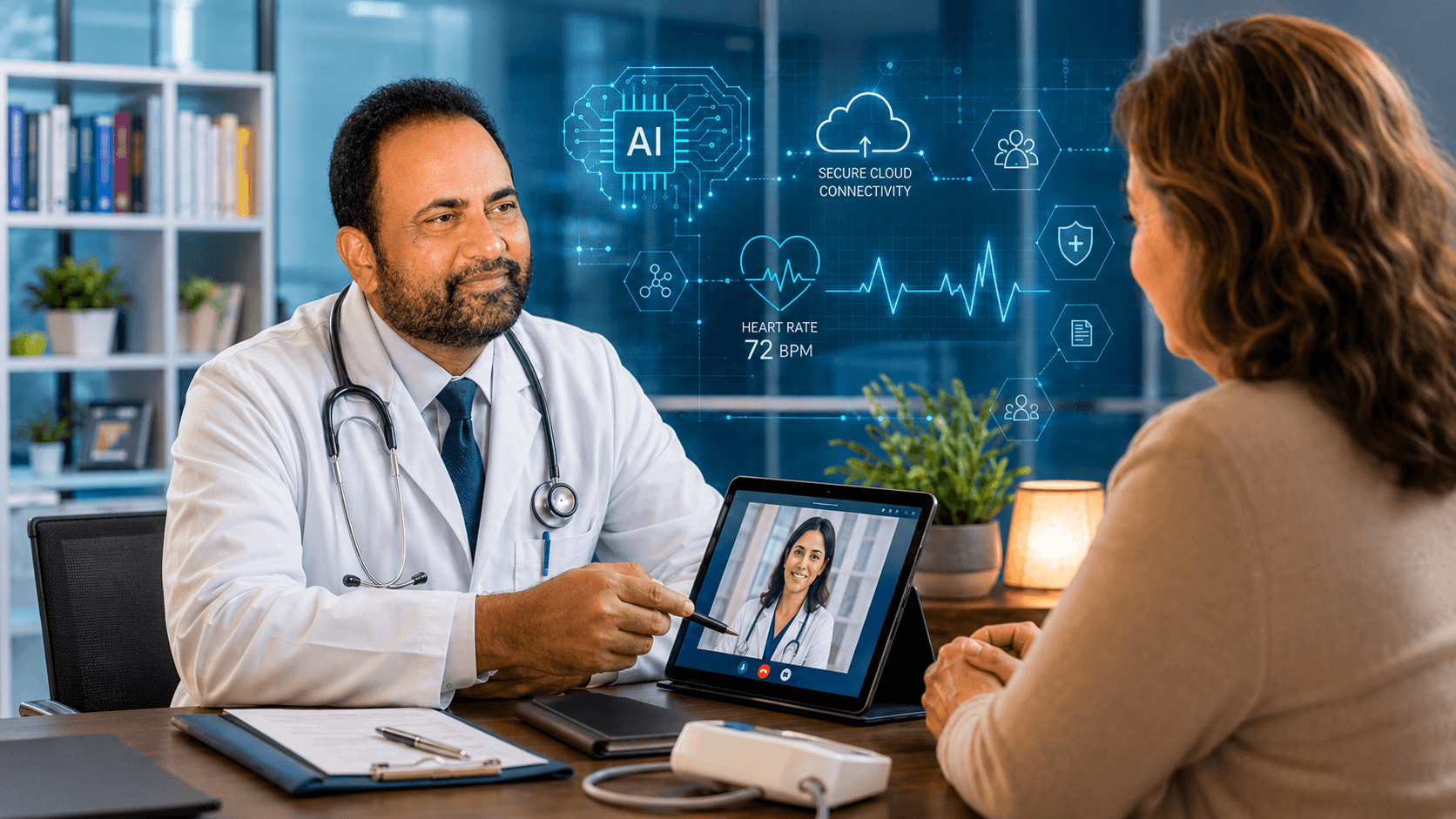
The rapid growth of telehealth has changed the way healthcare is delivered.
Today, patients can consult specialists without travelling long distances, receive follow-up care from the comfort of their homes, and access medical expertise regardless of geographical boundaries.
For many individuals, especially those living in rural communities or managing chronic conditions, this transformation has made healthcare more accessible than ever before.
But convenience should never come at the expense of connection.
A virtual consultation should never feel like a transaction.
Whether a patient sits across a desk or appears through a computer screen, they deserve the same attention, empathy, and reassurance.
Compassionate telehealth is reflected in small but meaningful actions.
Maintaining eye contact through the camera.
Listening without interruption.
Explaining medical conditions in language patients understand.
Encouraging questions.
Respecting privacy.
Following up after consultations.
Making every interaction feel personal.
Technology connects devices.
Compassion connects people.
That difference is what transforms digital healthcare into truly patient-centred care.
Leadership Shapes Compassionate Innovation
Innovation does not happen by accident.
It begins with leadership.
Healthcare leaders influence far more than budgets, technology investments, or operational strategies.
They shape organisational culture.
Leaders who value compassion inspire healthcare teams to place patients at the centre of every decision.
They encourage collaboration across disciplines.
They promote continuous learning.
They support employee wellbeing.
They embrace innovation responsibly while never losing sight of the human purpose behind every technological advancement.
When healthcare professionals feel respected and supported, they are better equipped to care for others.
When patients experience compassion consistently throughout an organisation, trust grows naturally.
Innovation flourishes in environments where people feel valued.
This applies equally to patients, clinicians, researchers, administrators, and every individual contributing to healthcare delivery.
Technology may transform healthcare systems.
Leadership transforms healthcare cultures.
Balancing Innovation with Humanity
As artificial intelligence and digital technologies continue advancing, healthcare organisations face an important responsibility.
The challenge is no longer deciding whether innovation should be adopted.
The challenge is ensuring innovation strengthens—not replaces—the human experience.
Every new technology should answer a simple question:
Does this improve the lives of patients?
If the answer is yes, innovation has fulfilled its purpose.
If the answer is no, technology alone cannot justify its existence.
Healthcare has always existed to relieve suffering, restore dignity, and improve quality of life.
Technology becomes meaningful only when it serves those goals.
This balance between innovation and humanity will define the next generation of healthcare.
Hospitals may become smarter.
Artificial intelligence will become more capable.
Predictive medicine will continue advancing.
Personalised healthcare will become increasingly precise.
Yet the qualities patients will continue seeking remain remarkably timeless.
Kindness.
Respect.
Trust.
Honesty.
Compassion.
Human connection.
These values will never become outdated.
In fact, as healthcare becomes increasingly digital, they become even more important.
A Personal Reflection
Throughout my journey as a healthcare professional, entrepreneur, and lifelong learner, I have witnessed extraordinary progress in medicine.
Technologies that once seemed impossible have become everyday clinical tools.
Healthcare continues evolving faster than ever before.
Yet every advancement has reinforced one simple lesson.
People remember how we make them feel.
Patients may appreciate faster diagnoses.
They may benefit from advanced treatments.
They may admire the remarkable capabilities of modern technology.
But long after appointments have ended and treatments have been completed, they remember the compassion shown during their most vulnerable moments.
A reassuring conversation.
A kind smile.
An honest explanation.
A healthcare professional who took the time to listen.
Those moments often become just as important as the treatment itself.
That is why compassion remains the most powerful innovation healthcare will ever possess.
Final Thoughts
Healthcare innovation is often measured by groundbreaking discoveries, sophisticated technologies, and revolutionary medical advances.
These achievements deserve recognition.
They continue improving millions of lives around the world.
But the greatest innovation does not begin with artificial intelligence.
It does not begin with robotics.
It does not begin with software.
It begins with people.
It begins with healthcare professionals who choose to listen before speaking.
To understand before judging.
To comfort before treating.
To see the individual before seeing the illness.
Technology makes healthcare more capable.
Compassion makes healthcare meaningful.
The future of medicine belongs not simply to organisations with the most advanced technology.
It belongs to organisations that successfully balance innovation with humanity.
Because when science and compassion work together, healthcare becomes more than efficient.
It becomes healing.
And in the end, patients may admire the technology—
but they will always remember the compassion.
"True healthcare innovation is not measured by the intelligence of our technology, but by the compassion with which we use it. When humanity leads innovation, healing becomes more than treatment—it becomes hope."
— Dr. Vijay Kumar