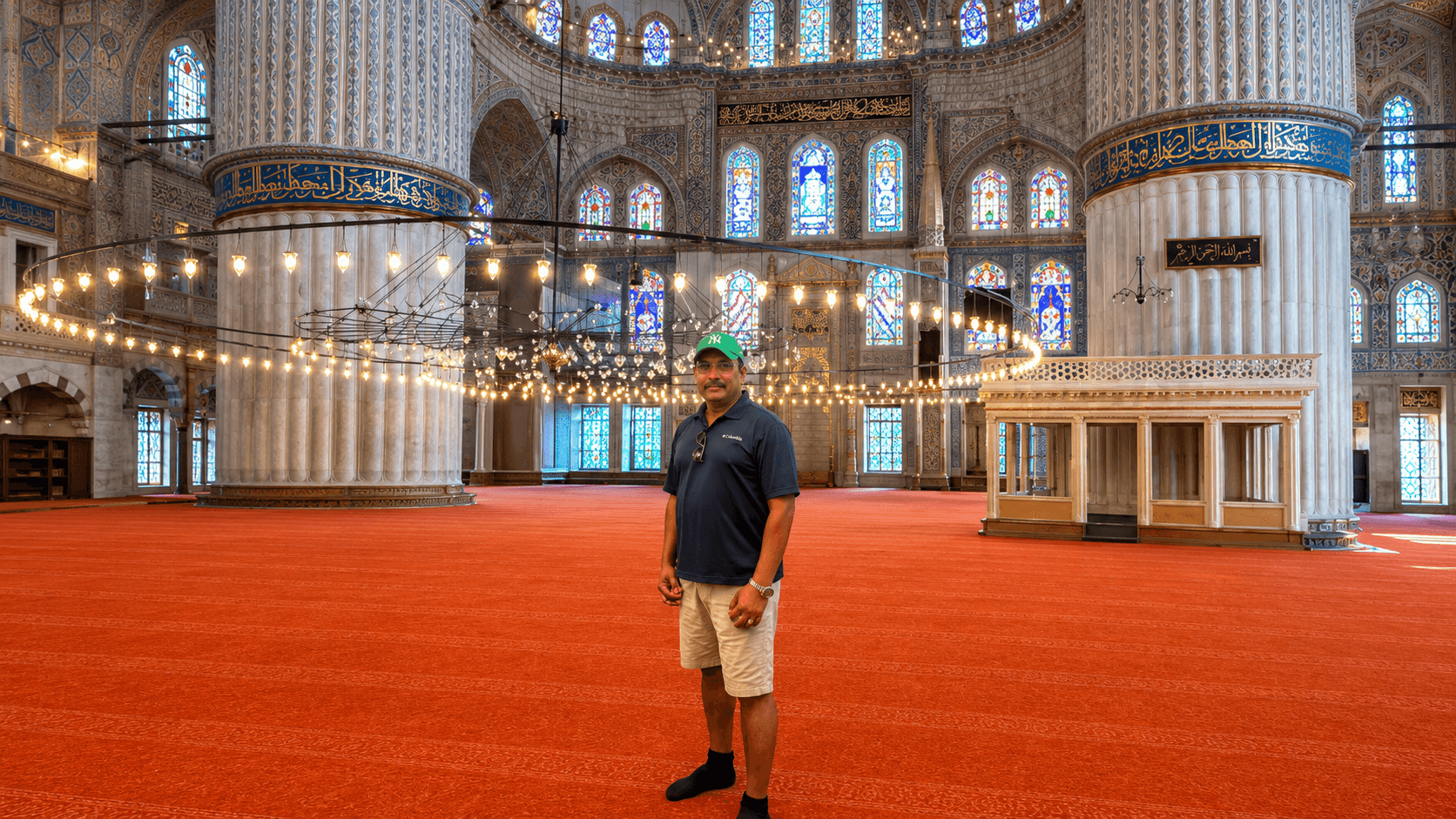
Hagia Sophia: Where Civilizations Meet and History Speaks
A Journey Through Time, Faith, Architecture, and Inspiration
By Vijay Kumar, MD, MPH, PhD, DPT
There are places we visit simply to see something beautiful, take photographs, and add another destination to our travel memories. Then there are places that quietly change the way we understand history, humanity, faith, and our own place in the world.
Hagia Sophia—known in Turkish as Ayasofya—in Istanbul, Türkiye, belongs to the second category.
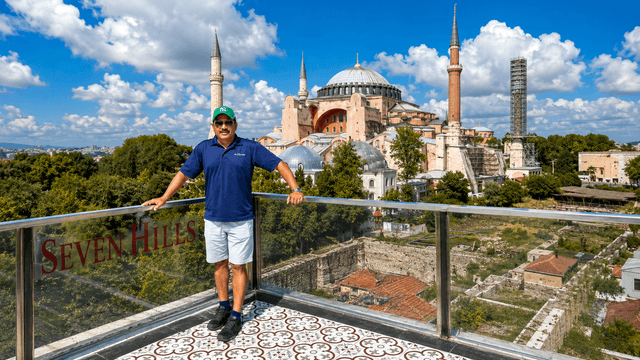
Long before entering the building, its presence can be felt across Istanbul’s historic peninsula. Its enormous central dome rises above the surrounding structures, while its minarets define a silhouette recognised around the world. From a distance, it appears monumental. Up close, it becomes even more difficult to comprehend how generations of architects, builders, artists, worshippers, rulers, scholars, and conservators contributed to the building that stands today.
Walking toward Hagia Sophia, I was aware that I was approaching far more than a famous tourist attraction. I was entering a place that had witnessed the rise and fall of empires, changes in political power, transformations in religious identity, advances in architecture, and countless moments of private prayer and public ceremony.
Inside, that awareness became even stronger.
Standing beneath its vast dome, surrounded by marble, mosaics, calligraphy, arches, galleries, columns, and filtered light, I was reminded that history is not confined to textbooks. It is preserved in physical spaces. It lives within walls, survives in artistic details, and speaks through the silence of places that have outlasted the generations that created them.
Every part of Hagia Sophia seems to carry a story. Its stones speak of ambition. Its dome speaks of engineering courage. Its mosaics and calligraphy speak of faith. Its repairs and adaptations speak of resilience. Its continuing importance speaks of humanity’s desire to create something meaningful that can survive beyond a single lifetime.
A visit to Hagia Sophia is therefore not simply a journey into the past. It is also an opportunity to reflect on vision, leadership, creativity, coexistence, cultural memory, and the responsibility each generation carries toward the achievements it inherits.
A Monument That Has Witnessed Nearly Fifteen Centuries
The present Hagia Sophia was commissioned by the Byzantine emperor Justinian I and completed in 537 CE. It was designed by Anthemius of Tralles and Isidore of Miletus, whose combination of geometry, engineering, and architectural imagination produced one of the most influential buildings in world history.
The building was constructed as the great cathedral of Constantinople, the capital of the Byzantine—or Eastern Roman—Empire. It replaced earlier churches that had occupied the site and was intended to represent both religious devotion and imperial authority.
The speed and ambition of its construction were extraordinary. In an age without modern cranes, computer modelling, reinforced concrete, or industrial machinery, its builders created an enormous enclosed space crowned by a dome that appeared almost weightless.
Hagia Sophia became a centre of religious and ceremonial life in Constantinople. Emperors were crowned there. Major religious services were held beneath its dome. Clergy, political leaders, diplomats, pilgrims, and citizens entered its halls for events that shaped Byzantine history.
For centuries, it stood among the largest and most impressive religious structures in the world. More importantly, its architectural ideas influenced generations of builders across regions and faith traditions.
Its identity changed dramatically in 1453, when Sultan Mehmed II conquered Constantinople and the city became part of the Ottoman Empire. Hagia Sophia was converted into an imperial mosque.
This transformation introduced new architectural and artistic elements. Minarets were added over time. Islamic calligraphy, a mihrab indicating the direction of prayer, a minbar used for sermons, and other Ottoman features became part of the structure.
Rather than existing as a frozen monument from a single period, Hagia Sophia continued to evolve. Ottoman architects reinforced and repaired the building, helping preserve a structure already many centuries old.
In 1935, during the early years of the Republic of Türkiye, Hagia Sophia opened as a museum. This allowed visitors from around the world to experience its Byzantine and Ottoman heritage within the same space.
In 2020, its status changed again, and Hagia Sophia resumed functioning as a mosque while continuing to receive visitors. It remains part of the Historic Areas of Istanbul, which are inscribed on UNESCO’s World Heritage List. UNESCO describes the building as an architectural masterpiece and a unique testimony to centuries of interaction between Europe and Asia.
Its story can therefore be summarised through several major identities:
- A Byzantine imperial cathedral
- A place of Eastern Orthodox worship
- A Latin Catholic cathedral for a period following the Fourth Crusade
- An Ottoman imperial mosque
- A museum open to international visitors
- An active mosque and globally significant heritage monument
Very few buildings have carried so many political, cultural, artistic, and spiritual meanings across such a long period.
Yet describing Hagia Sophia only through dates and changes of status does not fully explain its importance. Its greatest significance may be its ability to preserve multiple chapters of history within one physical structure.
The Meaning Behind the Name Hagia Sophia
The name “Hagia Sophia” does not refer to a historical woman named Sophia. It comes from Greek and means “Holy Wisdom” or “Divine Wisdom.”
This meaning adds another dimension to the monument.
Wisdom is not limited to knowledge or information. It involves the ability to understand experience, recognise complexity, respect what came before us, and make thoughtful decisions about the future.
Hagia Sophia embodies this idea in an unusual way.
It contains evidence of changing civilizations without belonging completely to only one moment. It carries marks of conflict, transformation, adaptation, preservation, and renewal. Its history cannot be reduced to a simple narrative of one group replacing another.
Instead, the building demonstrates that history is layered.
Every generation inherited a structure shaped by earlier generations. Each added its own meanings and responsibilities. Some elements were modified, concealed, restored, reinforced, or reinterpreted. The result is not a perfectly untouched building from 537 CE, but a living record of nearly fifteen centuries.
That complexity is precisely what makes Hagia Sophia so powerful.
It asks visitors to recognise that cultural heritage is rarely simple. Great monuments often contain stories of achievement and loss, faith and politics, continuity and change.
Wisdom begins when we are willing to see all those layers rather than selecting only the ones that confirm our existing views.
Architecture That Changed What Seemed Possible
Hagia Sophia is admired not only because of its age or historical importance. It is also a revolutionary work of architecture.
Its central dome dominates the interior. Measuring approximately 31 metres across and rising roughly 55 metres above the floor, the dome is supported through a sophisticated arrangement of pendentives, arches, piers, semi-domes, and surrounding structural elements. The ring of windows near its base allows light to enter in a way that can make the dome appear to float above the central space.
To a modern visitor, large domes may seem familiar. We have seen them in religious buildings, government institutions, museums, and photographs. However, the architectural achievement of Hagia Sophia must be understood within the technological limitations of the sixth century.
Its designers attempted something remarkably ambitious: combining the vast longitudinal space of a basilica with the centralised grandeur of a domed building.
The challenge was not simply creating a large roof. The weight and outward pressure of such a massive structure had to be transferred safely through the building. The architects used pendentives—curved triangular sections—to transition from the square arrangement below to the circular base of the dome.
This solution became one of Hagia Sophia’s most influential architectural contributions.
The building has experienced earthquakes, structural failures, reconstructions, reinforcements, and repairs throughout its history. Portions of the original dome collapsed after earthquakes in the sixth century and were rebuilt. Later architects and engineers continued adapting the monument to protect it from structural instability.
The fact that Hagia Sophia still stands is therefore not the result of one perfect act of construction. It is the result of continuous care.
That may be one of its most valuable lessons: longevity does not mean never experiencing damage. Longevity often depends on recognising weakness, accepting the need for repair, and investing in preservation.
The Experience of Standing Beneath the Dome
Photographs can show the scale of Hagia Sophia, but they cannot fully communicate the experience of standing beneath its dome.
Looking upward, the eye follows layers of arches, galleries, windows, decorative surfaces, and structural transitions before reaching the enormous curved ceiling.
The dome appears both powerful and light.
Its scale communicates authority, but the natural light passing through windows creates a sense of calm. The structure seems grounded in massive stone and brick while simultaneously reaching upward.
This combination may explain why the interior produces such a strong emotional response.
Visitors often lower their voices. Even those focused on photography tend to pause. The building encourages stillness without demanding it.
Sunlight changes the atmosphere throughout the day. Some surfaces become bright, while others remain in shadow. Details emerge gradually as the eyes adjust.
The experience is not limited to one focal point. Looking in different directions reveals marble columns, intricate capitals, upper galleries, historic mosaics, Islamic calligraphic medallions, the mihrab, chandeliers, arches, and surfaces marked by centuries of use.
No single photograph captures the whole building because the meaning of the interior lies partly in the relationship between its elements.
It is a space where architecture, light, history, and faith work together.
Byzantine Mosaics and Ottoman Calligraphy
One of the most compelling aspects of Hagia Sophia is the presence of Byzantine Christian art and Ottoman Islamic art within the same monument.
Its mosaics include representations associated with Christ, the Virgin Mary, angels, saints, emperors, and empresses. Some were created during different phases of Byzantine history and survived periods of damage, concealment, and restoration.
Among the best-known works is the Deësis mosaic in the upper gallery. It depicts Christ with the Virgin Mary and John the Baptist in a composition associated with intercession. Although the lower portion has deteriorated, the surviving faces demonstrate extraordinary emotional subtlety and artistic skill.
Other mosaics document relationships between religious authority and imperial power. They are not merely decorations; they are historical texts created in colour, glass, stone, and gold.
The Ottoman additions introduced a different visual tradition.
Large circular calligraphic medallions display sacred Islamic names, while architectural features including the mihrab and minbar establish the building’s function as a mosque. The minarets surrounding the exterior transformed the skyline and made Hagia Sophia an influential model within Ottoman architectural culture.
The coexistence of these traditions creates one of the most recognisable interiors in the world.
The Christian mosaics and Islamic calligraphy do not come from the same historical moment. They represent different beliefs, governments, artistic approaches, and communities. Yet they now occupy the same visual environment.
This does not erase the conflicts or political transformations that shaped the monument. History should not be romanticised. However, the preservation of these layers allows visitors to encounter complexity rather than a simplified past.
Hagia Sophia reminds us that history cannot always be separated into clean categories. Civilizations influence one another. Buildings are adapted. Artistic traditions respond to what already exists.
The result can carry meanings that none of its individual builders could have fully predicted.
History Is Layered, Not Erased
The phrase “history is layered, not erased” became especially meaningful to me while experiencing Hagia Sophia.
We often imagine historical change as a sequence in which one era ends and another begins. In physical monuments, however, the process is more complicated.
A new generation may build upon an older foundation. It may preserve some elements, conceal others, change the building’s purpose, add new symbols, or repair structural weaknesses using the methods available at the time.
Hagia Sophia reflects all these processes.
Its present form cannot be attributed to Byzantine builders alone, even though they created its original monumental structure. Nor can its preservation be understood without recognising centuries of Ottoman intervention and reinforcement.
Its modern history also includes archaeological study, conservation, museum administration, religious use, tourism, political debate, and international concern about heritage protection.
This layered character makes Hagia Sophia valuable not only as a monument but also as a place for serious historical reflection.
It challenges the idea that cultural identity must always be singular.
The structure has meant different things to different communities. For some, it is an important site in Christian history. For others, it is a major mosque associated with Ottoman history and Islamic worship. For architects and engineers, it is a revolutionary structural achievement. For historians, it is a physical archive. For travellers, it is a place of discovery.
These meanings do not have to be identical for the building to remain significant to humanity as a whole.
More Than a Tourist Destination
Hagia Sophia is frequently included near the top of Istanbul travel itineraries, and understandably so. It stands near other major historic sites, including the Blue Mosque, Topkapı Palace, the Basilica Cistern, and the remains of the ancient Hippodrome.
However, approaching Hagia Sophia only as a tourist attraction can limit the experience.
A checklist encourages us to ask, “Have I seen it?”
A meaningful journey encourages us to ask, “What did it teach me?”
Crowds, security procedures, photography, and limited time can make it tempting to move quickly. Yet Hagia Sophia rewards attention.
A visitor who pauses may begin noticing the uneven surfaces, variations in marble, differences between decorative periods, scale of the supporting piers, changing qualities of light, or relationship between the central dome and surrounding semi-domes.
Outside, another perspective emerges.
From elevated viewpoints and surrounding areas, Hagia Sophia appears as part of Istanbul’s larger historic skyline. Its minarets and dome interact visually with neighbouring mosques, the Bosphorus, gardens, streets, and layers of urban development.
Standing there, I thought about the millions of people who had viewed the same skyline from different historical moments.
Pilgrims may have approached it with devotion. Emperors and sultans saw it as a symbol of authority. Architects studied its form. Soldiers encountered it during moments of conquest. Scholars examined its art. Conservators worried about its survival. Travellers arrived with cameras and curiosity.
Each person brought a different identity and expectation.
Yet many likely shared a sense of wonder.
That is one of the powers of great monuments. People do not need identical beliefs or backgrounds to recognise extraordinary human achievement.
Faith, Silence, and Personal Reflection
Hagia Sophia has been shaped by faith for most of its existence.
Its architecture was designed to create a setting for worship. Its scale, light, acoustics, artistic imagery, and orientation were not simply aesthetic choices. They were connected to religious experience.
Today, because it functions as a mosque, visitors should remember that they are entering an active place of worship rather than only a historical exhibition.
Respectful behaviour is essential.
Beyond formal rules, this means understanding that the building carries spiritual meaning for people who enter it to pray. The visitor’s desire to photograph or explore should remain secondary to the dignity of worship.
At the same time, a person does not need to belong to a particular faith tradition to experience reflection within Hagia Sophia.
Sacred architecture often invites universal questions:
What do human beings consider worthy of their greatest effort?
Why do civilizations invest extraordinary resources in places of worship?
What do we hope will remain after our lifetime?
How does beauty influence belief?
Can a structure hold sacred meaning for more than one community across time?
The answers will differ for each visitor.
For me, the building encouraged humility.
It was a reminder that our individual lives are brief compared with the historical span of such a monument. The challenges that feel permanent to us may be small chapters within a much longer human story.
This perspective does not make personal responsibilities less important. It can make them more meaningful.
Knowing that our time is limited should encourage us to use it carefully.
Lessons in Vision and Leadership
Hagia Sophia was not built for a short-term objective. Its creators pursued a vision intended to communicate power, devotion, and permanence.
The building therefore offers lessons that extend beyond architecture and travel.
Great achievements begin with a vision larger than one person
The planners and builders of Hagia Sophia knew they were creating something that would affect generations. The work required leadership capable of coordinating design, labour, resources, artistic talent, engineering, and political ambition.
In professional life, we often become absorbed in urgent tasks. Hagia Sophia reminds us to consider what we are building for the long term.
Vision must be supported by execution
A grand idea without technical knowledge remains only an idea.
The monument required geometry, material understanding, skilled craftsmanship, project organisation, and practical problem-solving. Inspiration and execution were equally important.
Leadership includes adaptation
Hagia Sophia’s long survival depended on later generations recognising structural problems and responding to them.
Leaders must be willing to preserve a valuable mission while changing methods when circumstances demand it.
Meaning outlasts authority
The emperors and sultans connected with Hagia Sophia are no longer in power. The civilizations that shaped it have changed or disappeared.
The monument remains.
Power is temporary. Meaningful contribution can last much longer.
Lessons for Healthcare Professionals
As a healthcare professional, I found Hagia Sophia’s history surprisingly relevant to medicine.
Healthcare, like architecture, requires a combination of science, judgement, precision, teamwork, and humanity.
A building of Hagia Sophia’s complexity could not have been created by one profession alone. Similarly, quality healthcare depends on collaboration among physicians, nurses, therapists, pharmacists, technicians, public health experts, administrators, caregivers, and patients.
The monument’s repairs also offer a useful analogy.
A structure may appear strong from the outside while carrying hidden areas of vulnerability. In healthcare, symptoms are not always obvious, and a person’s needs cannot be understood through surface observation alone.
Careful evaluation matters.
Preservation also requires balance. Conservators must protect the building’s historic character while using modern knowledge to support its survival. Healthcare professionals face a similar challenge: respecting an individual’s experiences and values while applying current evidence and technology.
Most importantly, Hagia Sophia reminds us that our work becomes meaningful when it serves something beyond personal recognition.
The names of many people who physically built and maintained the monument have been lost. Their contribution remains visible.
Healthcare professionals may not always see the long-term effects of every act of care. Yet thoughtful service can influence families and communities far beyond a single clinical encounter.
Lessons for Entrepreneurs and Builders
Hagia Sophia also speaks to entrepreneurs, organisational leaders, and anyone attempting to build something lasting.
Modern business culture often focuses on speed, disruption, rapid growth, and immediate results. These qualities can be useful, but they should not replace purpose.
A structure that survives for centuries must rest on a strong foundation.
The same is true of an organisation.
A business may grow quickly through promotion or opportunity, but long-term success requires trustworthy systems, competent people, ethical decision-making, adaptability, and a mission that remains relevant.
Hagia Sophia survived because it could be repaired and reinterpreted. It did not remain unchanged, but it retained a recognisable identity through transformation.
This suggests an important leadership principle:
Resilience is not the ability to avoid change. It is the ability to adapt without losing the values that make preservation worthwhile.
Entrepreneurs can also learn from its combination of disciplines.
Its success came from connecting art with engineering, faith with design, ambition with craftsmanship, and vision with detailed execution.
Innovation often emerges at the intersection of different fields.
Travel as Education
Travel is often marketed as escape.
We escape work, routine, weather, stress, or familiar surroundings. Yet the most meaningful travel is not simply an escape from ordinary life. It is an education that changes how we return to ordinary life.
Historic places can teach us in ways that reading alone cannot.
Books provide essential context. They explain dates, people, conflicts, and ideas. Physical places add scale, atmosphere, material, and emotional presence.
Standing inside Hagia Sophia makes sixth-century engineering feel real. Seeing Byzantine mosaics near Ottoman calligraphy transforms abstract historical change into a visual experience. Observing present-day worship within an internationally visited monument makes questions of heritage and identity immediate.
Travel also reveals the limitations of our perspective.
We may arrive with simplified assumptions about a country, religion, empire, or cultural tradition. Direct experience introduces complexity.
That complexity is valuable.
Education should not merely provide more information. It should make us more thoughtful about what we believe we know.
Curiosity Is One of Life’s Greatest Teachers
A meaningful visit begins with curiosity.
Curiosity asks why the dome was revolutionary, how the building survived earthquakes, what the mosaics represent, when the minarets were added, how the interior changed, and why the monument continues to inspire debate.
It also asks broader questions.
Why do some structures become universal symbols?
How should historic religious buildings be used?
Who is responsible for preserving a monument that holds meaning for multiple communities?
How do we honour every layer of a complicated history?
Not every question has a simple answer.
That is not a weakness. It is part of the educational value of the experience.
Curiosity encourages humility because it reveals how much remains to be learned.
In professional life, confidence is often rewarded. However, confidence without curiosity can become rigidity. The willingness to ask questions, reconsider assumptions, and learn from unfamiliar perspectives is essential in healthcare, leadership, business, and personal growth.
Hagia Sophia turns the visitor into a student again.
Why Hagia Sophia Matters Today
Hagia Sophia matters because it is not only about the past.
Its continued presence raises contemporary questions about cultural heritage, religious identity, tourism, conservation, political authority, and international responsibility.
UNESCO has emphasised its universal value as part of the Historic Areas of Istanbul and has described it as a unique testimony to interactions between Europe and Asia.
Its physical survival also remains an active concern.
A major restoration and reinforcement project involving the central dome was announced in 2025, with conservation work intended to strengthen the monument against structural risks, including those associated with earthquakes. The work was planned in a way that would allow the site to remain accessible to worshippers and visitors, although large-scale conservation at such a complex monument can affect parts of the visitor experience.
This restoration provides another reminder that heritage cannot preserve itself.
Ancient monuments require modern expertise, funding, research, monitoring, and international attention. Admiration without stewardship is not enough.
Every generation must decide whether it will merely benefit from cultural heritage or accept responsibility for protecting it.
Respecting Complexity Without Losing Appreciation
Discussions surrounding Hagia Sophia can become political or emotionally charged, particularly because the building carries deep significance for both Christian and Muslim communities.
A thoughtful visitor should not ignore that complexity.
At the same time, acknowledging disagreement does not prevent appreciation.
We can recognise the monument’s importance in Byzantine Christian history while respecting its present function as a mosque. We can value its Ottoman contributions while understanding that changes to its status affect communities beyond Türkiye. We can admire the preservation of multiple artistic traditions while supporting responsible conservation and public access.
Maturity does not require choosing between admiration and critical thought.
It requires holding both.
Hagia Sophia’s greatest educational value may lie precisely in its refusal to fit comfortably within one category.
It is both ancient and active.
It is both a place of worship and a global landmark.
It is both Byzantine and Ottoman.
It is both local and universal.
It contains beauty shaped by periods of conflict and transformation.
This complexity is not something to solve. It is something to understand.
The Responsibility of the Modern Visitor
Visitors also carry responsibilities.
Historic monuments are not background sets created for photographs. They are fragile cultural spaces.
Responsible travel involves:
- Following current visitor and worship guidelines
- Dressing respectfully in active religious sites
- Remaining quiet in prayer areas
- Avoiding restricted spaces
- Not touching mosaics, stonework, or historic surfaces
- Respecting photography limitations
- Learning about the site before and after visiting
- Supporting legitimate conservation and cultural institutions
- Avoiding behaviour that disrupts worshippers or other visitors
Rules and access arrangements may change, particularly during restoration work or religious services. Travellers should therefore consult current official information shortly before visiting rather than relying solely on older travel articles or social-media posts.
Responsible travel also means resisting the urge to experience everything through a screen.
Photographs preserve memories, but attention creates them.
Sometimes the most valuable action is to put the camera down, stand quietly, and truly observe.
What Hagia Sophia Teaches Us About Time
Modern life is measured in minutes, deadlines, quarterly results, news cycles, and rapidly changing technology.
Hagia Sophia operates on a different scale.
It has survived for nearly fifteen centuries.
Generations have entered its doors believing their own political struggles, ambitions, and institutions were permanent. History proved otherwise.
The monument remains, but even it is not beyond change. Its dome has been rebuilt. Its decoration has been altered. Its function has shifted. Its structure requires continuing care.
This creates a more realistic understanding of permanence.
Nothing remains unchanged forever.
Endurance does not require absolute resistance to time. It requires the capacity to carry meaning through change.
For individuals, this is a powerful idea.
We may not control every transition in our lives. Careers change. Organisations evolve. Communities experience hardship. Health circumstances shift. Plans fail.
Resilience does not mean returning to an untouched previous state.
It may mean adapting while preserving the principles that matter most.
A Personal Reflection on Human Achievement
Standing inside Hagia Sophia, I felt humbled by the achievements of people who lived in a world very different from ours.
They did not possess modern construction equipment, digital modelling, or contemporary materials. Yet they created a structure that continues to challenge architects and inspire visitors.
This should not lead us to romanticise the past. Earlier societies faced inequality, conflict, disease, political instability, and limitations that modern life has overcome in many respects.
However, their achievements challenge the assumption that technological advancement automatically produces greater vision.
We have tools they could not imagine.
The question is whether we are using those tools to create work of comparable meaning.
Are we building institutions that serve beyond the present moment?
Are we investing in knowledge, health, education, culture, and community?
Are we creating systems that future generations will value?
Not every contribution needs to become a global monument. Lasting influence can take many forms: mentoring a student, caring for a patient, strengthening a family, creating ethical employment, preserving knowledge, solving a community problem, or building an organisation that serves others well.
Hagia Sophia encourages us to think beyond immediate recognition.
Some Destinations Transform Us
Some destinations entertain us.
They offer beauty, relaxation, food, shopping, or adventure. These experiences matter and can bring genuine joy.
Other destinations educate us.
They introduce unfamiliar history, beliefs, languages, and ways of life.
A smaller number transform us.
They change how we understand time, achievement, identity, or responsibility.
Hagia Sophia belongs to this rare category.
Its walls have witnessed empires, ceremonies, conquest, prayer, artistic creation, political change, conservation, and the passage of countless human lives.
Yet perhaps its greatest lesson is simple:
True greatness is measured not only by power or scale, but by the ability to inspire generation after generation.
The rulers connected with its history possessed great authority, but their power passed. The building’s ability to provoke wonder remains.
Final Reflection
As I stood within Hagia Sophia’s vast interior and later viewed its remarkable silhouette against Istanbul’s skyline, I realised that every meaningful journey offers an opportunity to grow.
Travel can make us more curious.
History can make us more humble.
Architecture can expand our understanding of what human beings can achieve.
Faith can remind us that people across civilizations have searched for meaning, purpose, and connection.
Conservation can teach us that valuable achievements require continued responsibility.
Hagia Sophia represents all these lessons within a single monument.
I left with photographs and unforgettable memories, but the most valuable part of the experience could not be captured by a camera.
It was the renewed awareness that we are temporary participants in a much longer human story.
We inherit knowledge, institutions, communities, and cultural achievements from those who came before us. We then decide what to preserve, what to improve, and what to build for those who will come after us.
Hagia Sophia has survived because generation after generation considered it valuable enough to protect, adapt, repair, and continue using.
Its meaning has changed, but its capacity to inspire has not.
That may be its greatest achievement.
It reminds us that civilizations rise and evolve. Technologies change. Political authority shifts. Generations come and go.
Yet creativity, faith, resilience, curiosity, knowledge, and the human desire to create meaning can endure.
Travel with curiosity.
Learn with humility.
Respect the complexity of history.
Return home inspired—not only to remember what others built, but to consider what contribution you will leave behind.
Author’s Note
This article reflects a personal travel experience and broader observations about history, architecture, culture, leadership, and human achievement. Hagia Sophia remains an active place of worship and a protected historical monument. Visitors should respect religious practices and consult current official guidance before planning a visit, as access arrangements may change.