From Rooftop Antennas to Artificial Intelligence
The Technological Revolution I Have Lived Through—and What Might Come Next
I was already in my mid-twenties when I touched a computer for the first time.
Today, that sentence may sound almost unbelievable to a young person.
Children now grow up touching screens before they can properly read or write. A toddler instinctively swipes a photograph expecting something to happen. Students attend classes online. Families separated by oceans can see one another almost every evening. A small device in our pocket can tell us exactly where we are, where we need to go, how long it will take to get there and whether traffic is waiting ahead.
But I grew up in a very different technological world.
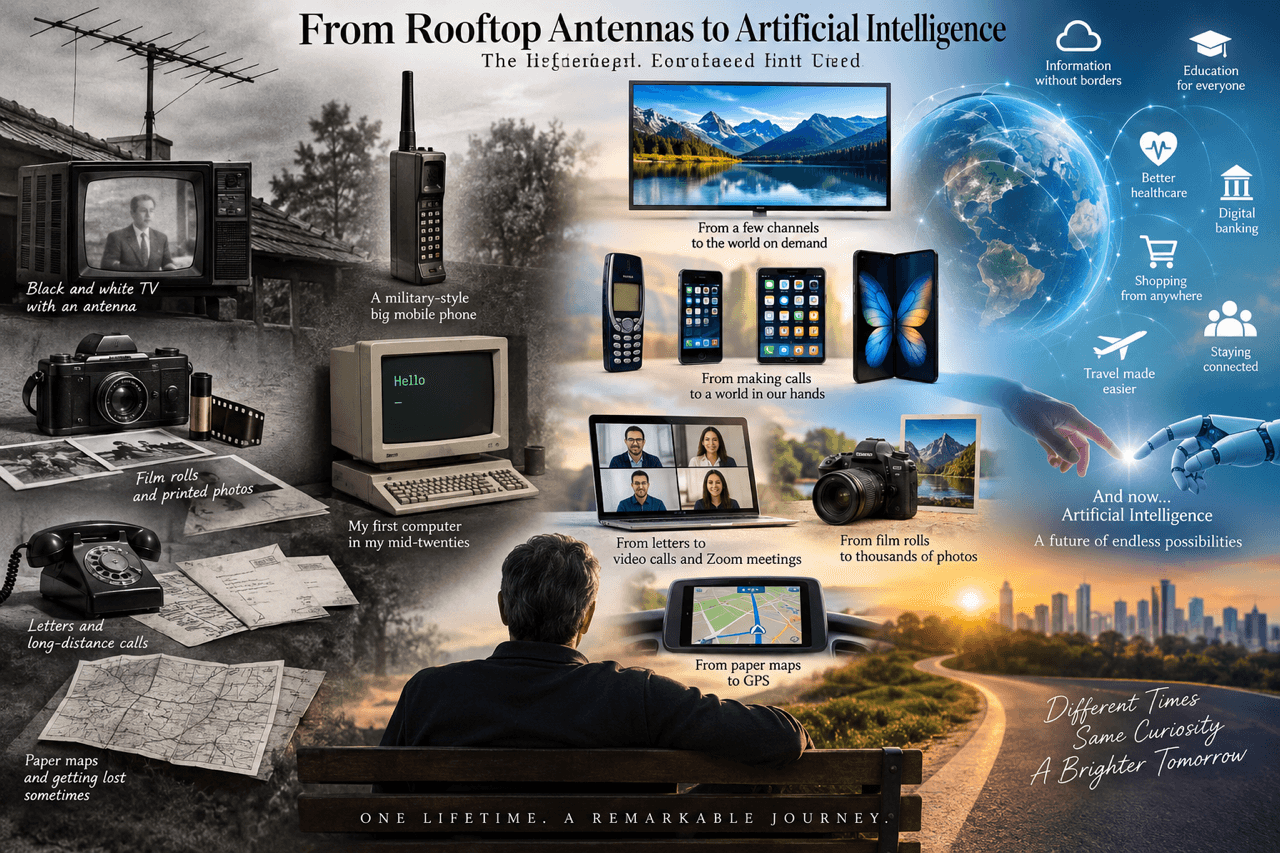
I remember black-and-white television.
I remember antennas on rooftops.
I remember film cameras.
I remember paper maps.
I remember letters and carefully planned long-distance telephone calls.
I remember the enormous early mobile phones that looked almost like military communication equipment.
And I remember encountering a computer for the first time when I was already in my mid-twenties.
There was no Google waiting to answer every question. There was no GPS calmly telling us where to turn. There was no FaceTime or WhatsApp connecting families across continents. There were no Zoom meetings bringing people from different countries around the same virtual table.
And there certainly was no artificial intelligence having a conversation with us.
Yet today, I can carry a device in my pocket that functions simultaneously as a telephone, computer, television, camera, map, newspaper, library, bank, office and meeting room.
And now I can communicate with artificial intelligence simply by speaking or typing ordinary sentences.
Sometimes I find myself asking:
Did all of this really happen within one lifetime?
It did.
And I have been fortunate enough to watch much of it unfold.
Black-and-White Television and the Rooftop Antenna
One of the clearest symbols of that earlier world is television.
Not a giant high-definition screen hanging almost invisibly on a wall.
Not Netflix.
Not YouTube.
Not hundreds of channels.
I remember black-and-white television—and the antenna on the roof.
Getting a good picture could sometimes depend upon the direction of that antenna. Reception wasn't always perfect. Weather could interfere. Pictures could become snowy or distorted.
And choices were limited.
Television programming happened according to someone else's schedule. If a program aired at a particular time, you watched it then. If you missed it, you missed it.
Then everything began changing.
Black-and-white became color.
Rooftop antennas were supplemented or replaced by cable and satellite systems.
Large, heavy television cabinets became thinner.
Then came flat screens.
High definition.
Digital television.
Smart televisions.
Streaming.
Today, we can sit in our homes and instantly choose from enormous libraries of movies, documentaries, sports, news and entertainment produced almost anywhere in the world.
We once asked:
"What is on television tonight?"
Today we ask:
"What do I want to watch?"
That difference represents something larger than better picture quality.
Technology transferred control from the broadcaster to the viewer.
When a Mobile Phone Looked Like Military Equipment
The transformation of the telephone has been even more extraordinary.
Some early mobile phones were enormous by today's standards. They looked almost like military-style communication equipment—a large box with a handset.
Yet the concept itself was revolutionary.
The telephone was no longer attached to a wall.
You could take it with you.
Then the equipment became smaller.
Eventually, we had handheld mobile phones.
Then came text messaging.
Screens improved.
Cameras appeared.
Internet access arrived.
Then touchscreens fundamentally changed our relationship with the device.
Eventually, the mobile phone stopped being primarily a telephone.
Think about everything today's smartphone has replaced or incorporated:
Camera
Video recorder
Calculator
Alarm clock
Calendar
Address book
Flashlight
Compass
Music player
Radio
Newspaper
Map
GPS
Boarding pass
Banking terminal
Television
Library
Photo album
Office
Meeting room
Increasingly, it is even replacing the wallet.
And now we are seeing foldable smartphones—screens that can literally change their physical shape.
We went from carrying a giant device simply to make a telephone call to carrying much of our personal and professional world in one hand.
I sometimes wonder whether we will even call these devices "phones" twenty years from now.
My First Computer
Against this background came another machine that would eventually change almost everything.
The computer.
I was in my mid-twenties when I first touched one.
Computers did not feel like today's intuitive devices. They were machines you had to learn.
There was something mysterious about watching information appear on a screen and realizing that this machine could store, calculate and manipulate information in ways that were completely new to most ordinary people.
I certainly could not have imagined where that first encounter would lead.
Today, computing is everywhere.
It is inside our phones.
Our automobiles.
Our televisions.
Our watches.
Our medical equipment.
Our businesses.
Our airplanes.
Our banking systems.
Our homes.
Computers became so successful that, in a sense, they began disappearing.
We no longer always recognize them as separate machines because computing has become embedded in everyday life.
Then the Internet Connected the World
The personal computer was revolutionary.
Connecting computers to one another changed civilization.
Before widespread internet access, obtaining information required effort.
Research might mean visiting a library, finding the correct books or journals and spending hours searching.
Communication naturally involved delays.
News traveled at a very different pace.
Then the internet arrived.
Suddenly, the computer sitting on a desk became a doorway to the world.
Email began replacing letters.
Websites became information centers.
Search engines transformed research.
Businesses created digital storefronts.
Universities placed educational resources online.
Governments began delivering services electronically.
Human knowledge became increasingly searchable.
For much of history, one of humanity's greatest problems was obtaining information.
Today, we have almost the opposite problem.
We are surrounded by information.
Our challenge is increasingly determining which information deserves our attention and trust.
From Film Rolls to Thousands of Photographs
Photography provides another remarkable example.
There was once a real limitation associated with taking photographs.
A roll of film contained only a certain number of exposures.
You thought before pressing the shutter.
Then you waited.
The film had to be developed before you knew whether the picture was good.
Maybe someone's eyes were closed.
Maybe it was blurry.
Maybe the lighting was wrong.
There was no delete button.
There was certainly no instant editing.
Digital cameras changed that.
Then smartphones changed it again.
Today, we can take hundreds or thousands of photographs, see them instantly, edit them immediately, store them electronically and send them around the world within seconds.
A photograph once had to physically travel.
Today, it can circle the world before the moment it captured is even over.
From Paper Maps to GPS
Travel provides one of my favorite examples of technological change.
We once unfolded paper maps.
We studied highways.
We wrote down directions.
We remembered landmarks.
We stopped at gas stations and asked strangers for help.
And sometimes we simply got lost.
Anyone who traveled extensively before GPS probably remembers missing an exit and realizing it miles later.
Today, I enter an address into my phone.
Within seconds, it determines my approximate position and calculates a route.
A voice tells me where to turn.
It estimates when I will arrive.
It can identify congestion and road closures and suggest another route.
And if I make a wrong turn?
It simply recalculates.
Think about the technology behind that ordinary experience: satellites, digital mapping, wireless communication, enormous databases and sophisticated software working together to tell us:
"Turn right in 500 feet."
Technology that once would have sounded like science fiction has become something we casually use to find a restaurant.
That is one of the remarkable characteristics of technological progress:
Yesterday's miracle quickly becomes today's normal.
From Letters to Seeing Someone Across the World
Communication may be where this transformation becomes most emotional.
There was a time when a long-distance or international telephone call was significant.
Families separated by continents could not simply see one another whenever they wished.
A letter might take days or weeks.
A telephone call might be planned because of cost and time differences.
You heard someone's voice, but you could not see their expression.
Today, someone sitting in Michigan can speak face-to-face with someone in India almost instantly.
Video communication through FaceTime, WhatsApp, Zoom and similar technologies has fundamentally changed what distance means.
Grandparents can watch grandchildren grow from thousands of miles away.
Families can participate in celebrations from different continents.
Students can learn remotely.
Healthcare professionals can conduct certain consultations virtually.
Businesses can bring people from several countries into one meeting without anyone boarding an airplane.
The COVID-19 pandemic accelerated the adoption of these technologies. Zoom meetings and virtual communication suddenly became part of everyday professional and educational life.
Technology did not eliminate physical distance.
But it dramatically reduced its control over human communication.
Banking, Shopping and Money Became Digital
Money changed too.
There was a time when daily transactions meant cash, checks, bank branches and paper statements.
Today, many people can go days without touching physical currency.
We transfer money electronically.
Deposit checks through a phone.
Pay bills automatically.
Purchase airline tickets online.
Reserve hotels in another country.
Order food from an app.
Tap a card or phone to make a purchase.
Something that once required standing in line at a bank can now happen while sitting on a couch.
Commerce has moved from the physical world into a combination of physical and digital experiences.
The remarkable part is not simply that transactions became faster.
It is that financial activity became increasingly integrated into everyday digital life.
Technology Transformed Healthcare
Having spent much of my professional life in healthcare, I find this transformation particularly meaningful.
Healthcare once revolved heavily around paper.
Paper charts.
Handwritten clinical notes.
Handwritten prescriptions.
Film X-rays.
Records stored in filing cabinets.
Today, electronic health records have transformed documentation. Medical imaging provides extraordinary detail. Telehealth can extend access in appropriate situations. Wearable devices can monitor aspects of activity and physiology. Robotic technologies assist in certain procedures.
Rehabilitation and physical therapy are evolving as well.
Digital outcome measurements, motion analysis, wearable sensors and remote monitoring are creating new opportunities to understand movement, function and recovery.
But technology should never become the purpose of healthcare.
The patient remains the purpose.
The best innovation is not necessarily the most sophisticated machine.
It is the innovation that solves a human problem.
Does it improve access?
Does it improve safety?
Does it provide clinicians with useful information?
Does it help someone regain mobility, independence or quality of life?
Technology should serve humanity—not the other way around.
And Then Came Artificial Intelligence
And now we have entered another extraordinary era.
Artificial intelligence.
For decades, our relationship with computers was largely based upon commands.
We had to learn how machines worked.
We learned software.
Menus.
Buttons.
Programming languages.
Commands.
Now something fundamentally different is happening.
Increasingly, machines are learning how to understand us.
We can communicate with artificial intelligence using ordinary human language.
We can ask questions.
Analyze information.
Translate languages.
Generate ideas.
Summarize documents.
Assist with writing.
Interpret patterns.
Create images.
Work with large amounts of data.
And we are probably still near the beginning of this technological chapter.
AI could accelerate scientific discovery, support healthcare, transform education and change how businesses operate.
But it also brings serious responsibilities.
Privacy matters.
Accuracy matters.
Ethics matter.
Human judgment matters.
The important question is no longer simply what artificial intelligence can do.
We also need to ask what we should ask it to do.
Technology may change.
Human responsibility does not disappear.
Technology Has Compressed Time and Distance
Looking across all these developments, I see one common theme.
Technology has compressed time and distance.
A letter that once took days or weeks became an email delivered in seconds.
An international telephone call became an instant video conversation.
A library search became an internet search.
A photograph that took days to develop became immediately available.
A paper map became real-time GPS navigation.
A visit to the bank became a few taps on a screen.
A meeting requiring travel sometimes became a Zoom call.
Technology has made information and communication extraordinarily fast.
But there is an interesting contradiction.
Human beings have not necessarily learned to think at the same speed at which information now travels.
And that brings us to another important question.
Are We More Connected—or Simply More Digital?
Technology deserves celebration.
But it also deserves reflection.
We have more ways to communicate than any previous generation.
Yet people can sit around the same dinner table looking at separate screens.
We may have hundreds or thousands of online connections while still experiencing loneliness.
We have access to enormous amounts of information, while misinformation can travel equally quickly.
We photograph almost everything, yet sometimes become so focused on recording an experience that we forget to experience it.
Work can follow us almost anywhere.
Technology has undoubtedly made us more connected.
But whether it makes us more human is something we decide through the way we use it.
What Would My Twenty-Five-Year-Old Self Think?
Sometimes I imagine going back and speaking with the young man who touched a computer for the first time.
I would tell him:
One day, you will carry a computer in your pocket.
It will also be your telephone.
Your camera.
Your television.
Your map.
Your newspaper.
Your library.
And your bank.
Satellites will guide your automobile.
You will take thousands of photographs without buying film.
You will see and speak with someone thousands of miles away instantly.
You will attend professional meetings without entering a meeting room.
You will have access to enormous amounts of human knowledge almost anywhere.
And one day, you will have conversations with artificial intelligence simply by speaking or typing ordinary sentences.
Would that young man have believed me?
Probably not.
It would have sounded like science fiction.
Yet here we are.
One Generation That Has Seen Two Worlds
Perhaps this is what makes my generation's technological experience so fascinating.
We remember life before the digital world dominated everyday life.
Yet we participate fully in that digital world today.
We remember black-and-white television with rooftop antennas, and now we watch high-definition streaming television.
We remember enormous mobile phones, and now we carry smartphones with folding screens.
We remember film cameras, and now our phones contain thousands of photographs.
We remember paper maps, and now satellites guide us turn by turn.
We remember letters and expensive long-distance calls, and now we video-call another continent instantly.
We remember searching libraries for information, and now enormous amounts of knowledge are accessible from our pockets.
We remember our first computer.
And now we communicate with artificial intelligence.
For younger generations, these technologies were waiting for them when they were born.
For my generation, we watched many of them being born.
That is an extraordinary perspective to have.
What Will We See Next?
After everything I have witnessed, perhaps the most fascinating question is not where technology has taken us.
It is:
Where is technology taking us next?
No one knows with certainty.
If someone had asked me when I first touched a computer to describe the world of 2026, I doubt I could have imagined smartphones, Google Maps, video calls, streaming television, social media, cloud computing or conversational artificial intelligence.
So predictions deserve humility.
But several directions are becoming visible.
Artificial Intelligence May Become an Everyday Companion
Today, we open different applications for different tasks.
Tomorrow, we may simply explain what we want.
"Plan my trip."
"Prepare me for tomorrow's meeting."
"Translate this conversation."
"Summarize these documents."
"Organize my day."
AI systems may increasingly coordinate tasks that currently require navigating numerous applications and websites.
The computer interface itself could become less visible.
The Smartphone May Eventually Disappear
The foldable phone may not be the destination.
It may simply be another step.
Lightweight smart glasses, wearable displays, advanced earbuds, voice interfaces or technologies that have not yet been invented could eventually reduce our dependence on the rectangular screen we currently carry everywhere.
Perhaps one day young people will look at today's smartphones the way today's generation looks at rotary telephones.
Language Barriers May Shrink
Imagine two people speaking different languages.
Each speaks naturally.
Each hears the other person in a language they understand almost instantly.
Real-time translation is already progressing, and future systems could make communication across languages increasingly natural.
Technology may not erase cultural differences—and should not—but it could make communication across those differences much easier.
Healthcare May Become More Predictive
This possibility particularly interests me.
Healthcare traditionally responds after something goes wrong.
Future medicine may increasingly identify meaningful changes earlier.
Wearables and other sensors could continuously gather information. AI could help healthcare professionals identify patterns that deserve attention.
Instead of only asking:
"What disease does this person have?"
Medicine may increasingly ask:
"What can we identify early enough to prevent or reduce future disease?"
The goal would not simply be living longer.
It would be remaining healthy, mobile, cognitively capable and independent for more of those years.
Robots May Become Ordinary
Robots may move beyond factories into ordinary life.
They could assist with logistics, agriculture, dangerous work, household tasks, rehabilitation and aspects of elder care.
The important question will again be how we design them to complement human beings rather than unnecessarily remove human interaction.
Transportation May Become Increasingly Autonomous
Automobiles already contain technologies that would have seemed astonishing only a few decades ago.
Future vehicles may handle increasing portions of driving.
Delivery systems may become more autonomous.
Transportation networks may communicate with one another in ways that improve safety and efficiency.
The automobile may eventually become less of a machine we continuously operate and more of a transportation environment we supervise or simply use.
Education Could Become Deeply Personalized
Imagine every student having access to an intelligent tutor that understands exactly where that student is struggling.
One student may need a concept explained visually.
Another may need repetition.
Another may need a practical example.
Another may be ready to advance more quickly.
AI could help personalize instruction while human teachers continue providing something technology cannot easily reproduce: mentorship, encouragement, judgment, social development and genuine human connection.
Scientific Discovery Could Accelerate
AI and advanced computing may help researchers examine possibilities that would take humans enormous amounts of time to investigate manually.
New medicines.
New materials.
Better energy systems.
Deeper understanding of biology.
Better approaches to disease.
The most important contribution of artificial intelligence may ultimately not be writing emails or answering questions.
It may be helping human beings discover things we previously could not discover.
Perhaps the Biggest Innovation Hasn't Even Been Imagined
This is the possibility I find most exciting.
The most transformative invention of the next thirty years may be something we currently have no name for.
Imagine asking someone decades ago to predict today's digital world.
They might have predicted better televisions.
Smaller telephones.
Faster computers.
But would they have predicted the entire ecosystem that eventually emerged?
Would they have imagined carrying one device containing a camera, GPS, bank, television, newspaper, library and video-conferencing system?
Would they have predicted ordinary people having conversations with artificial intelligence?
Probably not.
That is why predicting the future by simply improving today's technology can be misleading.
The greatest innovations often create possibilities we did not previously know we needed.
The Most Important Technology Is Still Human
After watching all of this change, I remain convinced of one thing.
Technology is extraordinarily powerful.
But it remains a tool.
GPS can tell us which road to take.
It cannot tell us what destination will give our life meaning.
A smartphone can connect us with thousands of people.
It cannot create genuine friendship.
High-definition television can show us the world.
It cannot teach us to appreciate it.
Artificial intelligence can process enormous amounts of information.
It cannot relieve human beings of our responsibility to exercise wisdom and judgment.
Healthcare technology can become extraordinarily sophisticated.
But a frightened patient may still need another human being to sit beside them and say:
"I am here."
That matters.
Perhaps it will matter even more in an increasingly technological world.
From Curiosity to Wonder
When I first touched a computer in my mid-twenties, I was curious.
Decades later, I am still curious.
But now that curiosity is mixed with wonder.
I have watched black-and-white television become high-definition digital television.
I have watched rooftop antennas give way to streaming.
I have watched giant mobile phones become powerful computers that fit in our hands.
I have watched film become digital photography.
I have watched paper maps become GPS.
I have watched letters become email and instant messaging.
I have watched international telephone calls become video conversations.
I have watched meeting rooms become Zoom screens.
I have watched libraries become accessible through a phone.
I have watched healthcare move from paper records toward digital and increasingly intelligent systems.
And now I am watching computers communicate with humans in ways that once belonged to science fiction.
It has all happened during one lifetime.
The first computer I touched in my mid-twenties was therefore not simply a machine.
Looking back, it was my first touch of a future that was already beginning to unfold.
And after everything I have witnessed, I have learned never to assume that today's limits will remain tomorrow's limits.
Human imagination repeatedly turns impossibilities into possibilities, possibilities into inventions and inventions into ordinary parts of everyday life.
Perhaps forty years from now, people will look back at 2026 and smile at what we considered advanced.
Maybe our smartphones will look primitive.
Maybe today's artificial intelligence will seem elementary.
Maybe healthcare will detect diseases before symptoms appear.
Maybe language barriers will barely interfere with communication.
Or perhaps the technology that changes everything has not even been imagined yet.
That may be the most exciting possibility of all.
I have lived from rooftop antennas to artificial intelligence.
Forty years ago, I could not have imagined the technological world I live in today.
Perhaps forty years from now, today's world will look equally primitive.
So when I ask myself—
"What will we see next?"
My answer is simple:
Probably more than we can imagine.
And I hope that whatever we invent next, we remember one thing:
The greatest measure of technological progress will never be how powerful our machines become. It will be how wisely we use them to improve human life.
— Dr. Vijay Kumar