From Bihar to a PhD: Education, Rural Development, and a Lifelong Commitment to Serving People
A personal reflection on education, rural development, perseverance, and why knowledge ultimately finds its greatest meaning in service.
A Milestone That Became Part of a Much Larger Journey
Some achievements become more meaningful as the years pass.
When I completed my Doctor of Philosophy (PhD) in Economics in 2002, I understood that I had reached an important academic milestone. More than two decades later, however, I see that achievement differently.
I no longer see only a degree.
I see the people and communities that inspired my research. I see the teachers and mentors who guided me. I see the long hours of study and research. I see Bihar—the place where my journey began.
And I see how the lessons I learned through economics and rural development would later influence the way I approached healthcare, public health, entrepreneurship, community development, and service.
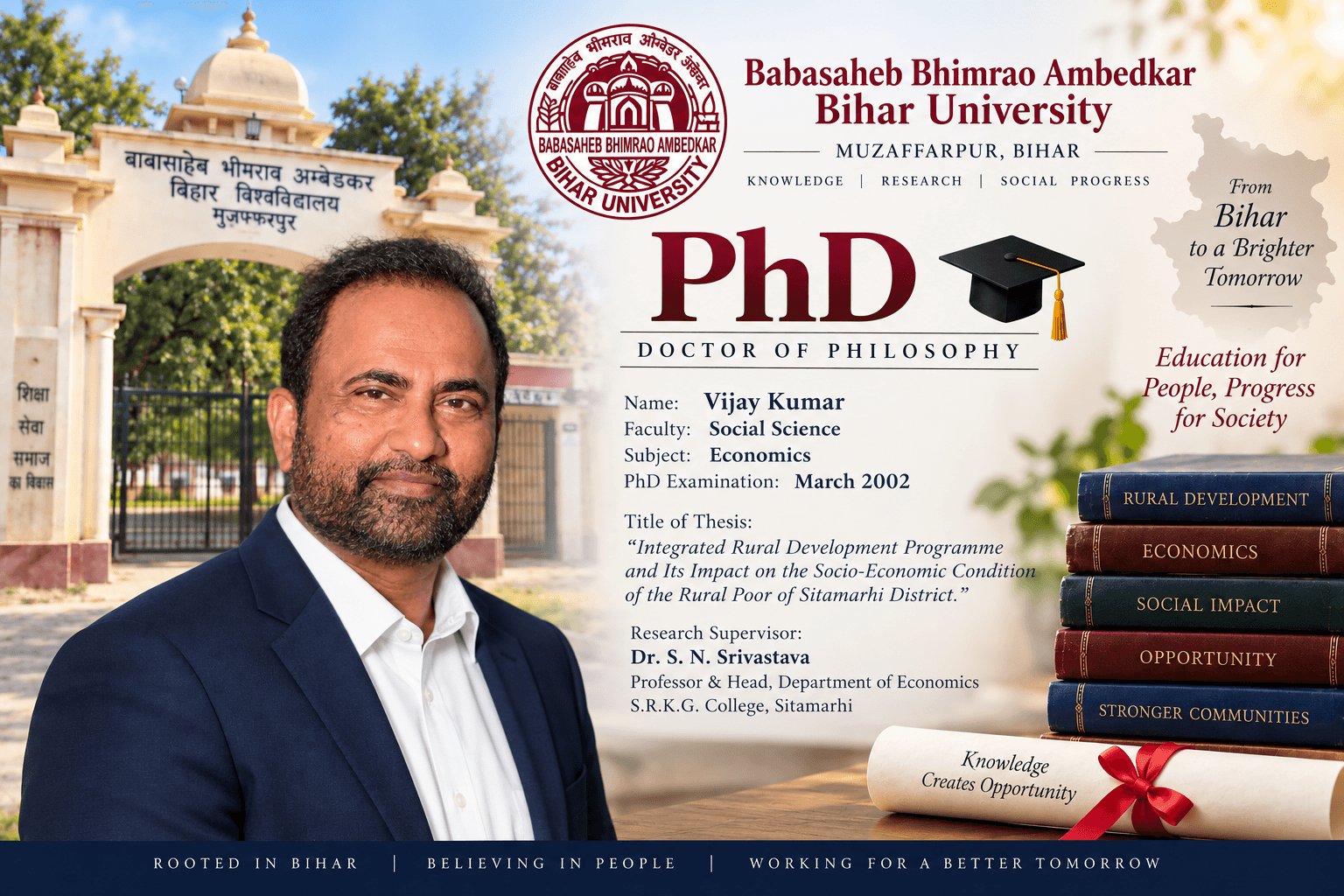
My doctoral thesis was titled:
“Integrated Rural Development Programme and Its Impact on the Socio-Economic Condition of the Rural Poor of Sitamarhi District.”
I pursued this research in the Faculty of Social Science, subject Economics, at B.R.A. Bihar University, Muzaffarpur, under the supervision of Dr. S. N. Srivastava, Professor and Head of the Department of Economics at S.R.K.G. College, Sitamarhi.
In March 2002, the university declared that I had passed the PhD examination.
Those facts appear on official documents.
But the most important part of the story cannot be captured by a certificate.
It is the story of why education matters, what research taught me about people, and why learning should ultimately lead to service.
My Roots in Bihar
My story begins in Bihar, India.
Bihar is a land of extraordinary history and intellectual heritage. It is also a place where generations of families have experienced poverty, limited resources, rural underdevelopment, and unequal access to opportunity.
Growing up with an understanding of these realities influenced the questions that interested me academically.
Economics was not simply about numbers.
Development was not simply about government reports.
Poverty was not merely a statistic.
Behind every statistic was a person.
Behind every poverty rate was a family.
Behind every employment figure was someone trying to provide food, education, security, and a better future for their children.
That understanding eventually became central to my doctoral research.
Why I Chose Rural Development for My PhD Research
My research focused on the Integrated Rural Development Programme and its impact on the socioeconomic condition of the rural poor in Sitamarhi District.
The subject was deeply meaningful to me because it addressed a fundamental question:
Do development programs actually improve the lives of the people they are designed to serve?
Governments can announce programs.
Budgets can be allocated.
Policies can be written.
Statistics can be published.
But ultimately, the true measure of any development program should be found in the lives of people.
Did a family's income improve?
Did employment opportunities increase?
Did people become more economically independent?
Were living conditions improved?
Did families gain greater access to resources and opportunity?
Did development actually reach those who needed it most?
These questions fascinated me then, and remarkably, similar questions continue to influence how I think today.
Sitamarhi Was More Than a Research Location
For academic purposes, Sitamarhi District was the geographical focus of my doctoral research.
But rural communities cannot be understood simply through numbers on a spreadsheet.
Development economics ultimately requires us to understand people.
Income matters.
Employment matters.
Land ownership matters.
Access to credit matters.
Education matters.
Infrastructure matters.
But so do dignity, opportunity, hope, independence, and the ability of families to imagine a better future.
That is one of the most important lessons I carried away from my research:
Development should never be measured only by how much money is spent. It should be measured by how much people's lives improve.
That principle would remain relevant long after my PhD was completed.
The Connection Between Economics and Healthcare
At first glance, economics and healthcare may appear to be very different disciplines.
My life's journey has taught me otherwise.
Healthcare is deeply connected to economics.
A person's health can be influenced by income, education, employment, housing, transportation, nutrition, environment, geography, and access to medical services.
A family struggling economically may delay healthcare.
A rural community without sufficient healthcare infrastructure may experience very different outcomes from a community with easy access to physicians, therapists, hospitals, and preventive services.
An elderly person may need treatment but lack transportation.
A working family may postpone care because of cost.
A rural patient may have to travel significant distances to obtain specialized services.
These are medical issues, but they are also socioeconomic issues.
My doctoral research taught me to look at systems.
My later experiences in healthcare and public health taught me to see the individual human beings living within those systems.
Together, these experiences shaped the way I understand community health and development.
From Rural Development to Public Health
Years after researching rural poverty and economic development, I continued studying and working in fields concerned with human well-being.
Public health asks many questions that would have sounded familiar during my economics research:
Why are some populations healthier than others?
Why do certain communities have better access to healthcare?
How does poverty affect health?
How does education influence quality of life?
How does geography affect access to services?
How can limited resources be allocated more effectively?
What interventions produce meaningful improvements in people's lives?
The language may change from one discipline to another, but the fundamental concern remains remarkably similar:
How do we create systems that give people a better opportunity to live healthy, productive, and dignified lives?
Looking back, I can see a connection between chapters of my life that might once have seemed unrelated.
The Mentor Behind the Research
No doctoral journey is completed entirely alone.
My PhD research was conducted under the supervision of Dr. S. N. Srivastava, Professor and Head of the Department of Economics at S.R.K.G. College, Sitamarhi.
A research supervisor does much more than approve a thesis.
A good mentor challenges assumptions.
A mentor asks difficult questions.
A mentor encourages intellectual discipline.
A mentor teaches a student to defend conclusions with evidence rather than confidence.
Research teaches us that believing something strongly does not make it true.
We must examine evidence.
We must question assumptions.
We must remain willing to revise our conclusions.
That intellectual discipline has value far beyond academia.
It is valuable in medicine.
It is valuable in business.
It is valuable in leadership.
And it is invaluable in life.
I remain grateful to the teachers, mentors, colleagues, friends, and family members who contributed in different ways to my educational journey.
No meaningful accomplishment is ever completely individual.
What a PhD Really Teaches
People often think that earning a PhD means becoming an expert.
That is partly true.
But doctoral education teaches something more profound:
The more you learn, the more you understand how much remains to be learned.
Research teaches intellectual humility.
You begin with questions.
You study what others have discovered.
You gather evidence.
You analyze.
You challenge assumptions.
You write.
You rewrite.
You defend your reasoning.
And sometimes you discover that your original assumption was wrong.
That is not failure.
That is learning.
One of the greatest dangers in life is becoming so confident in what we already know that we stop asking questions.
A genuine education should do the opposite.
It should make us more curious.
Behind Every Degree Is a Story Nobody Sees
A diploma is beautifully simple.
It contains a name.
A university.
A degree.
A subject.
A date.
But it cannot contain the entire journey.
It cannot show the hours spent studying.
It cannot show the books and research papers.
It cannot show frustration when progress was slow.
It cannot show revisions and corrections.
It cannot show competing responsibilities.
It cannot show moments of uncertainty.
And it cannot adequately recognize everyone who helped make the achievement possible.
This is true not only of doctoral education.
It is true of nearly every meaningful accomplishment.
We see the entrepreneur after the business succeeds.
We do not see every failed idea.
We see the physician wearing the white coat.
We do not see every night spent studying.
We see the athlete crossing the finish line.
We do not see the early mornings spent training.
We see the graduation photograph.
We rarely see the sacrifices behind the smile.
Achievement is visible. Perseverance usually happens in private.
Motivation Is Not Enough
One of the greatest lessons of a long educational journey is the importance of discipline.
Motivation is wonderful, but motivation changes from day to day.
Discipline is different.
Discipline means continuing even when you are tired.
Reading another page.
Examining another piece of evidence.
Revising another paragraph.
Correcting another mistake.
Returning tomorrow and doing it again.
Great accomplishments are usually constructed from very ordinary actions repeated consistently.
A PhD is completed one page at a time.
A business is built one decision at a time.
A community is strengthened one contribution at a time.
A marathon is completed one mile at a time.
And a life is built one day at a time.
March 2002: The Finish Line That Wasn't Really a Finish Line
In March 2002, when B.R.A. Bihar University declared that I had passed the PhD examination in Economics, I had reached an important destination.
But education has a wonderful way of turning destinations into beginnings.
Completing a doctorate did not make me think:
“Now I know enough.”
Instead, it strengthened my desire to continue learning.
Over the years, my interests and experiences expanded across healthcare, public health, physical therapy, entrepreneurship, leadership, community involvement, and service.
Looking backward, I understand that education is not necessarily a straight ladder where one degree simply leads to another.
It is more like a tree.
One branch leads toward another area of knowledge.
One experience creates curiosity about another.
One question produces several new questions.
And the roots continue supporting everything that grows afterward.
Never Allow Your Degree to Become a Boundary
One lesson I especially want younger people to understand is this:
Your education should expand your possibilities, not imprison you within a single identity.
Studying economics does not mean you can only think about economics.
Studying medicine does not prevent you from becoming an entrepreneur.
Studying engineering does not prevent you from becoming an educator.
A scientist can become a community leader.
A healthcare professional can study economics.
An entrepreneur can become a philanthropist.
Human beings are multidimensional.
Some of our greatest contributions emerge when knowledge from different disciplines intersects.
My journey across economics, healthcare, public health, business, and community service has reinforced that belief.
Life's problems do not arrive neatly labeled according to academic departments.
Neither should our thinking.
Education Should Ultimately Lead to Service
There comes a point when education must become about more than ourselves.
Degrees can create opportunities.
Education can improve careers.
Knowledge can create professional success.
But eventually we must ask:
What are we doing with what we have learned?
Can our education help someone else?
Can it strengthen a community?
Can it create employment?
Can it improve healthcare?
Can it mentor a young person?
Can it solve a problem?
Can it give someone an opportunity they otherwise might not have received?
These questions matter to me.
The value of education is not measured solely by the number of degrees hanging on a wall.
Its greatest value is found in what we do with the knowledge we have acquired.
Knowledge becomes most meaningful when it is transformed into service.
A Message to Students From Bihar and Rural India
There is a young person somewhere today sitting in a small town or village and wondering whether their dreams are realistic.
Perhaps they want to become a scientist.
A physician.
An economist.
An engineer.
A professor.
An entrepreneur.
A researcher.
Perhaps they want to study abroad.
Perhaps nobody in their family has ever earned a university degree.
Perhaps financial circumstances are difficult.
Perhaps opportunity seems far away.
To that young person, I would say:
Do not allow geography to determine the size of your dream.
Where you begin is part of your story.
It does not have to become the boundary of your future.
Your road may be harder than someone else's.
You may have fewer resources.
You may encounter failures.
You may need to change direction.
You may sometimes feel that progress is painfully slow.
Keep moving.
Education cannot guarantee that every dream will come true.
But education can dramatically expand the number of dreams you are capable of pursuing.
More Than Two Decades Later
When I look at my PhD documents today, more than two decades after completing the examination, I see something different from what I saw in 2002.
Then, I saw an accomplishment.
Today, I see continuity.
I see how studying rural development helped shape my understanding of socioeconomic inequality.
I see how economics connected naturally with public health.
I see how questions about access and opportunity followed me into healthcare.
I see how understanding resources became important in business and entrepreneurship.
I see how community development and community healthcare share a common principle:
People need opportunity close to where they live.
Most importantly, I see that education did not give me all the answers.
It taught me to continue asking better questions.
From Bihar to Wherever Life Takes Us
I remain proud of where my journey began.
Bihar gave me roots.
Education gave me opportunities.
Teachers gave me guidance.
Experience gave me perspective.
Challenges gave me resilience.
And life continues giving me reasons to learn.
I have traveled far from the place where my academic journey began, but distance does not erase one's roots.
If anything, it makes us appreciate them more.
There is a beautiful lesson in that:
Your roots and your dreams do not have to compete with each other.
You can remain deeply connected to where you came from while continuing to explore where life might take you.
My PhD Was Never Just About Three Letters
Today, the letters PhD appear after my name.
But those three letters mean something different to me now.
They remind me of Bihar.
They remind me of Economics.
They remind me of Sitamarhi.
They remind me of rural communities and the questions that shaped my research.
They remind me of my teachers and mentor.
They remind me of perseverance.
They remind me that knowledge carries responsibility.
And above all, they remind me that education is never truly finished.
A doctorate may be called a terminal degree.
I have never considered learning terminal.
There is always another book.
Another idea.
Another technology.
Another perspective.
Another generation from whom we can learn.
Another person we can teach.
Another problem waiting to be solved.
Keep Learning. Keep Growing. Keep Serving.
If there is one message I would like my PhD journey to leave with others, it is this:
Do not measure education simply by the degrees you collect. Measure it by the person you become and the people you are able to help because of what you learned.
Be ambitious, but remain humble.
Seek knowledge, but also seek wisdom.
Celebrate your accomplishments, but remember those who helped you achieve them.
Never be embarrassed by humble beginnings.
Never believe you are too old to learn.
Never assume failure means the journey is over.
And never allow success to convince you that you have learned enough.
In March 2002, I completed an important academic chapter when I passed my PhD examination in Economics at B.R.A. Bihar University, Muzaffarpur.
But that chapter did not close the book.
It opened another one.
And more than two decades later, I remain convinced that one of life's greatest privileges is simply this:
To keep learning.
To keep growing.
To keep serving.
And to use whatever knowledge we acquire to leave people's lives—and our communities—a little better than we found them.
The degree was a milestone. The journey continues.
— Vijay Kumar, PhD
Doctor of Philosophy — Social Science (Economics)
B.R.A. Bihar University, Muzaffarpur
PhD Examination — March 2002
Doctoral Research: Integrated Rural Development Programme and Its Impact on the Socio-Economic Condition of the Rural Poor of Sitamarhi District
“Education becomes truly meaningful when knowledge moves beyond the individual and becomes a source of opportunity, service, and positive change for others. A degree may mark a milestone, but the real journey begins with what we choose to do with what we have learned.”
— Dr. Vijay Kumar