Driving Into the Future: Innovation, Sustainability, and the Courage to Embrace Change
The Future Doesn't Belong to Those Who Predict It—It Belongs to Those Who Build It.
"Innovation is never simply about creating better technology. It is about creating a better future for people."
Some photographs capture a destination.
Others preserve a memory.
Every once in a while, however, a photograph captures something much deeper.
It captures a philosophy.
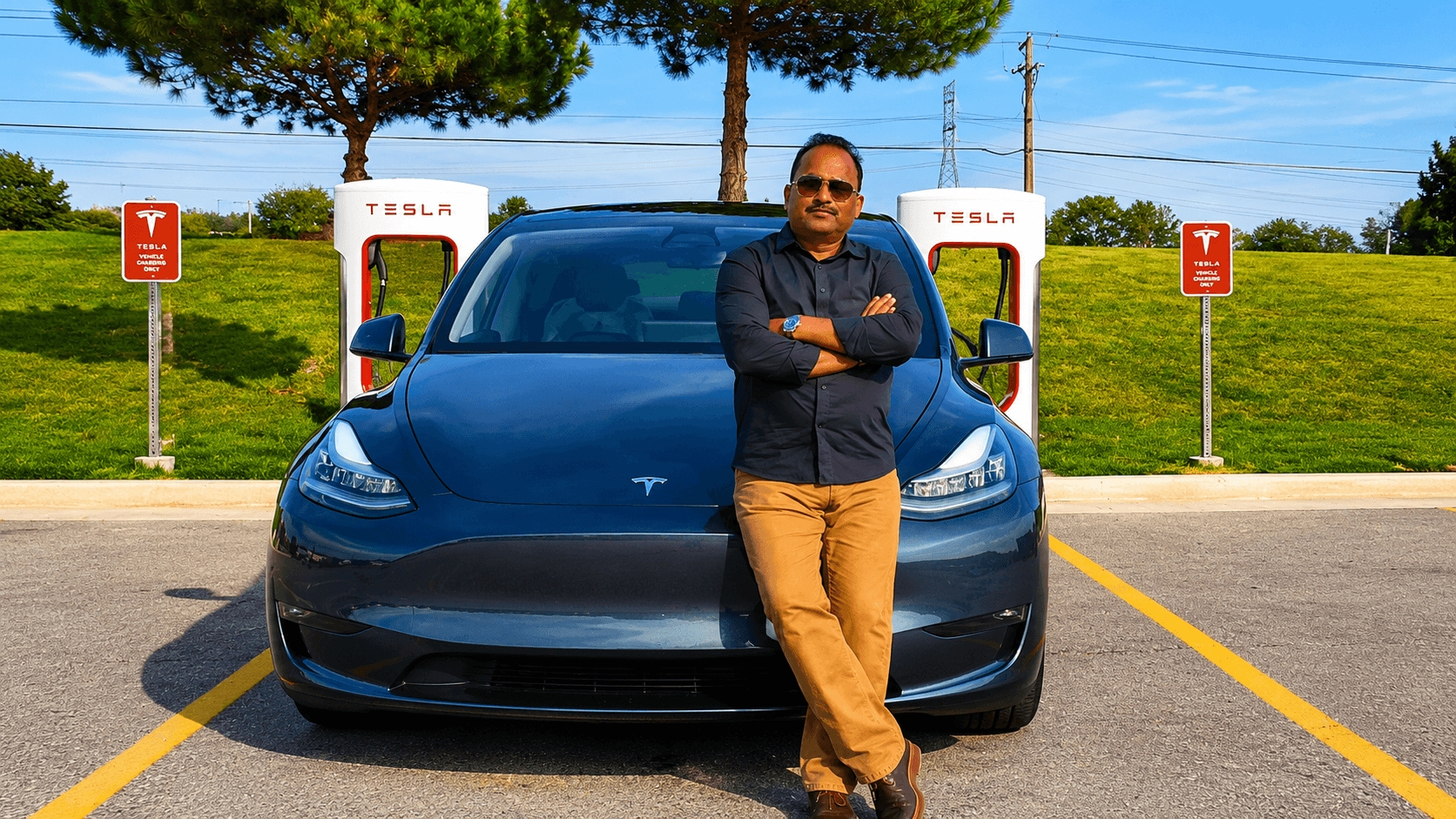
When I stood beside an electric vehicle at a Tesla Supercharger, I wasn't thinking about horsepower, acceleration, or the latest automotive technology.
I wasn't celebrating a purchase.
Nor was I trying to showcase a particular brand.
My thoughts were somewhere entirely different.
I was thinking about progress.
About humanity's remarkable ability to reinvent itself.
About how every generation eventually arrives at the same defining crossroads:
Remain comfortable with yesterday's solutions, or embrace tomorrow's possibilities.
Standing there, I realised that the vehicle behind me represented far more than transportation.
It symbolised a mindset that has quietly shaped every chapter of my own journey—a willingness to remain curious, continue learning, and move forward even when the destination is uncertain.
Throughout my career as a physician, I have witnessed medicine transform from handwritten records to electronic health systems, from traditional consultations to telemedicine, and now to artificial intelligence supporting clinical decision-making.
As an entrepreneur and co-founder of Weboraz, I have seen digital transformation redefine how businesses communicate, innovate, and solve increasingly complex problems.
As a traveller, I have discovered that every nation embraces progress differently, yet every society flourishes when innovation is guided by responsibility rather than fear.
The electric vehicle behind me is only one symbol of that larger story.
The real story is about the road ahead.
Every Generation Has Its Revolution
History is remembered not only through wars and political movements but also through technological revolutions that quietly reshape everyday life.
There was a time when electricity itself was viewed with suspicion.
Candles had illuminated homes for centuries.
Many questioned whether electric lighting was truly necessary.
The automobile was dismissed as impractical compared with horses.
Commercial aviation appeared unrealistic.
Television seemed unnecessary.
Personal computers were considered specialised tools for scientists.
The internet was viewed as an interesting experiment.
Smartphones were criticised as expensive distractions.
Today, each of these innovations has become woven into daily life.
Innovation follows a remarkably familiar pattern.
First, it is ignored.
Then, it is criticised.
Eventually, it is accepted.
Finally, it becomes indispensable.
Electric mobility represents the latest chapter in that ongoing story.
Debates surrounding charging infrastructure, battery technology, sustainability, and economics will undoubtedly continue.
Healthy debate has always accompanied meaningful progress.
Yet one reality remains constant.
Humanity has never stopped searching for better ways to solve old problems.
Innovation has never demanded perfection.
It has always demanded improvement.
Progress Begins With Curiosity
One lesson has remained constant throughout every stage of my professional journey.
Curiosity is more valuable than certainty.
When I began my career, I could never have predicted that my path would eventually connect medicine, research, public health, entrepreneurship, technology, leadership, and international travel.
Each chapter required different skills.
Medicine demanded compassion.
Research required patience.
Public health encouraged systems thinking.
Entrepreneurship strengthened resilience.
Technology required continuous learning.
Travel cultivated humility.
Rather than replacing one another, these experiences gradually complemented each other, creating a broader understanding of how meaningful innovation truly develops.
Innovation is not reserved for engineers, scientists, or inventors.
It belongs to anyone willing to ask one simple question:
"Can this be done better?"
That question has inspired every meaningful advancement throughout human history.
Curiosity remains the starting point of every breakthrough.
The Lesson Hidden Inside a Charging Station
To many people, a charging station is simply a place where an electric vehicle replenishes its battery.
To me, it represents something much more profound.
It symbolises infrastructure built not only for today's needs but for tomorrow's possibilities.
Every charging station reflects faith in the future.
Someone invested resources today because they believed tomorrow would look different.
That principle extends far beyond transportation.
Hospitals purchase advanced medical equipment years before it becomes essential.
Universities educate students who will solve problems that do not yet exist.
Entrepreneurs devote years to developing products long before customers discover them.
Parents invest countless hours raising children without knowing exactly who they will become.
Farmers plant seeds months before harvest.
Meaningful progress has always required patience before reward.
The charging station quietly reminds us that the future is rarely created overnight.
It is built gradually by those willing to prepare before everyone else recognises the opportunity.
Innovation Is About People, Not Machines
One of the greatest misconceptions surrounding technology is that it exists to replace people.
The opposite is often true.
The most meaningful innovations amplify human potential.
Artificial intelligence does not replace compassionate physicians.
It helps them make better-informed decisions.
Cloud computing does not eliminate teamwork.
It enables collaboration across continents.
Digital communication has not diminished relationships.
It has expanded the ways people connect.
Technology itself possesses neither wisdom nor purpose.
Those qualities come from the people who create it and the people who use it.
Whether we work in healthcare, education, business, or public service, our responsibility extends beyond adopting innovation.
We must ensure that innovation serves humanity with integrity, ethics, and compassion.
Technology without purpose quickly becomes novelty.
Technology guided by purpose changes lives.
Learning Never Has an Expiration Date
One of the greatest misconceptions in modern society is that education ends with graduation.
In reality, graduation simply marks the beginning of independent learning.
Some of the most inspiring individuals I have met across the world share one remarkable characteristic.
They never stop being students.
They read relentlessly.
They ask thoughtful questions.
They challenge assumptions.
They remain open to perspectives different from their own.
Most importantly, they understand that knowledge compounds over time.
The world is changing too quickly for anyone to rely solely on yesterday's expertise.
Whether we are physicians learning how artificial intelligence can support clinical decisions, entrepreneurs adapting to digital transformation, educators embracing new teaching methods, or travellers discovering unfamiliar cultures, continuous learning has become essential.
The future belongs not to those who know everything.
It belongs to those who never stop learning.
Sustainability Is More Than Protecting the Environment
When people hear the word sustainability, they often think only about renewable energy, electric vehicles, or reducing carbon emissions.
Those efforts are undeniably important.
But sustainability extends much further.
Sustainable healthcare means preventing disease rather than simply treating illness.
Sustainable businesses create long-term value rather than chasing short-term profit.
Sustainable leadership develops future leaders instead of depending on one individual.
Sustainable communities invest in education, innovation, and opportunity.
Electric mobility represents only one visible example of a much larger philosophy.
It reminds us that every generation has a responsibility to leave the world slightly better than it inherited it.
Progress should never be measured solely by what we build.
It should also be measured by what we preserve.
Innovation becomes meaningful when it creates lasting benefits for both people and the planet.
What Healthcare Can Learn From Innovation
Few industries evolve as rapidly—or carry as much responsibility—as healthcare.
Every advancement has the potential to improve, or even save, lives.
Throughout my career, I have watched medicine transform in remarkable ways.
Electronic health records have improved continuity of care.
Telemedicine has connected physicians with patients separated by thousands of miles.
Artificial intelligence is beginning to assist clinicians by analysing complex data, identifying patterns, and supporting earlier diagnoses.
Yet every technological breakthrough has reinforced one important truth.
Technology should never replace compassion.
It should strengthen it.
The physician's greatest responsibility remains unchanged.
To listen.
To understand.
To care.
Innovation is most powerful when it allows healthcare professionals to spend more time with patients rather than more time with paperwork.
The future of medicine will not be defined solely by smarter machines.
It will be defined by wiser use of those machines.
Artificial Intelligence: A Tool, Not a Replacement
Artificial intelligence has become one of the defining innovations of our generation.
Like every major technological advancement before it, it has generated both excitement and uncertainty.
Some fear it will replace professions.
Others believe it will solve every problem.
Reality lies somewhere between those extremes.
AI is neither magic nor a threat.
It is a tool.
Just as the stethoscope expanded a physician's ability to diagnose, artificial intelligence expands our ability to analyse information.
It can process enormous amounts of data in seconds.
It can recognise patterns that humans may overlook.
It can automate repetitive tasks.
What it cannot replace is wisdom.
Judgement.
Ethics.
Empathy.
Those qualities remain uniquely human.
The future will belong to professionals who understand how to combine technology with humanity rather than choosing one over the other.
Building Weboraz: Embracing Digital Transformation
When we founded Weboraz, our vision extended beyond creating websites or software.
We wanted to help businesses navigate an increasingly digital world with confidence.
Technology should never exist simply because it is fashionable.
It should solve meaningful problems.
Whether building websites, mobile applications, custom software, or AI-powered solutions, our objective has always been the same.
Simplify complexity.
Improve efficiency.
Create better experiences.
The principles remain remarkably similar to those represented by the charging station standing quietly behind an electric vehicle.
Prepare today for tomorrow's opportunities.
The organisations that thrive over the next decade will not necessarily be the largest.
They will be the ones most willing to adapt.
Leadership During Times of Disruption
Every generation experiences moments that redefine normality.
Economic shifts.
Global pandemics.
Technological revolutions.
Changing customer expectations.
True leadership becomes visible during periods of uncertainty.
Leaders who resist every change often become guardians of yesterday.
Leaders who embrace every trend without reflection risk losing direction.
The strongest leaders find balance.
They remain open to innovation while remaining grounded in timeless values.
Integrity.
Compassion.
Responsibility.
Purpose.
Technology changes.
Human values endure.
Leadership requires both.
Lessons From Traveling Around the World
One of the greatest privileges of international travel is witnessing how differently societies approach progress.
Switzerland demonstrated precision.
Japan taught discipline.
Mexico celebrated creativity.
India revealed how ancient wisdom can coexist beautifully with modern innovation.
Every destination reinforced the same lesson.
There is never only one way to solve a problem.
Every culture contributes something valuable to humanity's collective knowledge.
The entrepreneur observes.
The physician listens.
The traveller learns.
When these three perspectives come together, innovation becomes much more thoughtful.
The world becomes not simply a collection of destinations, but a collection of ideas.
Age Should Never Limit Learning
One of the most inspiring observations I have made throughout my travels is that curiosity has no age limit.
Some people stop learning shortly after graduation.
Others remain students throughout their lives.
The difference has little to do with age.
It has everything to do with attitude.
Every decade brings new technologies.
New industries.
New opportunities.
The willingness to learn determines whether change becomes an obstacle or an opportunity.
Experience provides wisdom.
Curiosity ensures that wisdom continues growing.
Together, they become one of life's greatest strengths.
Practical Ways to Embrace Innovation
Innovation does not require extraordinary resources.
It begins with everyday habits.
Read something outside your profession.
Travel somewhere unfamiliar.
Ask better questions.
Listen more carefully.
Challenge assumptions.
Experiment without fearing failure.
Surround yourself with people who think differently.
Remain curious even when you believe you already understand.
Small habits consistently practised often produce remarkable transformations.
Innovation is rarely one dramatic breakthrough.
It is usually thousands of small improvements accumulated over time.
A Personal Reflection
Standing beside that electric vehicle, I realised the photograph was never truly about the car.
It was about possibility.
Every meaningful chapter of my life has begun with uncertainty.
Medicine.
Research.
Public health.
Entrepreneurship.
Technology.
International travel.
Each required the courage to begin before every answer was known.
Looking back, I have never regretted embracing change.
I have only regretted the opportunities I hesitated to pursue.
Progress has never asked us to abandon our values.
It simply asks us to apply those values to a changing world.
Final Thoughts
The future is often imagined as a distant destination waiting somewhere beyond the horizon.
In reality, the future is quietly built through the decisions we make today.
Every innovation begins with curiosity.
Every breakthrough begins with a question.
Every meaningful change begins with someone willing to believe that improvement is possible.
Standing beside an electric vehicle reminded me that technology alone does not move humanity forward.
People do.
Vision does.
Courage does.
The willingness to learn, adapt, and continue building a better tomorrow has always been the driving force behind human progress.
The road ahead will undoubtedly present new challenges.
New discoveries.
New opportunities.
The question is not whether change will come.
It always does.
The question is whether we will have the courage to grow alongside it.
"The future is not a place we eventually arrive at. It is something we build every day through curiosity, compassion, innovation, and the courage to embrace change. Every step forward begins with a single decision to keep learning." — Dr. Vijay Kumar