Detroit International Marathon: Beyond the Finish Line, a Journey of Endurance, Determination, and Human Spirit
A personal reflection on running, healthy aging, international friendship, and the unforgettable feeling of crossing the finish line in Detroit
Introduction: Every Finish Line Has a Story
There are moments in life when a photograph captures much more than what the camera sees. It captures years of discipline, countless early mornings, physical challenges, personal determination, and the quiet satisfaction of accomplishing something meaningful.
For me, participating in the Detroit International Marathon is one of those experiences.
Looking at my photographs from the event, I see much more than a runner wearing a medal. I see a celebration of life, health, perseverance, and the remarkable ability of the human body and mind to overcome challenges.
I see thousands of people from different backgrounds, ages, professions, and nationalities coming together with a common purpose: to challenge themselves and cross a finish line.
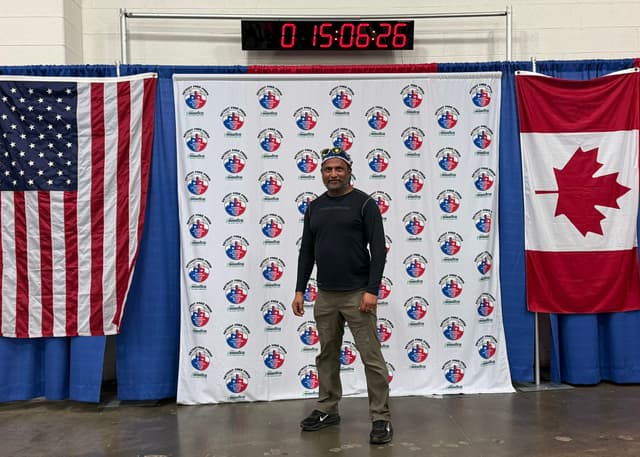
I see the American and Canadian flags standing proudly beside each other, representing friendship between two neighboring nations.
And perhaps most importantly, I see a reminder that growing older does not mean abandoning our ambitions.
It means learning how to pursue them with greater wisdom, patience, and appreciation.
Running has been part of my life for many years. From participating in 5K and 10K races to half-marathons and full marathons, I have always believed that physical activity is not simply a recreational choice. It is an investment in our future health.
The Detroit International Marathon beautifully represents that philosophy.
It is not merely a race through city streets. It is a journey through determination, international friendship, personal resilience, and the extraordinary human spirit.
Detroit: A City That Understands Endurance
Detroit is a city with a remarkable history.
Known worldwide as the Motor City, Detroit helped transform modern transportation through the automobile industry. Its factories, workers, entrepreneurs, and innovators contributed significantly to the economic development of the United States.
Yet Detroit's story has never been limited to automobiles.
It is also a story of reinvention.
Over the decades, the city has experienced economic prosperity, industrial decline, population changes, financial difficulties, and significant revitalization.
Through these challenges, Detroit has continued moving forward.
In many ways, that makes Detroit an ideal setting for an endurance race.
A marathon runner understands something about struggle.
There are moments when the legs become tired, breathing becomes more demanding, and the mind begins questioning whether continuing is worthwhile.
Yet the runner keeps moving.
Detroit has demonstrated a similar spirit throughout its history.
The city's ability to recover, adapt, and reinvent itself reflects the same determination that endurance athletes carry within themselves.
As I walked through downtown Detroit during the marathon activities, I felt that connection.
The buildings, streets, spectators, volunteers, and runners collectively created an atmosphere of optimism.
The city was not simply hosting a sporting event.
It was celebrating perseverance.
A Marathon That Connects Two Countries
One of the most distinctive features of the Detroit Free Press Marathon is its international character.
The event is famous for its cross-border course, which has historically taken runners between Detroit, Michigan, and Windsor, Ontario, through the Detroit–Windsor Tunnel and across the Ambassador Bridge. The exact route and border crossings can vary by year.
Very few running events offer participants the opportunity to experience two countries during a single race.
For runners, this creates a special sense of excitement.
The international nature of the event also carries a broader message.
The United States and Canada share one of the world's most important bilateral relationships. Their economic, cultural, educational, and family connections extend far beyond the physical border.
During marathon weekend, those connections become visible through sport.
In one of my photographs, I am standing between the American and Canadian flags. Behind me is the Detroit Free Press Marathon backdrop, with a digital race clock above it.
The symbolism of those two flags is meaningful.
They remind us that sport can bring people together regardless of nationality.
Running does not require everyone to speak the same language, practice the same religion, or share the same cultural traditions.
It requires a willingness to participate, respect others, and challenge oneself.
At a time when international relations are frequently discussed through politics, economics, and disagreements, events such as this remind us of the human relationships that connect nations.
A marathon may not solve global problems, but it demonstrates how shared experiences can build understanding and goodwill.
The Atmosphere of Marathon Day
Anyone who has participated in a major running event understands that race day begins long before the starting signal.
There is anticipation. There is excitement. There may also be anxiety.
Runners arrive carrying months of preparation, personal expectations, and sometimes private stories that nobody else knows.
Some are experienced marathoners hoping to improve their finishing times. Others are first-time participants who simply want to complete the distance. Some run in memory of loved ones. Some run to raise awareness for charitable causes. Others participate after recovering from illness, injury, or difficult personal circumstances.
Every runner has a story.
What I appreciate most about these events is that, for a few hours, ordinary social distinctions seem less important.
Professional titles, income levels, educational qualifications, and social status do not determine who deserves encouragement.
Everyone faces the same road. Everyone must move forward using their own physical and mental strength.
The crowd becomes a community.
Spectators cheer for strangers. Volunteers offer assistance without expecting anything in return. Fellow runners encourage one another, particularly during difficult moments.
There is something deeply reassuring about witnessing thousands of people supporting a shared goal.
It reminds me that despite the divisions we sometimes see in society, cooperation and kindness remain powerful human qualities.
The Finish Line: A Moment Beyond Words
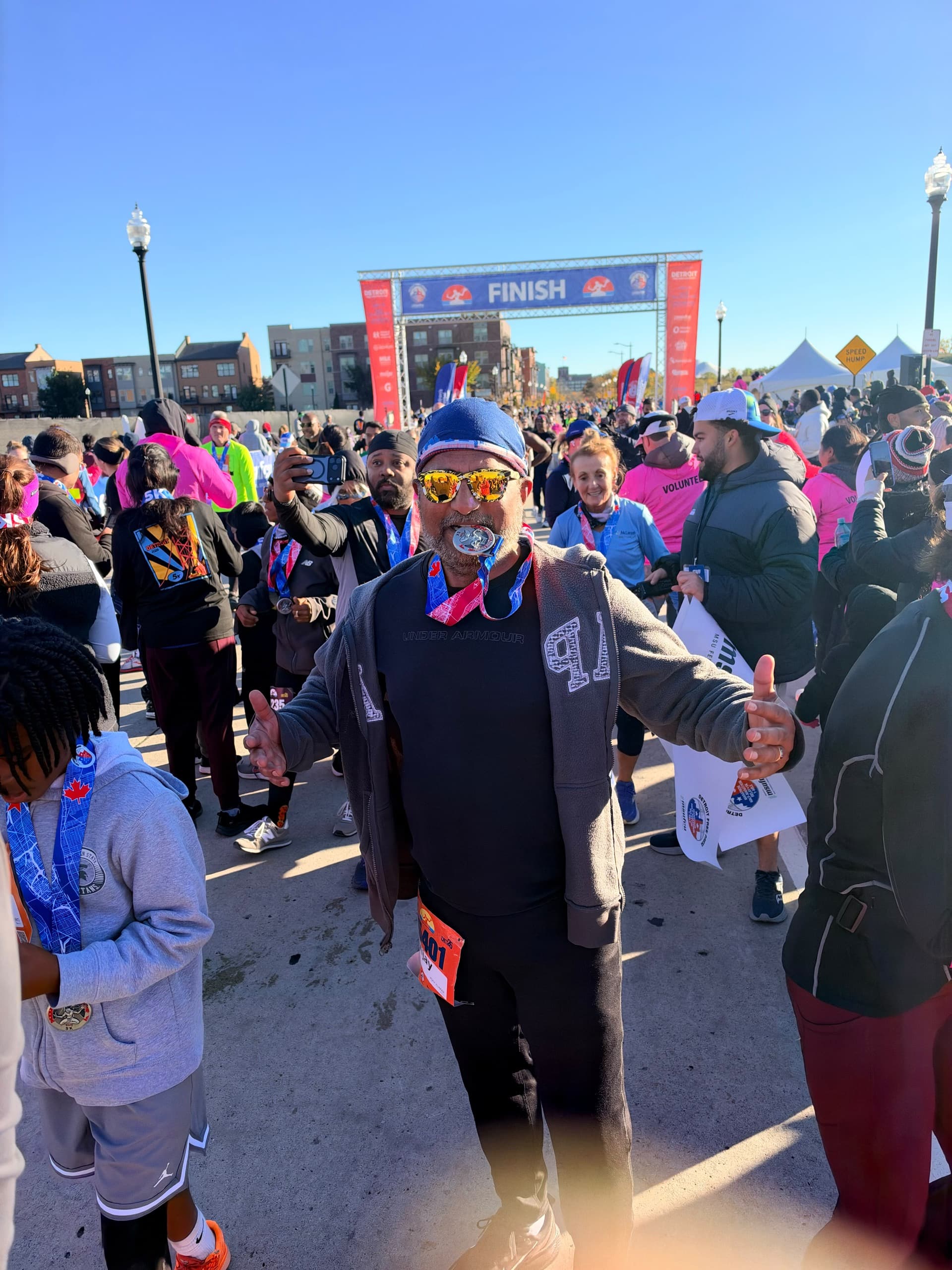
My photograph at the Detroit finish area, celebrating with my medal.
Of all the photographs from the event, the one near the finish line is particularly memorable.
I am standing with my arms extended, wearing my medal and sunglasses, surrounded by fellow runners and volunteers.
Behind me, the large FINISH banner marks the completion of an extraordinary effort.
The photograph captures a moment of happiness, but the meaning extends far beyond that single instant.
A finish line represents commitment fulfilled.
It is the visible conclusion of an invisible process.
Nobody watching a runner cross the finish line can fully appreciate the countless decisions that brought that person there.
They do not see the mornings when the runner preferred to stay in bed. They do not see the training sessions completed despite fatigue. They do not see the adjustments made to daily routines, meals, social commitments, and personal schedules. They do not see the doubts that sometimes arise during preparation.
The medal is therefore more than a decorative object.
It represents consistency. It represents discipline. It represents a promise made to oneself and honored through action.
For me, that is the real significance of endurance running.
It teaches us that meaningful achievements rarely happen overnight. They develop through repeated effort.
The finish line is not where the journey begins.
It is where preparation becomes visible.
Running and the Science of Healthy Aging
My appreciation for running is also deeply connected to my professional background in medicine, public health, rehabilitation, and physical therapy.
Over the years, I have become increasingly convinced that regular physical activity is among the most valuable investments individuals can make in their long-term health.
Exercise influences nearly every major system of the human body. It supports cardiovascular function, metabolic regulation, musculoskeletal health, mental well-being, and functional independence.
However, the benefits extend beyond simply reducing the risk of disease.
Physical activity can help preserve our ability to participate meaningfully in everyday life.
As we age, maintaining mobility becomes increasingly important.
The ability to walk independently, climb stairs, travel, play with grandchildren, participate in community activities, and perform daily tasks contributes significantly to quality of life.
Exercise helps protect these abilities.
Cardiovascular benefits
During running, the cardiovascular system responds to increased metabolic demand.
Heart rate rises, blood circulation increases, and working muscles receive additional oxygen and nutrients.
With consistent aerobic training, the body develops physiological adaptations that improve endurance. These may include increased stroke volume, improved oxygen utilization, and enhanced cardiovascular efficiency.
Regular aerobic exercise is associated with lower risks of cardiovascular disease, hypertension, and premature mortality. It can also improve blood pressure control, insulin sensitivity, and lipid profiles.
However, exercise must be appropriate for the individual's health status.
More exercise is not automatically better, and marathon participation is not necessary to obtain cardiovascular benefits.
For many individuals, brisk walking, swimming, cycling, or moderate recreational activity can provide substantial health advantages.
Preserving muscle strength and function
Aging is frequently accompanied by a gradual decline in skeletal muscle mass and strength.
This process, commonly associated with sarcopenia, can affect balance, mobility, and independence.
Running challenges the lower-extremity muscles, including the quadriceps, hamstrings, calves, and gluteal muscles.
However, running alone does not provide all the muscular benefits needed for healthy aging.
Resistance training is equally important.
Strengthening exercises help preserve muscle mass, improve joint stability, and support functional performance.
I strongly believe in combining cardiovascular activity with resistance training, flexibility exercises, and appropriate recovery.
A balanced fitness program is generally more sustainable than relying exclusively on one type of exercise.
Metabolic health
Regular exercise improves the body's ability to use glucose efficiently.
Muscle contractions stimulate glucose uptake and contribute to better insulin sensitivity.
Over time, consistent physical activity can support weight management and reduce the risk of developing type 2 diabetes.
Exercise also contributes to improved metabolic flexibility, allowing the body to use available energy sources more effectively.
These benefits are especially relevant in societies experiencing rising rates of obesity, diabetes, and sedentary behavior.
From a public health perspective, promoting physical activity is not simply about encouraging athletic achievement.
It is about preventing disease and preserving independence.
The Mental Strength Behind Every Mile
Running is often described as a physical activity, but anyone who has trained for an endurance event knows that the psychological component is equally important.
The body and mind constantly communicate during prolonged exercise.
As fatigue develops, the brain interprets signals related to discomfort, effort, temperature, energy availability, and emotional state.
A runner must learn to distinguish between ordinary exertion and warning signs that require slowing down or stopping.
This is where experience becomes valuable.
Endurance training can develop patience, concentration, emotional regulation, and confidence.
It teaches individuals how to manage discomfort without becoming overwhelmed by it.
It also demonstrates that progress does not always occur in a straight line.
Some training days feel excellent. Others feel disappointing. Sometimes the body performs better than expected. Sometimes it demands additional rest.
Learning to accept these variations is part of becoming a mature athlete.
I believe these lessons apply directly to everyday life.
Professional careers, family responsibilities, personal relationships, and major life goals all require persistence.
There will always be obstacles. There will always be unexpected setbacks.
The important question is how we respond.
Running teaches us that we do not need to solve every challenge immediately.
Sometimes we simply need to maintain a sustainable pace and continue making progress.
The Importance of Preparation
A marathon is not an activity that should be approached casually.
The traditional marathon distance is 26.2 miles, or approximately 42.2 kilometers.
Completing that distance places considerable demands on the cardiovascular, musculoskeletal, and metabolic systems.
Preparation must therefore involve more than enthusiasm.
A well-designed endurance training program generally includes gradual mileage progression, appropriate recovery periods, strengthening exercises, nutritional planning, hydration strategies, and adequate sleep.
Sudden increases in running distance or intensity can contribute to overuse injuries.
Common concerns include tendinopathies, stress injuries, plantar heel pain, muscle strains, and knee discomfort.
Recovery is an essential component of training rather than a sign of weakness.
Rest allows tissues to adapt to physical demands.
Nutrition also plays an important role.
Carbohydrates provide a major energy source during prolonged endurance activity, while protein supports tissue repair and recovery.
Hydration must be managed thoughtfully.
Both dehydration and excessive fluid consumption can create serious medical problems.
Excessive intake of plain water during prolonged exercise may contribute to exercise-associated hyponatremia, a potentially dangerous reduction in blood sodium concentration.
Runners should therefore develop individualized hydration strategies based on weather conditions, sweat losses, duration of activity, and medical considerations.
People with cardiovascular disease, diabetes, kidney disease, or other significant medical conditions should discuss ambitious endurance goals with an appropriate healthcare professional.
The objective is not merely to finish an event.
It is to participate safely and return home healthy.
The Role of Physical Therapy in Endurance Sports
As someone with a background in physical therapy and rehabilitation, I see endurance running from two perspectives.
I appreciate the emotional satisfaction of athletic participation, but I also understand the importance of biomechanics, injury prevention, and functional movement.
Running is a repetitive activity.
Every stride places mechanical demands on the muscles, tendons, bones, and joints.
Over thousands of steps, small movement inefficiencies or excessive training loads may contribute to discomfort or injury.
Physical therapists can help runners evaluate strength, mobility, balance, movement patterns, and training-related symptoms.
A comprehensive assessment may identify factors that deserve attention, such as reduced hip strength, limited ankle mobility, poor load tolerance, or an inappropriate progression in training intensity.
However, not every variation in running form is abnormal, and there is no single perfect running style that applies to everyone.
The goal of rehabilitation should be individualized.
For older runners, particular attention may be given to lower-extremity strength, balance, recovery capacity, and gradual progression.
Cross-training can also be valuable.
Swimming, aquatic exercise, cycling, and resistance training provide opportunities to maintain fitness while varying the mechanical stresses placed on the body.
This is one reason I value aquatic therapy as part of a broader rehabilitation approach.
Water provides buoyancy and can reduce weight-bearing demands, making certain exercises more comfortable for individuals with joint pain or mobility limitations.
Although aquatic exercise cannot fully replace the specific adaptations required for running, it can complement an appropriately designed training or rehabilitation program.
The broader message is simple.
We should train intelligently, respect our physical limitations, and seek professional guidance when necessary.
Age Is a Number, but Functional Ability Matters More
One of the most inspiring aspects of participating in running events is seeing individuals from many different age groups sharing the same course.
Younger runners may demonstrate remarkable speed. Older runners often demonstrate extraordinary consistency, experience, and determination.
Neither group should be judged solely by finishing time.
For me, healthy aging has never meant trying to remain young forever.
It means preserving the ability to enjoy life.
I want to remain physically active, mentally engaged, socially connected, and capable of exploring the world for as long as possible.
That philosophy influences how I approach daily life.
I value walking, running, resistance exercise, stretching, yoga, meditation, and outdoor activities.
I also believe that preventive healthcare, balanced nutrition, adequate sleep, and regular medical evaluations are essential parts of maintaining wellness.
There is no guarantee that exercise will prevent every illness.
Genetics, environmental exposures, social circumstances, and other factors also influence health.
Nevertheless, physical activity is one of the modifiable behaviors that can meaningfully improve the likelihood of maintaining independence and quality of life.
The most important question is not whether we can run a marathon at a particular age.
It is whether we are doing what we reasonably can to maintain our health.
For one person, that may mean completing a marathon. For another, it may mean walking around the neighborhood without assistance.
Both achievements deserve respect.
The People Who Make a Marathon Possible
Major sporting events would not exist without the dedication of countless individuals working behind the scenes.
The Detroit International Marathon is no exception.
Race organizers coordinate logistics, course planning, participant registration, public safety, medical support, and communication. Volunteers assist with directions, refreshments, information, and finish-line activities. Police officers and public safety personnel help manage traffic and protect participants. Medical professionals prepare to respond to emergencies. Spectators contribute encouragement and emotional energy.
In my finish-line photograph, the crowd includes volunteers, runners, and supporters celebrating together.
Their presence reminds me that individual achievement often depends on collective effort.
A runner may complete the distance using personal strength, but the experience is supported by an entire community.
This is an important lesson beyond athletics.
In healthcare, education, business, and family life, successful outcomes are rarely the result of one person's efforts alone. They depend on teamwork.
We should recognize the people whose contributions make our achievements possible.
Sometimes a simple word of encouragement can help someone overcome a difficult moment.
A marathon demonstrates that beautifully.
A Walk Through Downtown Detroit
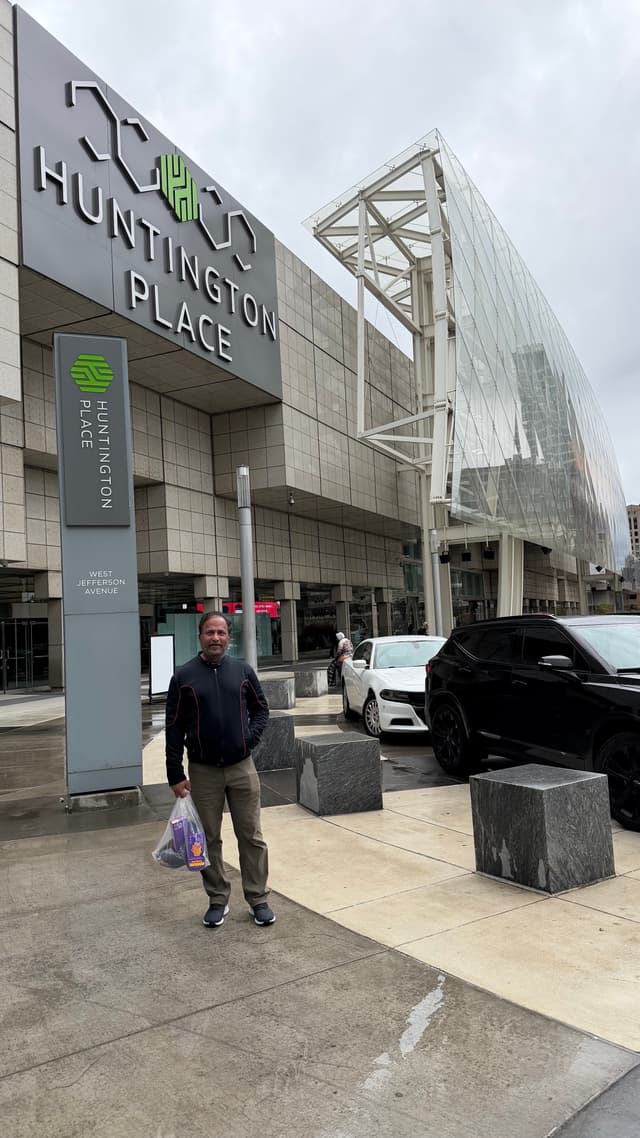
Another photograph from my visit shows me standing outside Huntington Place, the major convention center in downtown Detroit.
The building's modern architectural design reflects the city's evolving identity.
Formerly known as Cobo Center and later TCF Center, Huntington Place has long served as an important gathering location for conventions, exhibitions, and community events.
Standing outside the building, I reflected on how much Detroit has changed over the years.
Cities are living environments.
They evolve as industries change, populations shift, and new generations introduce different ideas.
Detroit's waterfront, convention facilities, entertainment districts, and public spaces represent important elements of its ongoing development.
I have always enjoyed exploring cities not simply as a tourist but as someone interested in their history, economy, culture, and people.
Every city has lessons to offer.
Detroit's lesson is resilience.
It is a city that continues to redefine itself while preserving its historical identity.
My visit during marathon activities gave me another opportunity to appreciate that transformation.
Running as a Public Health Movement
As a public health professional, I believe organized running events can serve a purpose far greater than competition.
They can motivate entire communities to become more physically active.
A person who registers for a 5K may begin walking regularly. Someone preparing for a 10K may develop healthier daily routines. Families attending a marathon may become inspired to participate in future community events. Children watching runners cross the finish line may discover an interest in athletics.
These changes may appear small, but collectively they can influence population health.
Physical inactivity remains a major global health concern.
Modern lifestyles frequently involve prolonged sitting, screen time, automobile transportation, and limited opportunities for movement. Many occupations require people to remain seated for much of the day.
Technology has made life more convenient, but convenience sometimes reduces the physical effort naturally incorporated into everyday activities.
Organized races offer a visible reminder that movement matters.
However, public health initiatives must remain inclusive.
Not everyone has the time, financial resources, physical capacity, or access to safe environments necessary for marathon training.
Communities should therefore promote multiple forms of physical activity, including walking trails, accessible recreation centers, community fitness programs, cycling infrastructure, and opportunities for older adults and people with disabilities.
The goal should not be to turn everyone into an endurance athlete.
The goal should be to make physical activity an achievable part of daily life.
Lessons From the Marathon That Apply to Life
The longer I participate in physical activities, the more I recognize how closely athletic experiences resemble life's larger challenges.
A marathon teaches patience because success requires preparation over time. It teaches humility because even experienced runners encounter difficult days. It teaches discipline because motivation alone cannot sustain long-term progress. It teaches adaptability because weather, physical condition, and unexpected circumstances may require changes in strategy. And it teaches gratitude because finishing an endurance event reminds us that the ability to move is itself a privilege.
These lessons are relevant to professional life as well.
In medicine and rehabilitation, meaningful improvement often requires time.
Patients recovering from surgery, illness, or injury may experience periods of rapid progress followed by frustrating plateaus.
The rehabilitation process requires realistic expectations, consistency, and encouragement.
The same principles apply to personal ambitions.
Building a business, pursuing education, raising a family, or developing a meaningful career involves sustained effort.
There may be setbacks along the way.
But a setback does not necessarily mean failure.
Sometimes it simply means adjusting the pace.
Running has reinforced this philosophy throughout my life.
Why I Continue to Challenge Myself
People occasionally wonder why someone would voluntarily participate in demanding physical activities when easier alternatives are available.
For me, the answer is not complicated.
I enjoy challenging myself.
Whether trekking through mountainous terrain, participating in long-distance running events, or exploring unfamiliar places, I find satisfaction in experiences that require preparation and determination.
These activities help me appreciate the relationship between physical health, mental strength, and personal freedom.
They also remind me not to take mobility for granted.
As a healthcare professional, I have seen how illness, injury, and age-related limitations can affect an individual's independence.
That experience has strengthened my commitment to maintaining an active lifestyle.
I do not exercise because I believe I can defeat aging.
Nobody can.
I exercise because I want to age with strength, dignity, and as much independence as possible.
There is an important distinction between pursuing fitness and pursuing perfection.
Fitness should enhance life, not become an obsession.
It should allow us to participate more fully in family activities, travel, work, recreation, and community life.
That is the philosophy I try to follow.
The Medal and Its Meaning
After an endurance event, participants often receive a medal.
To someone unfamiliar with running, it may appear to be a simple souvenir.
But runners understand its emotional value.
A medal carries memories.
It reminds us of the atmosphere at the starting area, the rhythm of footsteps, the encouragement of spectators, and the relief of reaching the finish.
It may also remind us of moments when continuing felt difficult.
In my photograph, I am celebrating with my medal near the Detroit finish line.
That moment represents more than a sporting accomplishment.
It reflects appreciation for the opportunity to participate. It reflects gratitude for physical health. And it reflects the satisfaction of being part of a community united by endurance and determination.
Years from now, the finishing time may be less important than the memories.
The people, the atmosphere, the flags, the city, and the feeling of accomplishment will remain.
That is the beauty of participating in meaningful experiences.
Their value often increases with time.
My Message to Others: Start Where You Are
I would never suggest that everyone should attempt a marathon.
A marathon is a demanding athletic event that requires appropriate preparation.
But I strongly encourage everyone who is medically able to incorporate regular physical activity into daily life.
You do not need expensive equipment or an elaborate fitness program to begin.
Walking is an excellent starting point for many people.
A short daily walk can gradually develop into a consistent routine.
Over time, some individuals may choose to increase their walking distance, introduce resistance exercises, or participate in community fitness activities. Others may eventually become interested in running.
The key is consistency.
The World Health Organization recommends that most adults accumulate at least 150–300 minutes of moderate-intensity aerobic activity per week, or 75–150 minutes of vigorous-intensity activity, along with muscle-strengthening activities on at least two days weekly.
Older adults should also incorporate activities that challenge balance and functional strength, particularly when fall prevention is a concern.
These recommendations provide a useful framework, but individual programs should account for health conditions, functional ability, and personal goals.
Physical activity does not need to be extreme to be meaningful.
A person who begins walking regularly after years of inactivity may be making a tremendous improvement in personal health.
That achievement deserves celebration.
The objective is progress, not comparison.
Conclusion: The Greatest Race Is the One We Run Against Our Own Limitations
When I look back at my Detroit International Marathon photographs, I see three meaningful images.
One captures the excitement of the finish line, surrounded by runners and volunteers.
Another captures my visit to Huntington Place, reminding me of Detroit's history and continuing transformation.
The third captures me standing between the American and Canadian flags, celebrating the international spirit of the event.
Together, these photographs tell a story that extends beyond running.
They represent physical activity, cultural connection, personal determination, and appreciation for life.
The Detroit International Marathon reminded me that endurance is not measured only in miles.
It is measured in our willingness to continue learning, growing, adapting, and challenging ourselves throughout life.
We cannot control every circumstance. We cannot prevent every illness or eliminate every obstacle.
But we can make choices that improve our opportunities for health, independence, and fulfillment.
We can remain curious. We can stay active. We can encourage others. And we can continue setting meaningful goals regardless of age.
The greatest achievement is not necessarily crossing the finish line ahead of someone else.
It is discovering that we are capable of more than we once believed.
As I stood near the finish line in Detroit, wearing my medal and surrounded by the energy of fellow participants, I felt grateful.
Grateful for the experience. Grateful for the people who made the event possible. Grateful for the ability to remain physically active. And grateful for another opportunity to celebrate the extraordinary journey of life.
Because ultimately, life itself is an endurance event. We may not all travel at the same speed, follow the same route, or face the same challenges. But every meaningful step forward deserves recognition.
And sometimes, the most important victory is simply having the courage to begin.
Author Note
"The photograph I keep coming back to isn't the one at the finish line — it's the one between the two flags. Training is solitary, but the day itself reminded me how much of any achievement belongs to the strangers handing out water and shouting your name. I'd happily trade a faster time for that reminder." — Dr. Vijay Kumar