Delhi Is Choking Again: Three Election Promises, Twenty Months in Power, and the Search for Accountability
Clean roads, clean air, and a clean Yamuna were prominent commitments to Delhi voters. Nearly twenty months later, what has changed?
By Dr. Vijay Kumar, MD, MPH, PhD | November 4, 2026
A Family Visit That Raised an Uncomfortable Question
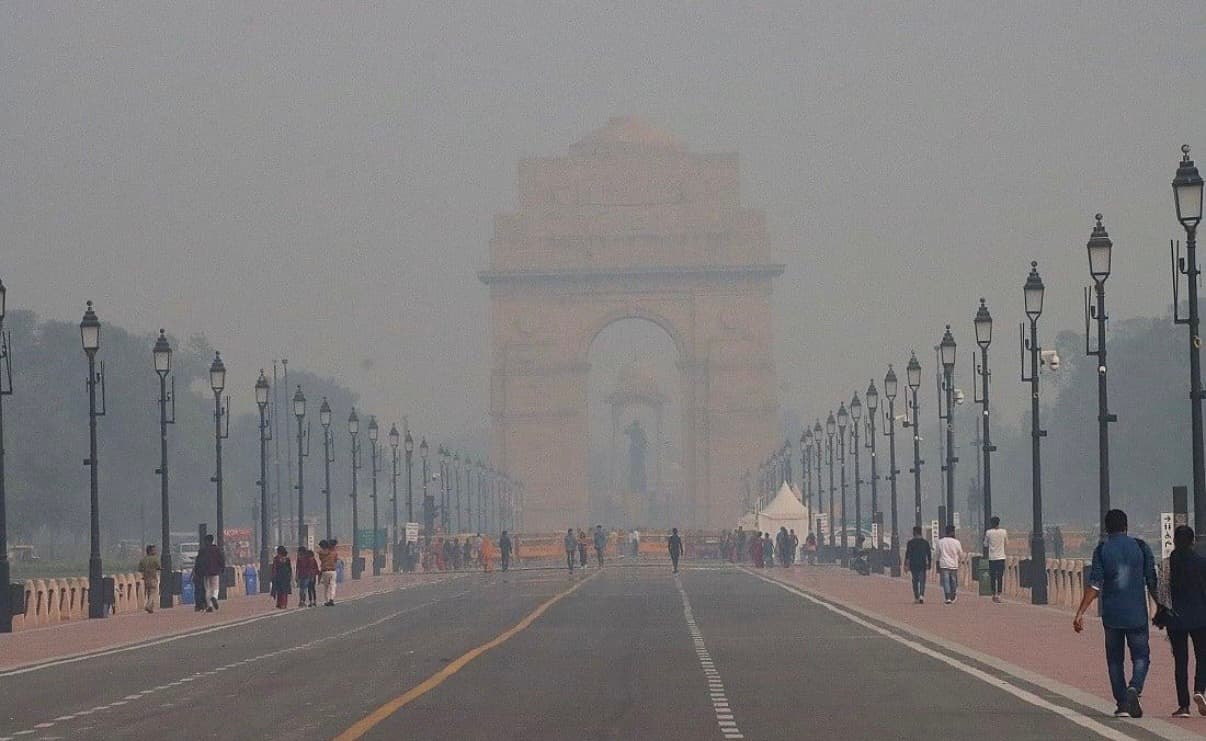
I am visiting family in Delhi, a city whose history, culture, and hospitality have always meant a great deal to me. Yet this visit has also brought an unwelcome reminder of the environmental crisis that residents face year after year.
I have experienced headaches, nausea, and unusual sleepiness. These symptoms cannot be attributed to pollution without medical evaluation, but they have made the problem feel immediate and personal.
As someone with a background in medicine, public health, and rehabilitation, I see polluted air not simply as an inconvenience but as a serious health issue.
Every winter, Delhi faces a familiar cycle: worsening air quality, emergency restrictions, anxious families, and promises of action.
Why does this pattern persist?
Delhi deserves more than temporary measures introduced when pollution becomes impossible to ignore. It needs sustained planning, transparent governance, and measurable improvements that residents can experience in their everyday lives.
The Latest Air-Quality Picture: Delhi's AQI Is Rising
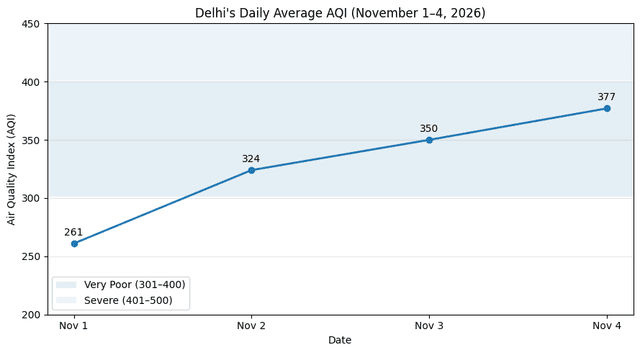
The reported Central Pollution Control Board (CPCB)-based readings showed a worrying increase in Delhi's daily Air Quality Index (AQI) during the first four days of November 2026.
The reported readings were:
November 1: AQI 261
November 2: AQI 324
November 3: AQI 350
November 4: AQI 377
On India's AQI scale, a reading between 301 and 400 falls into the Very Poor category, while 401–500 is classified as Severe.
These are daily citywide indicators, not measurements of exposure at every individual address. Nevertheless, they illustrate the seriousness of the situation.
Fine particulate matter known as PM2.5 is particularly concerning because these tiny particles can penetrate deep into the lungs. Long-term exposure is associated with cardiovascular and respiratory diseases, stroke, and premature mortality.
Children, older adults, outdoor workers, and people with existing illnesses are especially vulnerable.
The World Health Organization recommends an annual mean PM2.5 concentration of no more than 5 micrograms per cubic meter. It is important to remember that AQI and PM2.5 concentration are different measures and should not be compared directly.
Delhi's pollution comes from several sources, including:
Road traffic and vehicle emissions
Construction and road dust
Industrial activities
Diesel generators
Waste burning
Regional crop-residue fires
Winter weather conditions can also trap pollution close to the ground.
No single source or government can explain the entire problem. Effective action requires coordination across sectors and state boundaries, along with policies that continue throughout the year.
Three Prominent Election Commitments: A Performance Scorecard
The Bharatiya Janata Party (BJP) formed the Delhi government in February 2025 under Chief Minister Rekha Gupta.
Better roads, pollution control, and cleaning the Yamuna were prominent campaign themes, although they were not the government's only promises.
Approximately twenty months later, it is reasonable to ask what has changed.
A fair assessment must distinguish between government announcements, ongoing activities, and verified improvements.
1. Better Roads: Progress Reported, But Maintenance Matters
The government has reported approximately 1,193 kilometers of road redevelopment toward a larger target.
This work deserves recognition. Improving roads across a large city requires planning, funding, engineering, and coordination.
However, kilometers repaired are an output, not necessarily the ultimate public benefit.
Residents are concerned about practical questions:
Are roads safer for motorists, pedestrians, and cyclists?
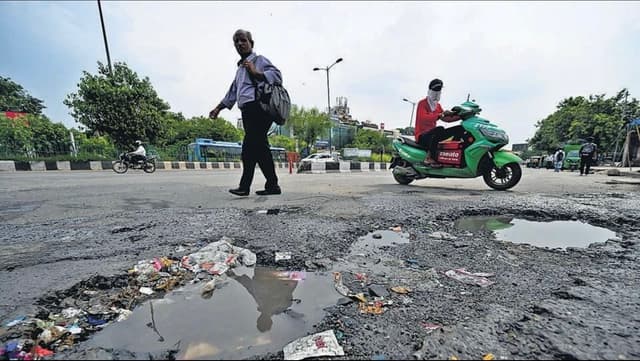
Are potholes repaired quickly?
Do drainage systems function during the monsoon?
Is construction dust adequately controlled?
Do repaired roads remain in good condition over time?
A road that deteriorates after one rainy season cannot be considered a durable success.
The government should publish independent road-condition audits, project completion dates, contractor accountability records, and maintenance performance.
My assessment: Meaningful progress has been reported, but the citywide promise remains unfinished.
2. Cleaner Air: Plans Are Underway, But Residents Still Need Results
The administration has announced a 2026–27 winter action plan that includes several measures:
Vehicle-emission enforcement
Restrictions on certain older vehicles
Construction-related controls
Public-transport improvements
Air-quality monitoring
Traffic-reduction measures
These are substantive policy actions and should be acknowledged.
Yet the return of very poor air quality in November shows that residents continue to face concerning exposure.
It would be incorrect to assume that a cleaner month automatically proves a policy has succeeded. Wind, rainfall, temperature, and other weather conditions influence AQI.
Equally, several days of poor air quality cannot, by themselves, prove that a newly introduced policy has failed.
The proper test should include weather-adjusted, multi-year trends in PM2.5 concentrations, the number of severe-pollution days, and emissions from major sources.
Delhi needs more than emergency restrictions when winter pollution becomes severe. It needs a year-round strategy that reduces pollution at its source.
My assessment: Policy activity is evident, but sustained clean air has not been delivered.
3. A Clean Yamuna: Announcements Must Become River Restoration
The Yamuna is more than a waterway. It is an ecological resource and a river of profound cultural and spiritual significance.
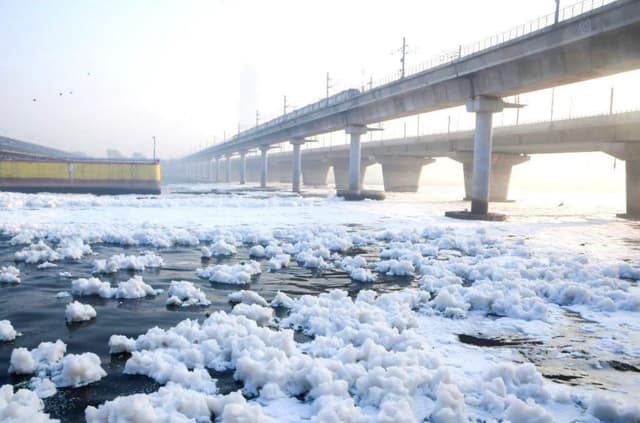
Yet the stretch flowing through Delhi has long suffered from sewage, polluted drains, and industrial discharge.
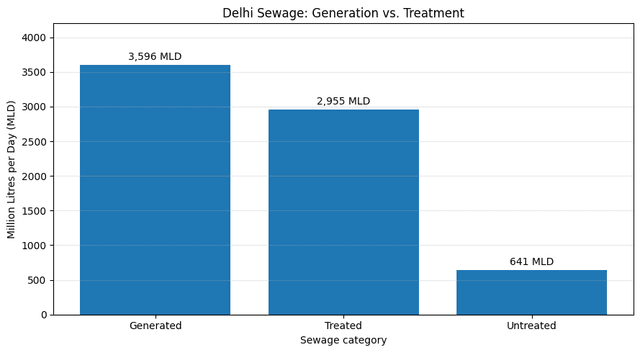
Historical government figures cited for 2025 indicated approximately:
3,596 million litres of sewage generated per day
2,955 million litres treated per day
641 million litres left untreated per day
These figures are historical baseline estimates, not verified November 2026 operating totals.
The administration has proposed several measures, including treatment-capacity expansion, decentralized treatment plants, sewer connections, drain interception, and a river-restoration target of 2028.
These projects are necessary. But building a sewage treatment plant is not the same as delivering clean river water.
The public needs independent measurements of:
Dissolved oxygen
Biochemical oxygen demand (BOD)
Bacterial contamination
Industrial pollutants
Untreated sewage entering the river
Without reliable water-quality measurements, it is difficult to determine whether the river is genuinely recovering.
My assessment: The clean Yamuna promise remains unfulfilled, and the stated 2028 restoration target is still ahead.
Government Plans Deserve Scrutiny—and Fair Credit
The Rekha Gupta administration inherited longstanding environmental problems.
It would be unfair to expect decades of environmental damage to disappear in twenty months.
However, it would be equally unfair to treat announcements, approved budgets, and project tenders as completed achievements.
Good governance requires public milestones, transparent expenditures, and independent outcome measurements.
Delhi also needs cooperation with neighboring states and the central government.
Vehicle emissions, industrial pollution, dust, and wastewater flows do not stop at administrative boundaries. A sustainable strategy must involve regional coordination and continue throughout the year, not only during winter emergencies.
Environmental protection should not become a seasonal political exercise.
It should be a continuous public responsibility.
A Public Scorecard Citizens Can Actually Use
One practical way to improve accountability is to publish a quarterly environmental and infrastructure scorecard.
Instead of relying only on announcements, residents should be able to see whether commitments are producing measurable results.
For roads:
Kilometers completed
Independent road-quality assessments
Pothole repair response times
Drainage failures and maintenance records
For air quality:
Annual PM2.5 levels
Number of severe AQI days
Weather-adjusted pollution trends
Enforcement results and emissions reductions
For the Yamuna:
Volume of untreated sewage
Sewage treatment plant compliance
Dissolved oxygen levels
Biochemical oxygen demand
Faecal contamination measurements
For public spending:
Budgeted versus actual expenditure
Project milestones and completion dates
Contractor details and responsibilities
Delays and corrective actions
Every major project should have a baseline, a deadline, a responsible department, and a verifiable outcome.
If targets are missed, the public deserves an explanation.
If targets are achieved, the government deserves credit.
Accountability is not partisan. It is the foundation of public trust.
The Health and Equity Dimension of Pollution
The costs of pollution are not shared equally.
Families with greater financial resources may be able to purchase air filtration systems, limit outdoor activities, or temporarily relocate when conditions become difficult.
Street vendors, traffic officers, construction workers, delivery personnel, and schoolchildren often have little choice but to remain exposed.
Air pollution can increase healthcare costs and undermine the physical activity that healthcare professionals recommend to help prevent conditions such as diabetes and heart disease.
Poor roads and contaminated waterways impose additional costs on residents and ecosystems.
From a public-health perspective, environmental protection is not simply about improving the appearance of a city. It is about protecting people's ability to live, work, study, and remain healthy.
Citizens and businesses also have responsibilities.
We can avoid open burning, reduce unnecessary vehicle idling, manage construction dust, dispose of waste responsibly, and report environmental violations.
But individual choices cannot replace effective sewage networks, industrial pollution standards, public infrastructure, or regional air-quality policies.
The responsibility for systemic improvement must be supported by effective institutions and public leadership.
A Message to Chief Minister Rekha Gupta
Chief Minister Rekha Gupta has an opportunity to make transparent environmental improvement a defining achievement of her administration.
I would encourage the government to publish quarterly public reports on all three commitments.
How many roads meet durable quality standards?
How many severe air-pollution days have been avoided?
How much untreated sewage has been prevented from reaching the Yamuna?
These are reasonable questions. They are not partisan attacks.
Having served on public boards and committees in the United States, I value governance that welcomes scrutiny and measures results.
The same standard should apply to every political party and every administration.
Citizens should not have to wait for another election campaign to find out whether their city is becoming cleaner and healthier.
They deserve transparent information throughout the government's term.
Conclusion: Promises Must Become Measurable Realities
Delhi is a magnificent city that deserves safe roads, healthier air, and a living Yamuna.
The government has taken steps, but none of these three commitments can yet be declared fully achieved.
Road redevelopment has progressed. Air-pollution interventions are underway. Yamuna restoration projects are planned and developing.
What matters next is whether these efforts produce durable improvements in everyday life.
The people of Delhi did not vote merely for project announcements. They voted for progress.
Clean roads.
Clean air.
A clean Yamuna.
These must become measurable realities—not recurring election slogans.
As someone who cares deeply about public health, community well-being, and accountable governance, I believe Delhi's environmental future deserves consistent attention beyond political cycles.
The city needs long-term solutions, transparent reporting, regional cooperation, and the willingness to measure success honestly.
A cleaner Delhi should not be an election promise that returns every few years. It should be a measurable achievement that residents can see, breathe, and experience every day.
About the Author
Dr. Vijay Kumar, MD, MPH, PhD, writes about public health, healthcare, leadership, social issues, and community well-being. Through his professional experience and personal reflections, he explores how policy decisions and public accountability shape everyday life.
Editorial note: Government-reported project figures and historical sewage estimates are identified as such. The AQI figures are daily citywide indicators, not live readings at every location. Personal symptoms require clinical assessment and should not be presumed to be caused by pollution.