Standing Beneath the Charminar: Where Hyderabad's History Still Breathes
There are some monuments you visit, admire, photograph, and then leave behind. And then there are places that seem to follow you long after you have walked away.
For me, Charminar in Hyderabad belongs to the second category.
Standing beneath those four magnificent minarets, surrounded by crowds, vendors, conversations, colors, traffic, faith, commerce, and centuries of history, I felt that I wasn't simply looking at an old monument. I was standing at a place around which an entire city had grown.
Four Minarets, More Than Four Centuries
The name Charminar literally evokes its defining feature — four minarets. The monument was constructed in 1591 by Sultan Muhammad Quli Qutb Shah, the founder of Hyderabad. Historical accounts differ on the precise motivation for its construction. One enduring tradition associates it with the end of a devastating plague, while historical evidence also connects its construction with the founding of Hyderabad and the beginning of the second Islamic millennium.
What is certain is that Charminar was not placed randomly within an existing city. It was integral to the conception of the new Hyderabad.
UNESCO's description of the Qutb Shahi monuments notes that Charminar stood at the crossing of two major axes and became the reference point around which the city's planning grid developed.
That realization changes the experience of standing there.
You are not merely standing beside one of Hyderabad's landmarks. In a historical sense, you are standing near the point from which Hyderabad unfolded.
Architecture That Still Commands Attention
Even surrounded by the density and energy of modern Hyderabad, Charminar dominates its surroundings.
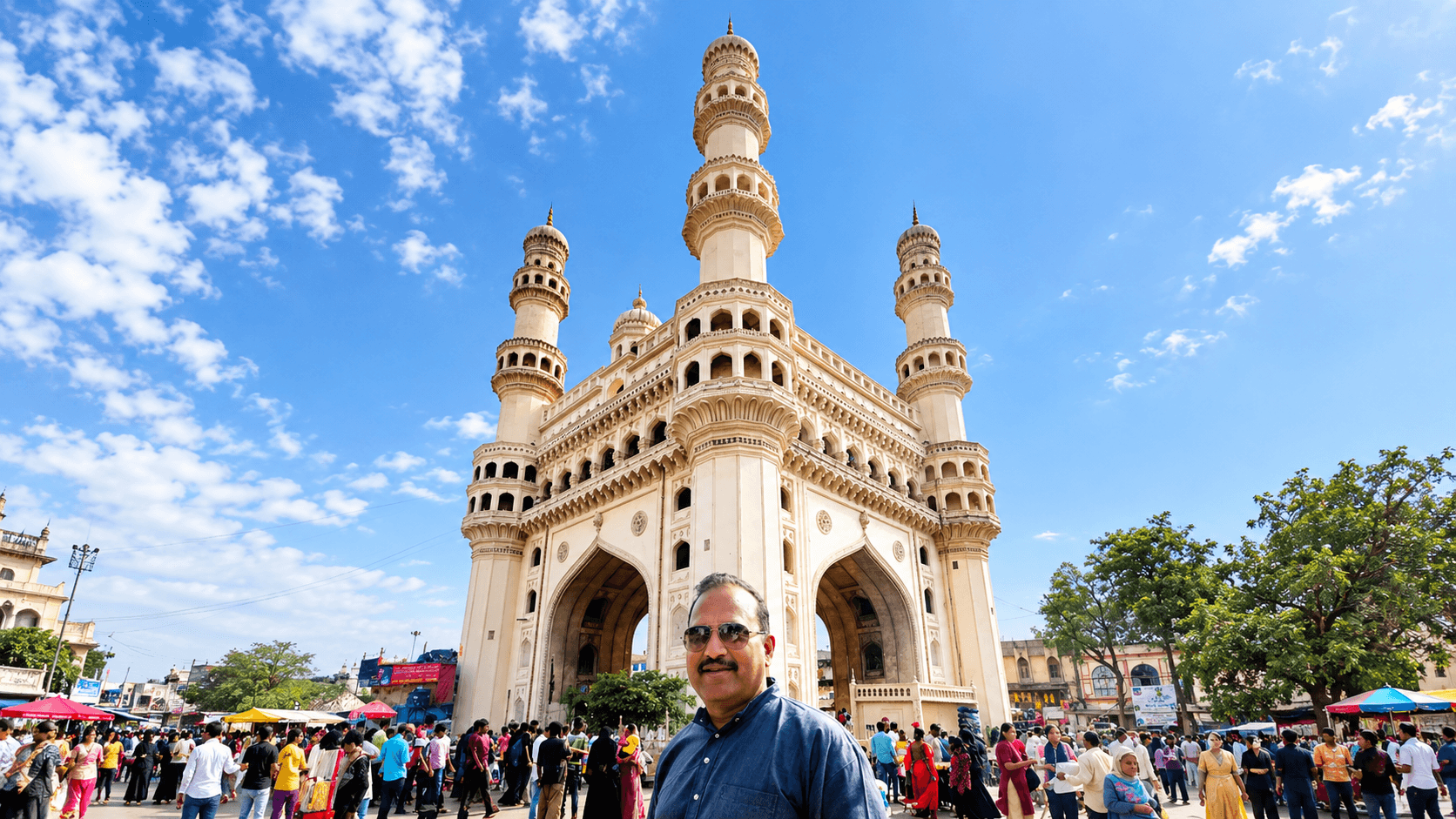
The monument is essentially square in plan, with four great arches opening toward the surrounding streets and a minaret rising from each corner. Telangana's official tourism information places the minarets at approximately 48.7 meters above ground level. The structure combines Indo-Islamic architecture with Persian influences and elaborate stucco ornamentation.
Look carefully and the building reveals much more than its famous silhouette. There are balconies, floral details, arches, carved surfaces and repeating geometric patterns. A mosque and prayer spaces occupy part of the upper structure, adding a religious dimension to a monument that simultaneously functions as an architectural, historical and civic symbol.
More than four centuries after its construction, it remains unmistakable.
The Monument Is Only Half the Experience
Yet what fascinated me most was not simply the architecture. It was life around the architecture.
Look at my photograph and you will see what I mean.
People are everywhere. Families walk past. Vendors conduct business. Visitors stop for photographs. Shoppers negotiate. People hurry somewhere while others simply stand and absorb the surroundings.
Nearby is the famous Laad Bazaar, long associated with bangles, traditional goods and the commercial culture of the Old City. The historic Mecca Masjid is also close to Charminar.
This is what makes Charminar different from monuments preserved in isolation.
History here has not been separated from everyday life. It lives in the middle of it.
Hyderabad: A City Comfortable With Contrasts
Hyderabad fascinates me because it refuses to belong entirely to either the past or the future.
One part of the city speaks through centuries-old arches, mosques, palaces and bazaars. Another speaks through technology parks, multinational companies, research institutions and rapidly expanding neighborhoods.
Telangana Tourism describes Hyderabad today as both a city of major historical landmarks and a significant technology hub.
At first, these identities might appear contradictory. I see them differently.
They demonstrate something important about successful societies: progress does not require erasing history. A city can build toward tomorrow while continuing to respect yesterday.
Perhaps individuals can do the same.
What Old Monuments Teach Us About Life
Travel has repeatedly reminded me that human beings tend to think in short periods.
A difficult year can feel permanent. A professional setback can seem enormous. A disappointment can occupy our entire field of vision.
Then you stand before something that has witnessed more than four centuries of human life.
Charminar has watched generations arrive and disappear. Political powers have changed. Empires have ended. Technologies have transformed civilization. Transportation has moved from animals and carts to automobiles and airplanes. The city surrounding the monument has expanded beyond anything its builders could have imagined.
And still those four minarets rise above Hyderabad.
There is a lesson in that.
Build your life around foundations strong enough to survive change. Circumstances will change. Careers will change. Fortunes will rise and fall. People will enter and leave our lives.
But values — integrity, education, perseverance, compassion, family, service and faith — can become our own foundations.
From History to Perspective
Whenever I travel through India, I am reminded of the extraordinary depth of the civilization around us.
Sometimes familiarity causes us to overlook it. We pass ancient buildings because they have always been there. We walk through markets without considering how many generations walked those same streets. We photograph monuments without asking what human ambitions, struggles and dreams created them.
Travel becomes much more meaningful when we begin asking those questions.
Standing beneath Charminar, I tried to imagine Hyderabad in 1591.
No automobiles. No smartphones. No skyscrapers. No airplanes overhead. No modern Hyderabad as we recognize it today.
Yet someone possessed the imagination to establish a new city and create an architectural centerpiece substantial enough to become its enduring symbol.
More than four centuries later, people from around India and the world still come to stand beneath it.
That is the remarkable power of human vision.
Four Directions, One Thought
Looking upward at the four minarets, I found myself thinking symbolically about their orientation.
They face outward in different directions, yet all belong to one structure.
Perhaps there is a message there for our increasingly divided world.
We may speak different languages. We may worship differently. We may come from different regions, cultures and economic circumstances. Our journeys may take us in completely different directions.
Yet our fundamental aspirations remain remarkably similar: dignity, opportunity, security, belonging, love, family and hope for the next generation.
Hyderabad itself has long been shaped by overlapping cultures and traditions. Its architecture, cuisine, languages and neighborhoods testify to centuries of interaction.
The Charminar stands beautifully within that story.
A Photograph — and a Memory
I have been fortunate to visit many remarkable places around the world, and photographs have become markers along that journey.
But the value of a travel photograph isn't simply that it proves, "I was there." Its greater value is that years later it can ask: what did being there teach you?
When I look at this photograph of myself standing before Charminar, I see much more than a tourist destination.
I see endurance. I see imagination. I see cultural continuity. I see a city that has learned to carry its history while constantly reinventing itself.
And perhaps most importantly, I see another reminder that our individual lives are brief chapters in a much larger human story.
We may not build monuments that stand for four hundred years. But we can build something meaningful.
We can educate someone. We can help someone heal. We can create an opportunity. We can strengthen a family. We can serve a community. We can leave behind ideas, institutions, relationships and acts of kindness that continue after us.
That, too, is a form of architecture.
Charminar was built of stone, granite, mortar and extraordinary imagination. Our own legacy is built one decision, one relationship and one contribution at a time.
And standing beneath those magnificent minarets in Hyderabad, surrounded by the beautiful chaos of life, that was the thought I carried home.
Author Note
"Every place I visit ends up teaching me something I wasn't looking for. Charminar reminded me that legacy has very little to do with permanence and everything to do with purpose. Four minarets have outlasted empires — not because stone is eternal, but because someone once built with enough intention that it still means something centuries later. I try to carry that thought into my own work: build for purpose, not for applause, and let time decide what lasts." — Vijay Kumar