Bharat Is Building World-Class Infrastructure—Now We Need World-Class Civic Discipline and Policing
There is something extraordinary happening in Bharat.
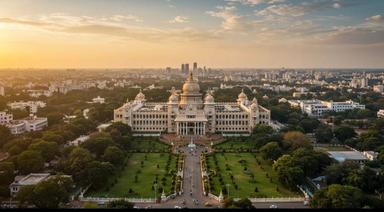
For those of us who live overseas but continue to maintain a deep emotional connection with India, returning today can be an experience filled with both pride and amazement. Highways that once made long-distance travel exhausting are being transformed. Expressways, airports, metro systems, digital payments, railway stations, tunnels, bridges and urban infrastructure increasingly reflect the ambitions of a country determined to become one of the world's leading economies.
Bharat is growing by leaps and bounds.
And it makes Indians living both within Bharat and across the world extremely proud and hopeful.
But as our physical infrastructure becomes increasingly world-class, another question deserves equal attention: is our civic behavior keeping pace with our infrastructure?
We can construct a magnificent highway. We can build a beautiful airport. We can create spotless railway stations, landscaped public spaces and modern city centers.
But infrastructure alone cannot create a world-class society.
That also requires civic responsibility, respect for public property, consideration for fellow citizens — and when voluntary compliance fails, effective and impartial enforcement of the law.
This is not an argument for excessive policing.
It is an argument for effective policing.
There is an important difference.
Laws Exist. The Question Is Whether They Are Predictably Enforced
Bharat does not suffer from an absence of laws.
We have traffic laws. We have municipal regulations. We have environmental regulations. We have restrictions on littering, dangerous driving, illegal parking, encroachment, noise and countless other activities affecting public life.
The greater problem is often the gap between law on paper and law in everyday life.
A law that is enforced occasionally becomes a suggestion.
A law that is enforced only when a police officer happens to be standing nearby encourages people to behave differently when that officer disappears.
A law that is applied differently depending upon someone's position or influence eventually loses public credibility.
By contrast, when enforcement is predictable, fair and largely unavoidable, human behavior changes remarkably quickly.
That lesson can be seen around the world.
Look at the Same Indian Citizen Overseas
There is an interesting phenomenon that many Indians who travel internationally will recognize.
An Indian driver who may casually change lanes, park wherever convenient or ignore certain traffic conventions at home can land in Singapore, Japan, Britain, Europe or the United States and suddenly become extraordinarily disciplined.
Why?
The person's DNA has not changed during the flight.
What changed was the environment of expectations and consequences.
The driver understands that a red light means red. A parking restriction means parking is prohibited. A speed limit is not merely an advisory number. Cameras may be operating whether a police officer is visible or not. A violation may generate a ticket automatically. And knowing an influential person is unlikely to make that ticket disappear.
That tells us something very important.
Civic discipline is partly cultural, but it is also learned behavior shaped by institutions, incentives and consequences.
The objective, therefore, should not be to criticize Indians as inherently undisciplined.
That would be both unfair and inaccurate.
Instead, Bharat should create systems in which responsible behavior becomes the easiest and most logical choice.
Do We Actually Have Enough Police?
This brings us to an important question.
With a population exceeding 1.4 billion, does Bharat have enough police personnel to provide the level of enforcement that a rapidly modernizing society requires?
The latest nationally comparable figures provide reason for concern.
According to Bureau of Police Research and Development data for January 2024, summarized by PRS Legislative Research, India had a sanctioned police strength of approximately 197 personnel per one lakh population — but the actual strength was only about 155 per lakh.
That gap is significant.
The sanctioned strength of state police forces was approximately 27.55 lakh personnel, while actual strength was about 21.62 lakh.
In other words, roughly 5.9 lakh sanctioned police positions were not filled — a vacancy gap of more than one-fifth of sanctioned strength.
Before Bharat even decides how many additional police positions a country of its size requires, there is an obvious first step: fill the positions that already exist.
The national average also conceals enormous variations.
As of January 2024, Bihar had only about 80 actual police personnel per lakh population, compared with 134 in Uttar Pradesh, 132 in Gujarat, 141 in Karnataka, 153 in Kerala, 160 in Tamil Nadu and 163 in Maharashtra. Delhi, because of its unique security requirements, had about 370.
This demonstrates why India's policing challenge cannot be solved through a single national number.
The requirements of rural Bihar are different from Delhi. The requirements of Mumbai are different from a Himalayan district. Tourist centers, border regions, megacities, industrial corridors and rural communities all require different models.
Nevertheless, an actual national ratio of approximately 155 police personnel per lakh population raises a legitimate policy question about whether existing resources are adequate for a nation undergoing such enormous social, economic and infrastructural transformation.
But More Police Alone Will Not Solve the Problem
This is perhaps the most important point.
Simply recruiting hundreds of thousands of additional officers will not automatically create better civic discipline.
The real equation is something closer to:
Manpower + training + technology + visibility + accountability + predictable enforcement + public cooperation = effective policing.
A country can have many police officers and still have weak enforcement.
Conversely, technology can allow a relatively limited number of officers to supervise enormous areas.
This is where Bharat can learn from some of the world's successful policing models without attempting to copy any country blindly.
Japan: Police Embedded Within the Community
Japan provides a fascinating example.
One of the foundations of Japanese community policing is the Koban system — small neighborhood police boxes that make officers highly accessible to ordinary citizens.
Japan's National Police Agency describes Koban and their rural counterparts, Chuzaisho, as being at the heart of community policing. Officers patrol neighborhoods, respond to emergencies, provide assistance and maintain regular relationships with local residents. Japan has thousands of these community police facilities.
The philosophy is important.
Police are not present only after something terrible happens.
They are integrated into everyday community life.
Visibility itself becomes deterrence.
But perhaps more importantly, police become familiar and accessible rather than distant government institutions.
Bharat already has police stations, chowkis, beat constables and community-policing initiatives. The lesson from Japan is therefore not necessarily to import the Koban system.
It is to strengthen the principle behind it: police should know their communities, and communities should know their police.
Singapore: Technology as a Force Multiplier
Singapore offers another useful lesson, particularly in traffic enforcement.
Singapore's Traffic Police explicitly describes technology as a force multiplier for round-the-clock enforcement. Cameras monitor speeding and red-light violations, allowing enforcement to continue without requiring an officer to stand physically at every intersection.
Singapore has continued expanding this approach. Speed-enforcement capability has been incorporated into red-light cameras, while penalties and demerit points are used alongside enforcement and public education.
This produces an important psychological effect.
The question in a driver's mind changes from "is there a police officer here?" to "if I break the rule, will the system detect it?"
That transformation is enormously powerful.
And Bharat — with Aadhaar-era digital infrastructure, FASTag, UPI, digital vehicle databases, e-challans, CCTV networks and rapidly expanding intelligent transportation systems — is particularly well positioned to build such an enforcement architecture.
We should not need a traffic policeman standing beneath every traffic light.
Technology should perform much of that work.
Where Bharat Could Benefit From Stronger Everyday Enforcement
There are several areas where stronger, fairer and more consistent enforcement could dramatically improve everyday life.
Traffic Discipline
This may be the most urgent area.
Wrong-way driving, excessive speeding, jumping traffic signals, driving without helmets, ignoring seat belts, dangerous overtaking, blocking intersections, distracted driving and poor lane discipline are not minor inconveniences.
They can kill.
The Ministry of Road Transport and Highways' Road Accidents in India 2023 documents the enormous burden of crashes and fatalities and specifically tracks violations including over-speeding and impaired driving.
Bharat is spending enormous amounts of money building extraordinary roads.
Those roads deserve equally modern enforcement.
More speed cameras, red-light cameras, automatic number-plate recognition and electronic enforcement could help.
But enforcement should be transparent and designed primarily to change behavior — not merely to collect revenue.
Illegal Parking and Encroachment
A beautiful road loses much of its usefulness when vehicles occupy travel lanes.
A beautifully constructed sidewalk becomes meaningless when pedestrians cannot walk on it because it has been occupied by vehicles, vendors, construction material or permanent encroachments.
And pedestrians forced onto roads create additional traffic and safety problems.
Rules governing public spaces must therefore be enforced consistently.
This also requires governments to provide realistic alternatives — proper parking, well-designed vending zones, accessible sidewalks and sensible urban planning.
Enforcement without infrastructure can become unfair.
Infrastructure without enforcement can become useless.
We need both.
Littering, Spitting and Public Cleanliness
Bharat has made enormous progress in sanitation and cleanliness.
But public cleanliness ultimately cannot be delivered by sanitation workers alone.
A municipality may clean a street every morning, but if hundreds of people believe throwing waste onto that street is acceptable, government is fighting a losing battle.
The long-term solution requires education beginning in childhood.
But there must also be consequences for deliberate violations.
Littering fines are meaningless if nobody expects them to be enforced.
The goal should eventually be to create a social norm where throwing garbage from a car window feels as unacceptable in Delhi, Patna, Mumbai or Bengaluru as it would in Singapore or Tokyo.
Honking and Noise Pollution
Unnecessary honking is another example where civic behavior and enforcement intersect.
The horn should be a safety device.
It should not become a substitute for patience.
Hospitals, schools, residential neighborhoods and crowded urban areas deserve reasonable protection from excessive noise.
Better enforcement, public education and appropriately deployed automated monitoring could gradually change behavior.
Queues and Respect for Shared Public Spaces
Not everything requires police.
Some behaviors are primarily matters of civic culture.
Respecting queues, keeping entrances clear, allowing passengers to exit before entering, respecting elderly people and persons with disabilities, keeping public toilets clean and treating parks and monuments as shared national assets should become normal social expectations.
The strongest societies eventually reach a point where citizens themselves reinforce responsible behavior.
That is the ideal.
Police should be the backstop of civic order — not the only source of civic order.
Public Property Is Our Property
A metro station does not belong to the government.
A highway does not belong to a minister.
A railway coach does not belong to Indian Railways in some abstract sense.
They belong collectively to the people of Bharat.
When public property is vandalized, damaged or deliberately misused, ultimately citizens pay for its replacement through taxes and public expenditure.
Protecting public infrastructure should therefore become part of modern Indian patriotism.
Patriotism is not expressed only by waving the Tiranga.
It is also expressed by how we treat the country beneath that flag.
Enforcement Must Be Equal
There is another essential condition.
Strong enforcement works only when citizens believe it is fair.
If an ordinary citizen receives a challan while someone influential expects preferential treatment, respect for law deteriorates.
The objective should be a system in which the technology does not recognize whether the vehicle belongs to a businessman, politician, bureaucrat, doctor, laborer or tourist.
The camera sees a violation.
The system generates the consequence.
That is equality before law in practical everyday life.
Technology, properly designed with safeguards for privacy, due process and appeals, can actually make enforcement less arbitrary and more democratic.
Police Officers Also Need Support
While discussing policing, we must also remember the human being wearing the uniform.
Indian police officers frequently work difficult hours, manage enormous crowds, respond to emergencies, handle traffic, investigate crime, provide VIP and event security and perform administrative duties — all while facing intense public expectations.
If Bharat expects world-class policing, police personnel deserve world-class training, equipment, technology, staffing and working conditions.
Filling vacancies would reduce pressure on existing personnel. Administrative work that can be automated should be automated. Specialized civilian staff can perform functions that do not require sworn police officers. Traffic management should increasingly rely on technology. And officers should receive continuous training in communication, de-escalation, investigation, cybercrime, human rights and community engagement.
Modern policing should be firm without becoming unnecessarily confrontational.
Authority and courtesy are not opposites.
Bharat Does Not Need a Police State
This distinction cannot be emphasized enough.
Calling for better enforcement does not mean asking Bharat to become a police state.
Quite the opposite.
In a well-functioning society, citizens encounter fewer arbitrary interventions because rules are clear and enforcement is predictable.
The objective is not more policemen confronting more citizens.
The objective is fewer violations because citizens know the rules will be enforced.
Technology can help achieve exactly that.
Imagine major Indian cities where dangerous speeding automatically generates an electronic challan. Imagine vehicles repeatedly blocking sidewalks being identified electronically. Imagine illegal dumping captured through cameras and traced. Imagine commercial vehicles violating designated routes being detected automatically. Imagine traffic signals dynamically coordinated while violations are recorded without requiring officers to stand in dangerous intersections.
Then police personnel could spend more of their valuable time investigating crime, protecting vulnerable citizens and engaging with communities.
Development and Discipline Must Move Together
I recently traveled extensively by road in Bharat and was struck by the extraordinary transformation taking place.
The quality of several highways, rest areas, food courts, digital tolling and cashless payments demonstrated a country moving confidently into the future.
That experience left me extremely proud.
But perhaps this next phase of development requires us to ask a more difficult question.
We have learned how to build world-class infrastructure.
Can we now create world-class civic behavior around it?
The answer, I believe, is absolutely yes.
But it will require three partners.
Government must provide good infrastructure and fair enforcement. Police must enforce laws professionally, consistently and impartially. Citizens must accept responsibility for the public spaces we share.
None can succeed without the others.
From Fear of Police to Respect for Law
Perhaps the greatest transformation would be psychological.
The objective should not be to make Indians afraid of police officers.
It should be to make everyone respect the law.
There is a profound difference.
Fear works only while authority is physically present.
Respect for a functioning system works even when nobody is watching.
Japan's neighborhood policing illustrates the value of community presence. Singapore demonstrates how technology can multiply enforcement capacity. Bharat can study these experiences while developing an Indian model appropriate for 1.4 billion people, thousands of cities and towns, hundreds of thousands of villages and enormous cultural and geographic diversity.
We do not have to become Singapore.
We do not have to become Japan.
We have to become the best version of Bharat.
The Next Chapter of India's Transformation
For decades, discussions about India's development centered on whether we could build enough roads, airports, electricity networks, sanitation systems, telecommunications and digital infrastructure.
Increasingly, Bharat is demonstrating that it can.
The next challenge may be less visible but equally important: building a culture capable of protecting and respecting everything we are creating.
That means filling police vacancies. It means better training and deployment. It means community policing. It means cameras and automated enforcement where appropriate. It means transparent fines and meaningful appeal systems. It means consequences that apply equally. It means civic education in schools.
And ultimately, it means citizens recognizing that discipline is not something government imposes upon us.
Civic discipline is something we give to one another.
When I stop at a red light at midnight even when the road appears empty, I am contributing to that culture.
When I refuse to throw garbage onto a highway, I am contributing.
When I park without blocking someone else's path, respect a queue, avoid unnecessary honking and protect public property, I am contributing.
Multiply those seemingly small decisions by 1.4 billion people and something extraordinary happens.
Infrastructure becomes civilization.
Bharat's transformation should therefore not be measured only by kilometers of expressways, numbers of airports, size of the economy or height of skyscrapers.
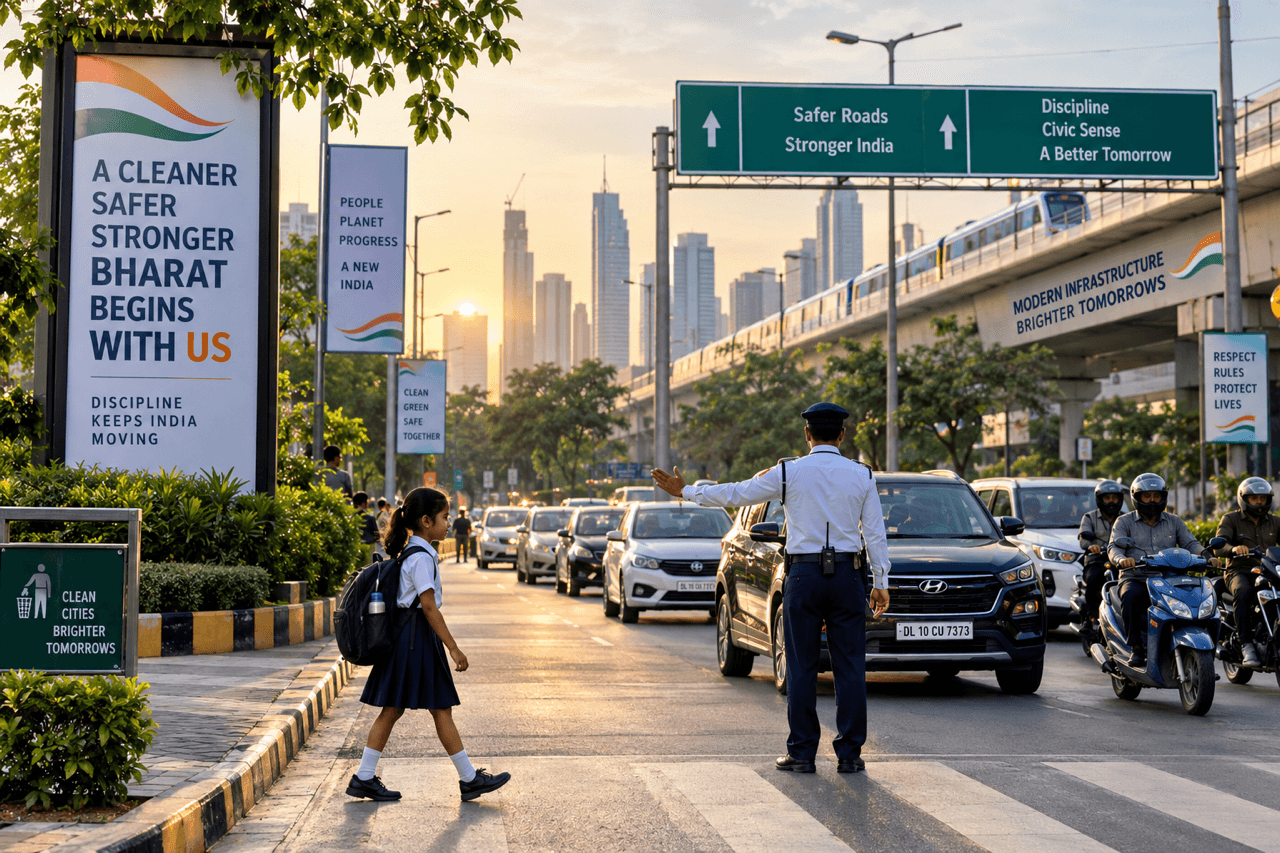
It should also be measured by how safely a child can cross a street, whether an elderly person can use a sidewalk, whether traffic follows lanes without a policeman standing nearby, whether public spaces remain clean after they are constructed, and whether the law applies equally to the powerful and the ordinary citizen.
That is the Bharat I hope to see.
A Bharat with magnificent infrastructure — and civic discipline worthy of it.
A Bharat where police are respected partners in the community rather than merely an emergency presence.
A Bharat where technology makes enforcement predictable while reducing unnecessary confrontation.
A Bharat where laws are simple, reasonable, transparent and actually enforced.
And above all, a Bharat where citizens understand that rights and responsibilities travel together.
We should be immensely proud of how far Bharat has come.
But pride should never prevent us from asking how we can become even better.
Our highways are becoming world-class. Our airports are becoming world-class. Our digital infrastructure is already admired around the world.
Now let us make our civic discipline, public behavior and everyday enforcement world-class as well.
Because the greatest nations are not defined merely by what they build.
They are defined by how their citizens protect, respect and live within what they have built.
Author Note
"I noticed something on that last road trip that I couldn't quite shake — how quickly I fell back into old habits of watching for a policeman rather than just following the rule. That reflex says more about the system than about me. I'd like a Bharat where I stop at a red light because it's red, full stop, not because I'm checking mirrors first." — Vijay Kumar