Beautiful Northeast India: A Journey of Nature, Spirituality, Culture, and Unforgettable Memories
From the sacred Kamakhya Temple and the mighty Brahmaputra River to the breathtaking hills of Meghalaya and Cherrapunji, discovering another extraordinary side of my motherland.
By Dr. Vijay Kumar
India Never Stops Surprising Me
Having traveled across continents, explored ancient civilizations, climbed mountains, and experienced some of the world's spectacular landscapes, I have learned an important lesson: no matter how much of the world we see, there is always something new waiting to be discovered.
Sometimes, the most extraordinary discoveries are found within our own country.
My journey through Northeast India was one such experience. From the spiritual atmosphere of Kamakhya Temple in Guwahati to the majestic Brahmaputra River, from the warmth of traditional Assamese hospitality to the lush hills of Meghalaya and the remarkable landscapes of Cherrapunji, this journey brought together nature, culture, spirituality, and human connection.
Born and raised in Bihar and having spent much of my adult life in the United States, I feel a special emotional connection whenever I return to India.
I have explored Switzerland, Alaska, Nepal, and the Himalayas. I have trekked toward Everest Base Camp and experienced the spiritual significance of Mount Kailash. Yet Northeast India offered an experience that was uniquely its own.
The mountains, the people, the cultural traditions, and the peaceful surroundings reminded me that India is not simply a country with beautiful destinations. It is a living civilization in which every region has its own story.
And Northeast India has an extraordinary story to tell.
Guwahati: The Gateway to Northeast India
My exploration began in Guwahati, one of the most important cities in Northeast India.
Situated beside the mighty Brahmaputra River, Guwahati is often described as the gateway to the northeastern states. It is a city where ancient religious traditions coexist with modern development.
Busy streets, commercial activity, and contemporary buildings reflect the changing face of India. Yet beneath this modernization lies a cultural heritage shaped by centuries of history, literature, music, traditional textiles, agriculture, and the river itself.
One of the things that impressed me was the importance people place on preserving their traditions. Cultural identity remains visible in celebrations, clothing, music, hospitality, and everyday life.
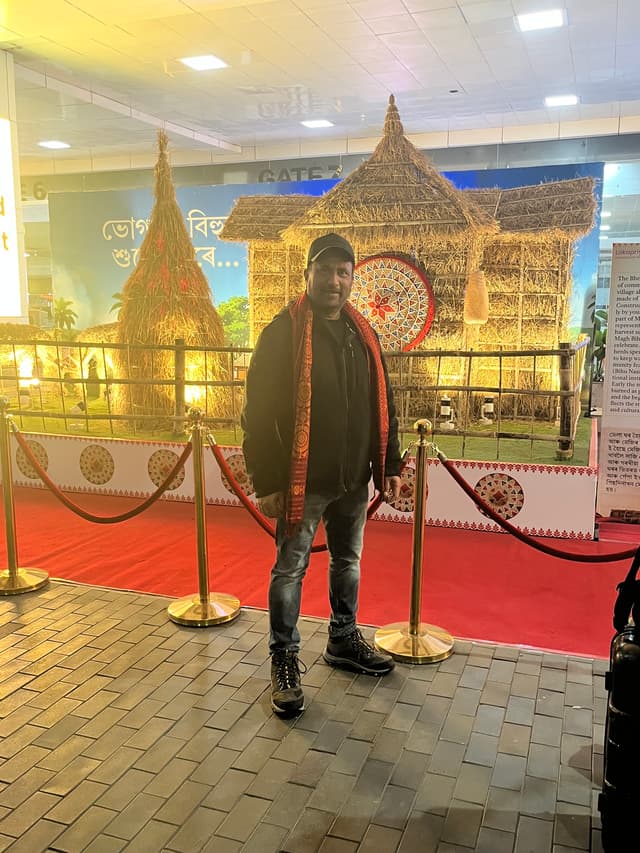
I particularly enjoyed seeing representations of traditional rural life, including thatched houses, agricultural structures, and decorative artwork. These scenes reminded me of my childhood in Bihar, where village life, farming, family relationships, and community traditions played an important role in our upbringing.
Although the architecture and customs differ, the emotional connection to rural life feels familiar.
It reminded me that India's villages remain important custodians of our cultural heritage.
A Traditional Welcome That Touched My Heart
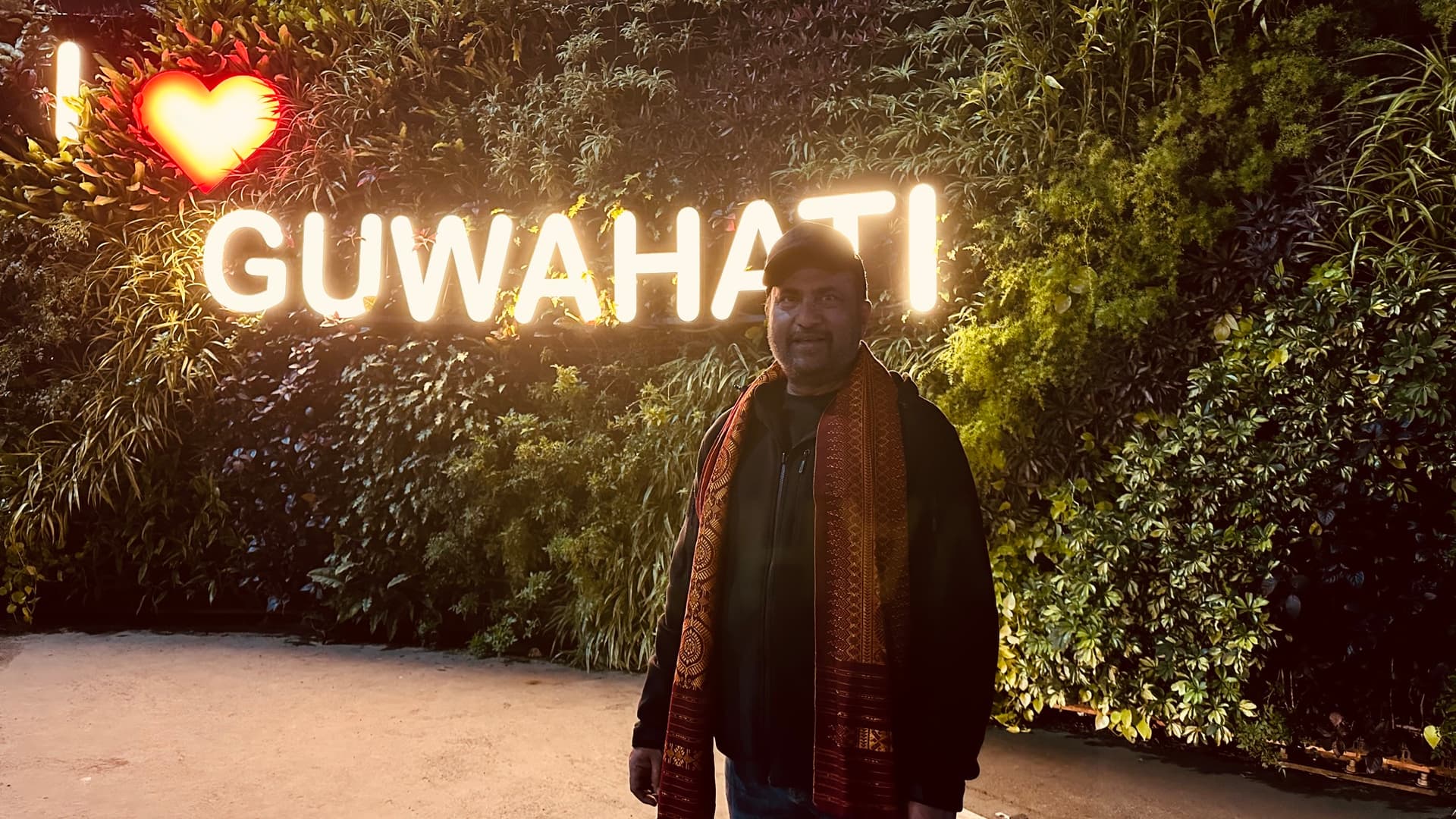
One of the most memorable moments of my journey was receiving a beautiful traditional scarf placed around my neck.
It was a simple gesture, but it carried a profound message.
Traditional woven textiles hold an important place in the cultural identity of Northeast India. In Assam, the gamosa is widely associated with respect, affection, hospitality, and honor. Other northeastern communities have their own distinctive ceremonial textiles and scarves.
I wore the scarf proudly.
Having traveled internationally for many years, I have experienced hospitality in different cultures. Some people welcome guests with flowers, others with music, traditional greetings, or ceremonial gifts.
But I have always believed that the true meaning of hospitality is not found in how elaborate the welcome is. It is found in the sincerity behind it.
That scarf represented more than a piece of fabric. It represented acceptance, friendship, and respect.
It reminded me of the Indian philosophy of Atithi Devo Bhava—the guest is like God.
Even today, looking at the photograph of myself wearing that scarf brings back the warmth of the welcome.
These are the small moments that make travel unforgettable.
Kamakhya Temple: Where Faith, History, and Spirituality Meet
No account of my visit to Guwahati would be complete without mentioning the sacred Kamakhya Temple.
Located on Nilachal Hill, Kamakhya Temple is one of India's most revered Hindu pilgrimage sites. It holds particular significance within the Shakta tradition, which worships the Divine Mother as the supreme creative power.
As a Hindu who has visited important spiritual destinations, including Pashupatinath in Nepal and Rameswaram, I appreciate how every sacred place offers its own atmosphere, history, and significance.
Kamakhya Temple was no exception.
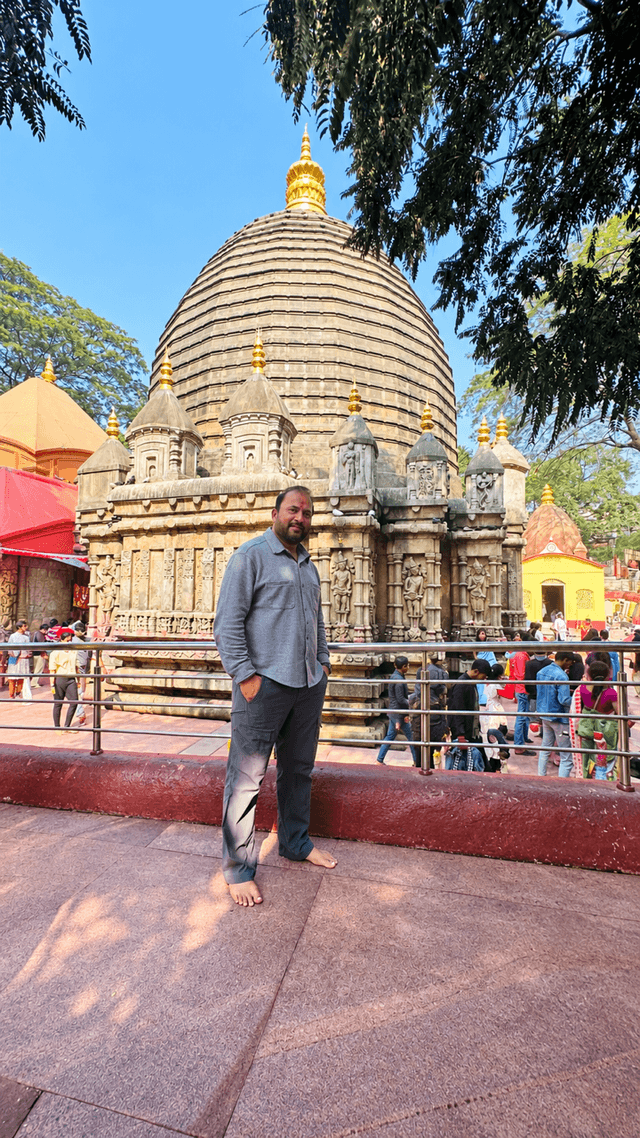
Standing barefoot before its magnificent stone structure, I was struck by its distinctive architecture. The temple's dome, golden finial, intricately constructed stone walls, and smaller towers reflect centuries of craftsmanship and religious devotion.
The present temple complex incorporates historical rebuilding and additions, particularly those associated with the Koch rulers during the sixteenth century.
Yet Kamakhya's significance extends far beyond its architecture.
According to Hindu tradition, the temple is one of the important Shakti Peethas associated with the legend of Goddess Sati and Lord Shiva. It is especially connected with the generative power of the goddess and the sacred feminine principle.
Unlike temples where worship centers on a conventional human-shaped idol, the principal sanctum at Kamakhya is associated with a natural rock formation and a sacred spring.
This distinctive form of worship reflects an ancient relationship between spirituality, fertility, and nature.
The temple is also famous for the annual Ambubachi Mela, which is associated with the goddess's symbolic menstruation and the regenerative power of nature.
Standing among devotees, I reflected on how faith has connected generations of people across centuries.
India's temples are not merely buildings. They are repositories of history, cultural memory, artistic achievement, and spiritual belief.
Kamakhya Temple is a remarkable example of this enduring heritage.
Standing Beside the Mighty Brahmaputra River
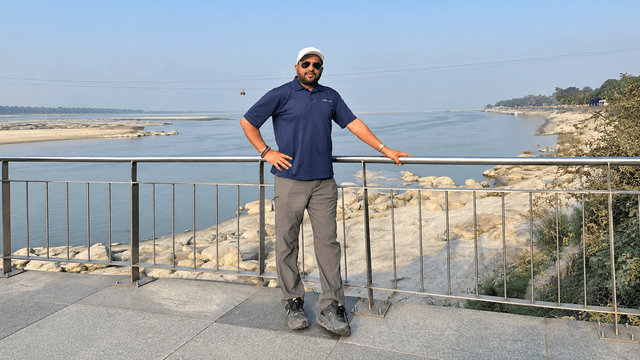
Another unforgettable moment was standing beside the mighty Brahmaputra River.
In one of my favorite photographs, I am standing along the riverfront in Guwahati, looking toward the broad expanse of water stretching into the distance.
The Brahmaputra is one of Asia's great river systems. Originating in the Tibetan Plateau, it flows through Arunachal Pradesh and Assam before continuing into Bangladesh, where its waters become part of the vast river system leading to the Bay of Bengal.
Its course crosses landscapes, ecosystems, cultures, and international boundaries.
In Assam, the Brahmaputra is much more than a geographical feature. It is central to agriculture, transportation, livelihoods, literature, folklore, and regional identity.
Standing beside this enormous river, I thought about how rivers have shaped human civilization.
The Nile helped sustain ancient Egypt. The Ganges has been central to the spiritual and historical life of northern India. The Mississippi has played a major role in American commerce and development. The Brahmaputra has shaped the life and culture of Assam.
As someone originally from Bihar, I have a deep appreciation for rivers. Growing up, I witnessed how rivers could be both life-giving and destructive. Seasonal flooding in Bihar has affected countless families, agricultural lands, roads, and communities.
The Brahmaputra presents a similar duality. It nourishes the region, while powerful monsoon flows can also cause devastating floods and erosion.
This contrast reminds us of nature's extraordinary power. We depend on rivers for survival, yet we must respect their unpredictable strength.
As I stood beside the Brahmaputra, I felt a sense of calm. The water moved steadily, indifferent to the pressures and worries of everyday human life.
It was a beautiful reminder that sometimes we need to slow down and simply appreciate the world around us.
Meeting People: The Most Valuable Part of Travel
Whenever I travel, I enjoy meeting people and learning about their lives.
Monuments, mountains, rivers, and buildings are important, but human connections often create the most lasting memories.
During this journey, I had the opportunity to meet and spend time with local people. A photograph capturing a friendly group gathering reminds me of the conversations and connections that made the experience meaningful.
Northeast India is home to remarkable cultural diversity. The region includes numerous communities with distinctive languages, histories, traditions, music, clothing, and social customs.
Assam is home to Assamese-speaking communities and many other ethnic and linguistic groups. Meghalaya is particularly associated with the Khasi, Jaintia, and Garo peoples, each with rich cultural traditions.
These differences are not barriers. They are opportunities to learn.
I have always believed that traveling with an open mind is one of the best ways to overcome stereotypes and misunderstandings.
When we meet people personally, share conversations, and experience their hospitality, we begin to appreciate the complexity and beauty of different cultures.
A photograph may capture a smile, but the memory of kindness often remains long after the journey ends.
The Road to Meghalaya: Entering the Abode of Clouds
Leaving the urban environment of Guwahati and traveling toward Meghalaya reveals an entirely different landscape.
Buildings gradually give way to green hills. Roads wind through elevated terrain, and forests, valleys, and distant mountain ridges begin to dominate the horizon.
The name Meghalaya means "abode of clouds," and the region certainly lives up to its name.
For me, mountains have always represented freedom, adventure, and reflection. I have trekked through high-altitude terrain, explored the Himalayas, and admired the landscapes of Switzerland, Alaska, and Nepal.
Yet Meghalaya offers a different experience.
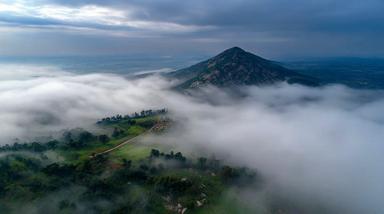
Its beauty is not defined by towering snow-covered peaks. Instead, it lies in rolling hills, deep green valleys, dramatic cliffs, waterfalls, and clouds that can transform the scenery within minutes.
During my visit, I stopped at beautiful viewpoints to admire the surroundings. In one photograph, I am standing beside a mountain road with a vast valley stretching behind me. In another, I am leaning against a railing, quietly looking across forested hills.
These moments were especially meaningful.
There was no need to rush. No appointment to attend. No immediate responsibility demanding attention.
Just the opportunity to stand quietly and appreciate the beauty of nature.
Cherrapunji: Visiting One of the Wettest Places on Earth
One of the highlights of my journey through Meghalaya was visiting Cherrapunji, also known as Sohra.
Like many Indian students, I remember learning about Cherrapunji in school geography lessons. It was famous for receiving extraordinary amounts of rainfall.
At that time, Cherrapunji was simply a name in a textbook. Years later, visiting the region was a completely different experience.
Located in Meghalaya's East Khasi Hills, Cherrapunji is internationally known for its exceptional monsoon rainfall. The region's climatic conditions are influenced by moisture-laden winds from the Bay of Bengal that rise over the Khasi Hills, producing intense precipitation.
Nearby Mawsynram is also famous for its exceptionally high rainfall.
But Cherrapunji is much more than a rainfall statistic.
It is a region of dramatic landscapes, green valleys, limestone formations, waterfalls, and remarkable ecological diversity. Its terrain reflects the interaction of rainfall, geology, vegetation, and centuries of natural processes.
Looking across the hills, I was struck by the vastness of the landscape. Mountain slopes appeared to continue endlessly into the distance, while vegetation created beautiful patterns of green against the sky.
For someone who enjoys trekking and outdoor exploration, the region felt particularly inviting.
There was also something fascinating about standing in a place I had heard about since childhood.
Travel has a wonderful way of turning classroom knowledge into personal experience. Geography becomes more meaningful when we actually stand in the places we once studied.
The Peacefulness of the Mountains
One of my favorite experiences during the trip was simply standing quietly and looking across the hills.
In today's world, we are constantly surrounded by distractions. Our phones demand attention, professional responsibilities follow us everywhere, and we move from one task to another without always taking time to reflect.
Mountains encourage a different rhythm.
They invite us to slow down.
Standing at a viewpoint in Meghalaya, I watched distant ridges fade into the horizon. The surrounding vegetation, open sky, and expansive valleys created a peaceful atmosphere.
I found myself thinking about how much of our lives we spend pursuing goals: education, careers, family responsibilities, financial security, and professional recognition.
All these things have their place. But somewhere along the way, we must also make time simply to live.
I have always enjoyed physical activity, running, trekking, and exploring the outdoors. These experiences are not merely hobbies for me. They are part of how I maintain balance in life.
The mountains of Meghalaya reminded me that nature offers a kind of peace that cannot be purchased.
Sometimes, the greatest luxury is having the time to appreciate a beautiful view.
A Quiet Moment Beside the Water
Another photograph from my Northeast India journey captures a moment that I particularly cherish.
I am standing beside a beautiful body of water, facing distant mountains. My back is toward the camera, sunlight reflects from the water, and the surrounding hills create a peaceful landscape.
There is something symbolic about that photograph.
I am not looking at the camera. I am looking ahead.
Perhaps that is how life should be approached. We carry memories of the past, learn from our experiences, and continue looking toward the future. But we must also appreciate the present.
Standing beside the water, I felt grateful for the opportunity to experience another beautiful corner of the world.
I have visited famous lakes in Switzerland, explored mountain scenery in Canada, and enjoyed remarkable landscapes in many countries. Yet the peaceful waters and surrounding hills of Northeast India offered their own unforgettable beauty.
Nature does not need to compete. Every destination has its own character, and every experience adds something meaningful to our lives.
The Cultural Richness of Northeast India
Beyond its natural attractions, Northeast India possesses an extraordinary cultural heritage.
Traditional textiles, handicrafts, music, dance, food, festivals, and community practices reflect the region's diversity.
The scarf placed around my neck was a beautiful introduction to that heritage. Throughout the region, weaving is an important cultural art form, and traditional garments often carry patterns associated with particular communities.
These textiles represent more than clothing. They preserve identity, craftsmanship, and historical memory.
Meghalaya is also known for matrilineal traditions among several communities. In many Khasi, Jaintia, and Garo families, descent and inheritance follow the maternal line, although specific customs vary between communities and families.
This offers an interesting perspective on the diversity of Indian family structures.
India cannot be understood through one language, one religion, one cuisine, or one social tradition. Our country is an extraordinary collection of different cultures connected through shared histories and national identity.
Traveling through Northeast India reinforced that understanding. It made me appreciate once again how much there is to learn about our own country.
Nature, Physical Activity, and Well-Being
As a healthcare professional, I often reflect on the relationship between lifestyle, physical activity, and overall health.
Traveling through Meghalaya reminded me how beneficial it can be to spend time outdoors.
Walking through scenic areas, exploring unfamiliar places, and enjoying natural surroundings can encourage physical activity and support mental well-being.
Research has associated time spent in natural environments with improvements in mood and perceived stress. Physical activity also supports cardiovascular health, muscular strength, mobility, and long-term functional independence.
Of course, traveling alone does not guarantee better health. But it can provide valuable opportunities to disconnect from daily pressures and reconnect with ourselves.
For me, maintaining an active lifestyle has always been important. Whether running marathons, trekking in the mountains, exercising regularly, or simply walking through a beautiful destination, I believe movement should remain an essential part of life.
We often invest enormous amounts of time and energy in our professional responsibilities while neglecting our own physical and emotional needs.
Nature reminds us that taking care of ourselves is not a luxury. It is a necessity.
Why More Indians Should Explore Northeast India
One question stayed with me throughout this journey.
Why do we sometimes know more about foreign tourist destinations than about the extraordinary places within our own country?
Many Indians dream of visiting Switzerland for its mountains, New Zealand for its landscapes, or other international destinations for their natural beauty.
There is nothing wrong with those aspirations. I have been fortunate to travel internationally, and those experiences have enriched my life.
But India also offers spectacular natural landscapes, fascinating cultures, and remarkable historical sites.
Northeast India deserves greater recognition.
Its mountains, rivers, forests, waterfalls, villages, temples, and cultural traditions offer travelers an opportunity to experience a different dimension of India.
However, increased tourism must be accompanied by environmental responsibility.
Mountain ecosystems are fragile. Uncontrolled construction, littering, deforestation, and poorly managed tourism can damage the very landscapes that attract visitors.
Local communities should benefit from tourism, and their traditions and natural resources should be respected.
Responsible travel means leaving a destination as beautiful as we found it.
We should explore these regions with curiosity, humility, and respect.
A Personal Connection to My Motherland
Living abroad for many years has given me opportunities to experience different societies, healthcare systems, educational institutions, and cultural traditions.
But India remains deeply connected to my identity.
My roots are in Bihar. My childhood memories, family traditions, cultural upbringing, and early experiences are inseparable from India.
Every time I return, I discover something new.
Sometimes it is a historical monument. Sometimes it is a spiritual destination. Sometimes it is a conversation with someone whose life experiences are completely different from mine.
And sometimes it is simply a beautiful landscape that reminds me how extraordinary my country is.
Northeast India brought all these experiences together.
The sacred atmosphere of Kamakhya Temple reminded me of India's spiritual heritage. The Brahmaputra reminded me of the relationship between rivers and human civilization. The traditional scarf reminded me of the importance of hospitality and cultural respect. The people I met reminded me of the beauty of human connection.
And the mountains of Meghalaya reminded me of the peace that nature can bring.
Together, these experiences created a journey I will remember for years.
What This Journey Taught Me
Every meaningful journey leaves us with lessons.
Northeast India reminded me that beauty can be found in both grand landscapes and small gestures.
A mighty river can inspire humility.
An ancient temple can encourage spiritual reflection.
A traditional scarf can communicate friendship.
A conversation with a stranger can create a lasting memory.
And a quiet moment beside a lake can remind us to appreciate life.
Travel also teaches us that the world is much larger than our individual experiences. Different communities may have different languages, customs, and beliefs, but kindness and human dignity remain universal values.
The more we travel, the more we recognize how much we share. The more we learn, the more we appreciate the diversity that makes humanity so fascinating.
Conclusion: Beautiful Northeast India, You Have My Heart
As I reflect on my journey through Guwahati, Meghalaya, and Cherrapunji, I feel grateful for the opportunity to experience this remarkable region.
I will remember standing barefoot before the sacred Kamakhya Temple.
I will remember the magnificent Brahmaputra River flowing through Guwahati.
I will remember the warmth of the traditional scarf placed around my neck and the friendly people I met.
I will remember the mountain roads, deep valleys, peaceful waters, and beautiful landscapes of Meghalaya.
And I will remember visiting Cherrapunji, a place I had known about since my school days.
This journey was not simply about visiting tourist attractions. It was about rediscovering the extraordinary diversity of my motherland.
India has so many stories waiting to be experienced. Northeast India tells one of its most beautiful stories—a story of faith, nature, tradition, resilience, and hospitality.
The greatest reward of travel is not how many places we visit, but how deeply those places touch our lives.
Beautiful Northeast India, thank you for the memories.
I hope to return someday and explore even more of your magnificent landscapes and rich cultural heritage. Until then, I will carry these memories with gratitude.
Travel far. Stay curious. Respect traditions. Embrace nature. And never stop discovering the beauty of your own country.
— Dr. Vijay Kumar
Travel note: Visitors planning a trip to Northeast India should check current local weather, road conditions, access requirements, and relevant travel guidance before departure. Please respect local customs, communities, and the natural environment.