Barcelona, Spain: A Journey Through Art, Architecture, Faith, and the Extraordinary Vision of Antoni Gaudí
Introduction: A City Where Buildings Tell Stories
Travel has always been much more than visiting a new destination for me. It is an opportunity to understand civilizations, appreciate human creativity, experience different cultures, and reflect on how people express their beliefs, ambitions, and imagination.
Among the cities I have explored, Barcelona, Spain, holds a special place in my memories. It is a city where centuries of history coexist with modern urban life, where architecture becomes art, and where imagination transforms stone into something extraordinary.
Two landmarks particularly captured my attention during my visit: La Sagrada Família, the remarkable basilica associated with Antoni Gaudí, and Casa Milà, popularly known as La Pedrera.
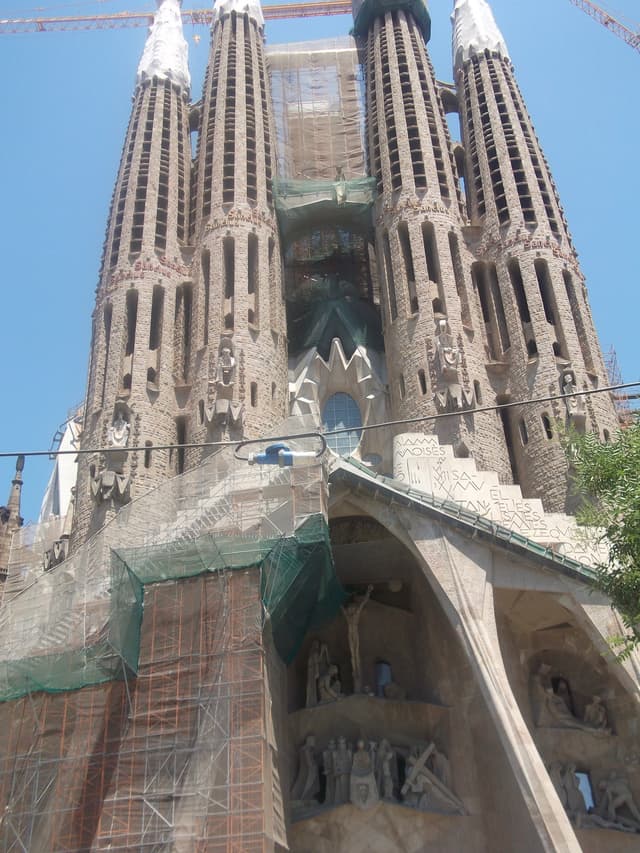
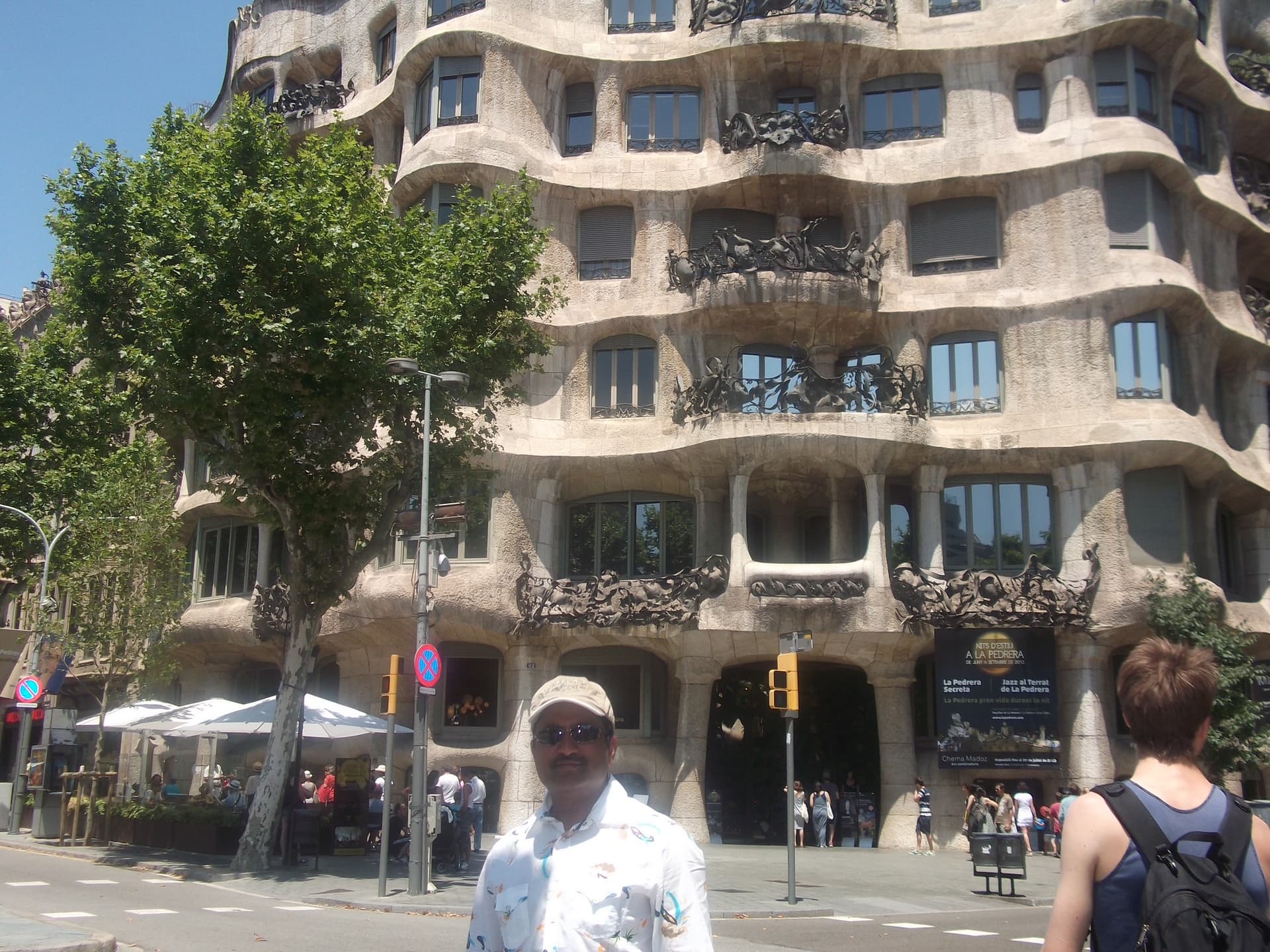
Looking back at my photographs, I am reminded of the experience of standing before these architectural masterpieces. One photograph captures me in front of Casa Milà, surrounded by the everyday activity of Barcelona. Another shows the magnificent towers of La Sagrada Família, with cranes and scaffolding visible above the structure.
These photographs are more than travel souvenirs. They represent the extraordinary power of human imagination and the determination to create something that can inspire generations.
Barcelona: Where History Meets Modern Life
Barcelona is the capital of Catalonia, an autonomous community in northeastern Spain, situated along the Mediterranean Sea. Its history spans more than two thousand years, and its streets reflect Roman origins, medieval architecture, Gothic churches, and modern artistic movements.
What makes Barcelona fascinating is its ability to preserve its historical identity while remaining a vibrant modern city.
Its neighborhoods, public squares, broad avenues, cafés, and distinctive buildings offer countless opportunities to explore. Walking through the city allows visitors to appreciate details that might otherwise go unnoticed: a decorative balcony, a historic façade, a street musician, or a quiet corner filled with local life.
For someone who enjoys exploring cities on foot, Barcelona offers an engaging way to experience history at a human pace.
Yet one feature distinguishes the city particularly strongly: its architecture. And few architects have shaped its visual identity as profoundly as Antoni Gaudí.
Antoni Gaudí: The Architect Who Refused to Think Conventionally
Born in Catalonia in 1852, Antoni Gaudí became one of the most influential architects associated with Catalan Modernisme.
His approach differed from conventional architectural thinking. Instead of relying exclusively on straight lines, symmetry, and traditional geometric forms, he drew inspiration from nature.
He studied trees, plants, mountains, caves, shells, and other natural formations. Nature, he understood, rarely depends on perfect straight lines to create strength, efficiency, and beauty.
Gaudí translated these observations into buildings that appear almost alive. His work features flowing surfaces, unusual columns, intricate ironwork, colorful mosaics, and innovative structural forms.
What fascinates me is that Gaudí was not simply decorating buildings to make them attractive. He was rethinking the relationship between architecture, engineering, nature, and human experience.
Science helps us understand how things function, while art encourages us to imagine what might be possible. Gaudí demonstrated that these disciplines can work together to produce something extraordinary.
His career reminds us that innovation often begins when we observe the world carefully and become willing to question familiar assumptions.
Casa Milà: A Building Inspired by Nature
One of my memorable stops in Barcelona was Casa Milà, commonly known as La Pedrera, a name meaning “the stone quarry.”
Completed in 1912, this residential building was commissioned by Pere Milà and Roser Segimon. Its appearance is unlike that of a conventional apartment building.
The stone façade moves in waves, resembling a rocky landscape shaped by wind and water. Its elaborate wrought-iron balconies look like twisted branches, vines, or abstract sculptures. The overall structure challenges the rigid rectangular forms commonly associated with urban architecture.
Standing in front of Casa Milà, I could appreciate why Gaudí’s work continues to attract visitors from around the world.
My photograph captures the building’s distinctive façade, the surrounding trees, pedestrians, and the ordinary activity of the street. That contrast is meaningful: an architectural masterpiece has become part of everyday life.
Casa Milà was designed as a residential building, not originally as a museum. Its design incorporates innovative ideas about natural lighting, ventilation, structural support, and spatial organization. The rooftop, with its sculptural chimneys and ventilation towers, offers another remarkable expression of Gaudí’s imagination.
Today, Casa Milà forms part of the UNESCO World Heritage listing associated with Gaudí’s works.
Looking at its façade, I found myself reflecting on an important question: Why do we so often insist that buildings must follow conventional patterns?
Sometimes, meaningful innovation begins when someone challenges what everyone else considers normal.
La Sagrada Família: A Monument to Faith and Determination
If Casa Milà demonstrates Gaudí’s artistic imagination, La Sagrada Família reveals the extraordinary depth of his spiritual and architectural vision.
Construction of the Basilica of the Sagrada Família began in 1882, and Gaudí took over the project in 1883. Over time, it became the central focus of his professional life.
When Gaudí died in 1926, the basilica remained unfinished. Yet the work continued, with generations of architects, engineers, sculptors, craftspeople, and construction workers contributing to its development.
This continuity is remarkable. Most of us work on projects that we expect to complete within our own lifetimes. Gaudí pursued a vision that would require contributions from people he would never meet.
Standing before La Sagrada Família, I was struck not only by its physical scale but also by the ambition behind its creation. Its towers, intricate carvings, and elaborate religious symbolism create an impression that is difficult to capture fully in words.
My photograph shows the basilica during an active phase of construction. Cranes rise above the towers, and scaffolding surrounds parts of the structure.
Some travelers might prefer photographs without construction equipment. For me, those cranes and scaffolds are part of the story. They demonstrate that this is not merely a monument preserved from the past; it is an evolving architectural achievement shaped by multiple generations.
The Meaning Behind the Towers
Gaudí envisioned La Sagrada Família as a structure rich in Christian symbolism. Its planned design includes eighteen towers representing Jesus Christ, the Virgin Mary, the four Evangelists, and the twelve Apostles.
The basilica’s façades communicate different aspects of the life of Jesus Christ.
The Nativity Façade celebrates birth and life through intricate sculptural details inspired by nature. The Passion Façade presents the suffering and crucifixion of Christ through dramatic, angular forms. The Glory Façade is intended to express humanity’s spiritual journey toward God.
These architectural elements transform the building into a form of storytelling. Rather than relying only on written explanations, the structure communicates through sculpture, geometry, and visual symbolism.
Visitors from different countries, languages, and cultural backgrounds can appreciate its artistry, even when they do not share the same religious traditions.
This is one of the extraordinary strengths of great art: it can communicate across cultural boundaries.
Architecture, Religion, and the Universal Search for Meaning
Throughout my travels, I have been fascinated by the ways civilizations express devotion through architecture.
From temples in India and Nepal to sacred sites elsewhere in the world, I have observed how communities use craftsmanship, geometry, sculpture, and symbolism to express their beliefs.
Whether one stands before a Hindu temple, a Buddhist monastery, a mosque, or a Christian cathedral, a shared human aspiration becomes apparent. People seek to create spaces that connect everyday life with something they consider greater than themselves.
The traditions and symbols may differ, but the desire to preserve beliefs, honor heritage, and create something meaningful is familiar across cultures.
Standing before a Christian basilica in Spain, I could appreciate the devotion to craftsmanship and spiritual expression that I have also admired at temples in India.
I believe travel becomes especially valuable when we recognize these connections rather than focusing only on differences. Understanding another culture does not require us to abandon our own traditions. Instead, it allows us to appreciate the many ways human beings search for meaning.
The Engineering Genius Behind Gaudí’s Designs
One aspect of Gaudí’s work that deserves particular attention is his understanding of structural engineering.
His designs may appear irregular or unconventional, but they reflect careful consideration of how forces move through structures.
Gaudí experimented with hanging-chain models to explore natural load distribution. A freely hanging chain forms a curve under gravity. Studying and inverting such forms helped him investigate architectural shapes that could carry loads efficiently through compression.
This approach influenced his thinking about structures, including the use of branching columns, curved surfaces, and complex geometric forms.
These features were not simply decorative. They also contributed to the structural behavior and spatial experience of his buildings.
I find this relationship between observation, science, and design particularly fascinating. Nature contains countless examples of systems that perform multiple functions efficiently. The human body, for example, depends on bones, muscles, and joints working together to balance strength, movement, and stability.
Gaudí’s work reminds us that innovation often begins with careful observation. Before designing something new, we can learn a great deal by understanding how nature has already addressed similar challenges.
Barcelona’s Streets: An Open-Air Museum
Beyond its famous monuments, Barcelona offers an architectural experience simply through walking.
Its streets reveal Gothic, Romanesque, Modernista, and contemporary influences. The Eixample district, where Casa Milà is located, is especially notable for its planned street grid, broad avenues, and distinctive chamfered corners.
The district reflects nineteenth-century efforts to accommodate a growing population while improving circulation and urban living conditions.
I enjoy observing how cities organize their public spaces. The design of streets, sidewalks, intersections, parks, and public transportation influences how people experience daily life.
Well-designed urban environments can encourage walking, social interaction, and accessibility. From a public health perspective, walkable neighborhoods can also create more opportunities for physical activity and reduce dependence on automobiles.
Barcelona offers an interesting example of how architecture and urban planning influence the everyday habits of residents and visitors.
When practical, I prefer walking because it allows me to notice details that might otherwise be missed. A building’s balcony, a small café, a street musician, or a conversation between local residents can become part of the travel experience.
Often, these small observations create the most lasting memories.
A City of Culture, Food, and Mediterranean Life
Barcelona’s identity extends far beyond architecture.
Its Mediterranean location has influenced its cuisine, commerce, climate, and cultural traditions. The city is known for lively public spaces, markets, outdoor dining, and a strong regional identity.
Catalonia has its own language, Catalan, alongside Spanish, and a distinctive cultural heritage. Exploring these differences is one of the pleasures of international travel.
Food is also an important part of understanding a place. As a vegetarian traveler, I enjoy discovering how local ingredients and culinary traditions can be adapted to personal dietary preferences.
Mediterranean cuisine offers many possibilities through vegetables, legumes, grains, olive oil, fruits, and other plant-based ingredients.
Travel is not only about visiting famous attractions. It is also about observing how ordinary people live, how traditions are maintained, and how communities express their identity.
The rhythm of a city, its markets, cafés, and public spaces can reveal as much about its culture as its most celebrated monuments.
Why Historic Architecture Matters
Modern societies often emphasize speed, efficiency, and immediate results. We want projects completed quickly and frequently measure success through deadlines, productivity, and financial returns.
Historic architecture reminds us that some achievements require patience across generations.
La Sagrada Família is a powerful example. Gaudí did not live to see his great project completed, and many of the people who contributed to its construction over the decades never saw its eventual form either. Yet their efforts became part of something larger than themselves.
I find this idea deeply meaningful.
In our professional and personal lives, we often focus on what we can accomplish today. But some of our most valuable contributions may benefit people we will never meet.
Education is one example. A teacher may influence a student who makes an important discovery decades later. Healthcare is another. A clinician may help someone regain independence and continue contributing to family and society.
Similarly, an architect may design a structure that inspires generations.
The true value of an achievement is not always measured by how quickly it is completed. Sometimes, its greatest significance lies in how long its influence continues.
Lessons From Gaudí: Creativity Requires Courage
Gaudí’s career also offers an important lesson about originality.
His designs were not universally appreciated when they first appeared. Some critics considered his architectural style excessive or unconventional. Casa Milà, with its unusual appearance, attracted criticism.
Today, many of the features that once seemed strange are celebrated as examples of extraordinary creativity.
This transformation reminds us that public opinion is not always the best measure of innovation. People who challenge conventional thinking may initially face skepticism, and new ideas can appear unusual before their value becomes widely understood.
Scientific discoveries, medical advances, and technological innovations have often required people to question established assumptions.
Of course, originality alone is not enough. Successful innovation also requires knowledge, discipline, practical understanding, and attention to detail.
Gaudí combined imagination with structural reasoning. That combination helped make his work enduring.
For younger generations, his life offers a valuable message: do not be afraid to think differently, but develop the knowledge and skills needed to transform imagination into meaningful achievement.
Looking Back at My Photographs
Photographs have a remarkable ability to reconnect us with moments from the past.
When I look at my picture in front of Casa Milà, I see more than a traveler standing before a famous building. I see a moment of curiosity and exploration. Behind me stands a structure that challenged traditional architectural thinking, while the city continues its daily routine.
My photograph of La Sagrada Família tells a slightly different story. It captures a monumental project in progress. The scaffolding and cranes remind me that history is not always something finished and preserved. Sometimes, history is still being created before our eyes.
When we travel, we often concentrate on reaching the next destination or taking the next photograph. Only later do we fully appreciate the significance of what we witnessed.
This is one reason I enjoy writing about my travels. Writing allows me to revisit those experiences, connect them with broader ideas, and preserve their meaning.
Travel as a Form of Lifelong Education
I have always believed that education should continue throughout life.
Formal education provides knowledge and professional skills, but travel offers another kind of learning. It allows us to experience history, geography, culture, religion, architecture, and human behavior more directly.
Reading about Antoni Gaudí is informative. Standing before one of his buildings creates a different understanding. A photograph in a textbook can show the appearance of La Sagrada Família, but seeing its towers rise above the surrounding city reveals its scale and complexity in a way that words alone cannot fully convey.
Travel also encourages humility. The more places we visit, the more we recognize how much there is to learn.
Every civilization has contributed something valuable to humanity. Some have made remarkable advances in science and mathematics; others have developed extraordinary artistic, philosophical, and architectural traditions.
The most rewarding approach to travel is not simply to decide which destination is better. It is to understand what makes each place unique.
Barcelona taught me to appreciate how architecture can become a form of cultural storytelling. It also reminded me that human creativity can transcend geography, religion, and generations.
Preserving the Past While Building the Future
One challenge facing modern cities is balancing preservation with development.
Growing populations need housing, transportation, infrastructure, and economic opportunities. At the same time, historic buildings and cultural landmarks deserve protection.
Barcelona demonstrates both the possibilities and the complexities of maintaining that balance. Its architectural heritage contributes to the city’s identity and attracts international visitors, but historic preservation requires continued investment, careful planning, and responsible management.
Tourism can also create challenges, including congestion, pressure on public infrastructure, and the need to respect local communities.
As travelers, we should recognize that famous destinations are not merely attractions created for our enjoyment. They are living communities. Barcelona’s residents must continue working, raising families, and maintaining their everyday lives while sharing their city with visitors from around the world.
Responsible tourism means respecting local customs, protecting historic sites, and appreciating the people who make a destination special.
Preserving architectural heritage is not simply about maintaining beautiful buildings. It is about protecting the stories, skills, and cultural achievements they represent.
What Barcelona Left With Me
Every meaningful journey leaves behind something beyond photographs. Sometimes it is a new friendship, a deeper understanding of history, or a lesson about life.
Barcelona left me with a renewed appreciation for human imagination.
Casa Milà reminded me that creativity can transform an ordinary residential building into a work of art. La Sagrada Família demonstrated that extraordinary achievements often require vision, patience, faith, and cooperation across generations.
Together, these landmarks illustrate the remarkable influence one individual’s ideas can have on the world.
Antoni Gaudí died in 1926, yet his work continues to inspire architects, engineers, artists, students, and travelers. That is an extraordinary legacy.
It also raises a question worth considering in our own lives:
What are we creating today that might continue to benefit others long after we are gone?
Not everyone will design a world-famous building. But each of us has opportunities to contribute through our families, professions, communities, and personal relationships.
A meaningful legacy does not always require international recognition. Sometimes, it begins with helping one person, teaching one student, supporting one family, or improving one community.
Conclusion: Barcelona Is More Than a Destination
When I reflect on my visit to Barcelona, I remember a city where history and modern life exist side by side. I remember the flowing stone façade of Casa Milà and the extraordinary towers of La Sagrada Família. Most importantly, I remember the lessons these places represent.
Great achievements require imagination. Meaningful work requires dedication. Lasting contributions often demand patience. And extraordinary ideas sometimes begin when someone has the courage to see the world differently.
I encourage travelers to experience Barcelona not merely through sightseeing, but through curiosity. Look closely at its buildings. Learn about the people who designed them. Understand the history behind their creation, and reflect on what these architectural masterpieces reveal about human civilization.
For me, Barcelona was not simply another stop on my travels. It was a reminder that when art, science, faith, and imagination come together, human beings can create something truly timeless.
Travel teaches us that the world is much larger than the places we call home, and that every journey offers another opportunity to learn, appreciate, and grow.
Author Note
Dr. Vijay Kumar, MD, MPH, PhD, shares reflections on travel, healthcare, education, leadership, culture, and the ideas that connect people across generations. Through personal experiences and observations, he explores how journeys can deepen understanding and inspire lifelong learning.