Varanasi (Kashi): A Morning on the Ganges That Changed My Perspective on Life
"Sometimes the greatest journeys are not measured in miles, but in moments that quietly transform the soul."
Travel has a remarkable way of changing us.
Some destinations impress us with breathtaking landscapes. Others captivate us with architectural brilliance, vibrant cultures, or extraordinary history. Yet every so often, we encounter a place that offers something far greater than beautiful scenery—it offers perspective.
For me, that place is Varanasi, also known as Kashi or Banaras.
Long before I arrived, I had heard countless stories about this ancient city. Some described it as the spiritual heart of India. Others called it the oldest continuously inhabited city in the world. Many believed that every stone, every temple bell, every ripple of the River Ganga, and every sunrise carried thousands of years of devotion, wisdom, and faith.
I had seen photographs.
I had watched documentaries.
I had read about its history.
Yet nothing truly prepared me for the emotions I experienced on that cold January morning.
As our small wooden boat drifted gently onto the sacred waters of the Ganga before sunrise, I realised that I was not simply beginning another sightseeing excursion.
I was beginning a conversation.
A conversation with history.
A conversation with faith.
Most importantly, a conversation with myself.
Where Time Refuses to Move
Modern life constantly teaches us to move faster.
Reply to another email.
Attend another meeting.
Finish another project.
Set another goal.
Even our holidays often become carefully planned checklists where success is measured by the number of attractions visited rather than the depth of the experience itself.
Varanasi refuses to participate in that race.
Instead, it quietly invites every visitor to slow down.
Here, dawn arrives patiently.
The river awakens without haste.
Temple bells ring with timeless rhythm.
Priests prepare morning rituals with remarkable serenity.
Pilgrims descend centuries-old stone steps carrying prayers that have remained unchanged for generations.
Even the birds seem to understand that mornings in Kashi deserve silence rather than urgency.
Wrapped in the cool winter air, standing barefoot on the wooden boat as it glided across the calm waters, I realised something unusual.
For perhaps the first time in many months, I wasn't thinking about business.
I wasn't thinking about patients.
I wasn't thinking about meetings, deadlines, responsibilities, or the countless decisions waiting for me after returning home.
For a brief but unforgettable moment, my mind simply became still.
That silence felt like a gift.
Why Kashi Is Unlike Any Other Place
Every country has cities that define its identity.
Jerusalem.
Rome.
Mecca.
Lhasa.
Each holds profound spiritual significance for millions of people.
Yet Kashi possesses a character unlike any other.
According to ancient Hindu tradition, this sacred city was established by Lord Shiva himself. It is believed that while kingdoms rise and fall, while civilizations disappear, and while empires become chapters in history books, Kashi continues to exist under the divine protection of Shiva.
Whether one approaches the city through faith, history, or simple curiosity, it becomes immediately clear that this is far more than a destination.
It is a living civilisation.
Walking through its narrow lanes, nothing feels staged for visitors.
Faith is not performed here.
It is lived.
Children recite morning prayers before school.
Shopkeepers begin their day by offering flowers at nearby shrines.
Sadhus meditate quietly beneath temple walls that have witnessed centuries of devotion.
Families arrive carrying gratitude, hope, grief, and prayers for loved ones.
Life and death coexist naturally.
Celebration and mourning unfold on the same riverbanks.
In many parts of the world, these realities remain carefully separated.
In Kashi, they flow together as effortlessly as the Ganga herself.
Perhaps that is what makes the city so deeply moving.
It never asks us to ignore life's complexities.
Instead, it teaches us to embrace them with acceptance.
Before Sunrise on Mother Ganga
Our boat departed while darkness still embraced the river.
The city lights shimmered softly upon the water, their reflections dancing with every gentle movement of the boat.
A cool breeze carried the fragrance of incense mixed with the fresh scent of the river.
There was very little conversation.
The silence itself seemed sacred.
Occasionally another wooden boat drifted past carrying pilgrims wrapped in warm shawls.
Some whispered prayers.
Some closed their eyes in meditation.
Others simply gazed toward the eastern horizon, patiently waiting for the first glimpse of sunlight.
Then, almost imperceptibly, the sky began to change.
Grey softened into blue.
Blue gradually welcomed shades of gold.
The first rays of sunlight touched the ancient ghats, illuminating temples, stone steps, and centuries of history all at once.
The city awakened gently.
Not with noise.
But with devotion.
I suddenly understood why photographers, artists, saints, and travellers have been drawn to this place for generations.
Yet the beauty of that sunrise was never about capturing the perfect photograph.
It was about learning to be fully present.
For those few precious moments, nothing else mattered.
Feeding the Birds: A Lesson in Freedom
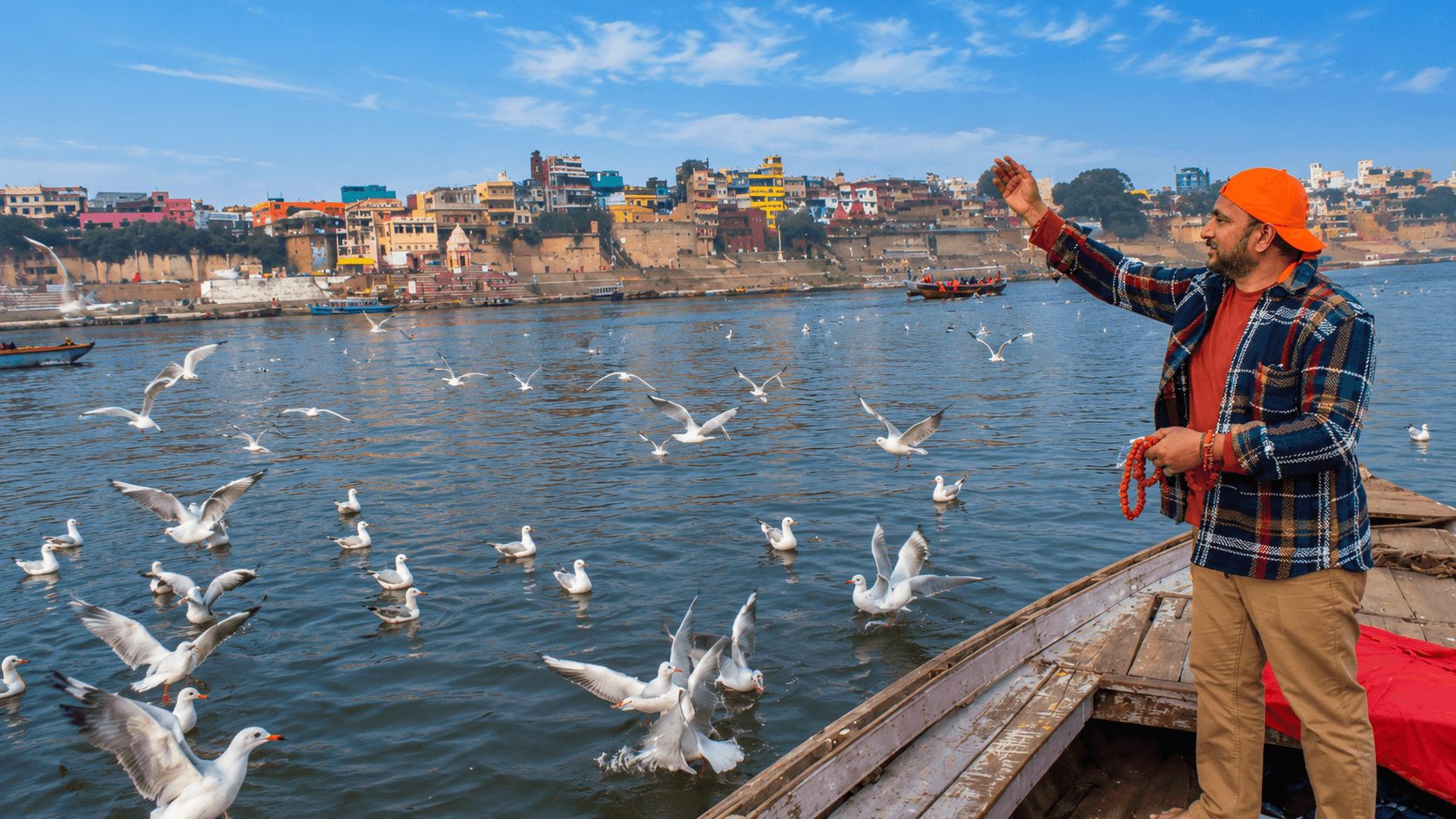
As our boat floated peacefully across the river, someone handed me a small handful of grains.
At first, only a few white gulls approached.
Then dozens arrived.
Within moments, hundreds of birds surrounded the boat, their graceful wings gliding effortlessly above the sacred waters.
Some skimmed the river's surface.
Others hovered patiently beside us.
A few landed fearlessly close enough to take grains directly from my hand.
Watching them, I found myself smiling without knowing exactly why.
There was something deeply peaceful about their presence.
As I continued feeding them, an unexpected thought crossed my mind.
These birds knew nothing of promotions.
Nothing of titles.
Nothing of competition or recognition.
They weren't anxious about tomorrow.
They weren't comparing themselves with one another.
Their lives unfolded with remarkable simplicity.
Their existence depended upon trust.
Trust in another sunrise.
Trust that the river would continue flowing.
Trust that life would continue providing what they needed.
Standing there surrounded by hundreds of birds, I realised they were quietly teaching lessons that no leadership seminar or management conference had ever expressed so beautifully.
Freedom begins where fear ends.
Perhaps much of the anxiety we carry throughout our lives comes not from reality itself, but from our constant desire to control what has never been ours to control.
The birds reminded me that peace often begins when we learn to let go.
The River That Has Witnessed Everything
Few rivers in human history have shaped civilisation as profoundly as the Ganga.
For thousands of years, she has nourished kingdoms, inspired poets, guided saints, sustained farmers, comforted grieving families, and welcomed millions seeking spiritual renewal.
Generation after generation has approached these sacred waters carrying different hopes.
Kings sought blessings before battle.
Scholars searched for wisdom.
Saints pursued enlightenment.
Parents prayed for their children.
Children prayed for their parents.
Families arrived carrying both gratitude and grief.
The river accepted them all without distinction.
Standing quietly upon that wooden boat, I found myself wondering how many countless stories these waters had witnessed.
How many dreams had begun here?
How many tears had fallen into the river?
How many prayers had been whispered before sunrise?
How many lives had quietly changed without anyone else ever knowing?
The river never judged those who came before her.
She simply continued flowing.
Steady.
Patient.
Unhurried.
There is something profoundly comforting about that.
Life moves forward whether we are ready or not.
The Ganga gently reminds us that perhaps we should learn to move forward with the same quiet grace.
Lessons Beyond Religion
One misconception many travellers have is believing that Kashi is meaningful only for Hindus.
I respectfully see it differently.
Without question, Varanasi remains one of Hinduism's holiest cities.
Its temples, rituals, and centuries-old traditions form an inseparable part of its identity.
Yet the lessons it offers extend far beyond religious boundaries.
Humility.
Acceptance.
Compassion.
Presence.
Impermanence.
Gratitude.
These are not values that belong to one religion alone.
They belong to humanity.
As someone who has spent much of my professional life in medicine, healthcare leadership, education, entrepreneurship, and service, I frequently meet people searching for certainty.
Patients seek certainty.
Business leaders seek certainty.
Students seek certainty.
Parents seek certainty.
Yet standing beside Mother Ganga that morning, I was reminded of something both simple and profound.
Life has never promised certainty.
It has only promised change.
And perhaps wisdom begins the moment we stop resisting that truth and start embracing it with grace.
Walking Along the Ghats: Where Every Step Carries a Story
As the golden light of the morning spread across the river, our boat slowly drifted past one ghat after another. Each appeared distinct, yet all were connected by the same sacred waters that have sustained civilisation for thousands of years.
The ghats of Varanasi are far more than stone steps descending into the Ganga. They are open-air chapters of India's spiritual, cultural, and historical journey. More than eighty ghats line the riverbank, each carrying its own traditions, stories, and significance.
Some are places of celebration where pilgrims offer flowers, perform rituals, and begin their day with prayer. Others provide quiet corners where scholars study ancient scriptures or devotees sit in silent meditation. A few, such as Manikarnika and Harishchandra Ghats, gently remind every visitor of life's greatest certainty—our mortality.
Watching these scenes unfold from the boat was profoundly humbling.
There was no attempt to separate joy from sorrow.
Birth and death.
Hope and grief.
Celebration and farewell.
Everything existed together, flowing naturally beside the same river.
As a physician, I have spent much of my life helping patients navigate illness, uncertainty, and recovery. Medicine teaches us to preserve life whenever possible, yet standing before these ancient ghats reminded me that healing is not always about curing.
Sometimes healing begins with acceptance.
Acceptance of uncertainty.
Acceptance of change.
Acceptance of life's natural rhythm.
Perhaps that is one of Kashi's greatest teachings.
The Eternal Flow of Mother Ganga
To millions, the Ganga is not merely a river.
She is Mother Ganga.
A symbol of purity.
Compassion.
Renewal.
Ancient scriptures describe her descent from the heavens through the locks of Lord Shiva before flowing across India to nourish humanity.
Whether one interprets this literally or symbolically, the message remains timeless.
Great power must always be guided by wisdom.
Great blessings should always be received with humility.
As I watched the river continue its endless journey, I found myself reflecting on the pace of modern life.
We spend years chasing promotions.
Building businesses.
Accumulating achievements.
Collecting possessions.
Believing each accomplishment will finally bring lasting contentment.
Yet the Ganga measures success differently.
She has witnessed empires rise and disappear.
She has watched kings, saints, scholars, entrepreneurs, and ordinary families come and go.
Still, she continues flowing quietly, asking for nothing in return.
Perhaps true greatness never demands attention.
It simply continues serving.
The Sacred Morning Symphony
One of the most unforgettable memories of that morning was not what I saw.
It was what I heard.
Temple bells echoed gently across the river.
Ancient Vedic chants floated through the cool morning air.
Conch shells announced the beginning of another sacred day.
The rhythmic splash of wooden oars blended effortlessly with birds circling overhead.
Every sound seemed perfectly placed.
Nothing competed for attention.
Nothing felt hurried.
Everything belonged.
In today's world, silence has become increasingly rare.
Notifications interrupt conversations.
Meetings replace reflection.
Screens accompany nearly every waking moment.
We often fear silence because it forces us to listen to ourselves.
Yet that morning reminded me that silence is never empty.
It is full of answers.
If only we are willing to hear them.
A City That Teaches Humility
Travel has allowed me to visit remarkable places around the world.
Each destination has offered valuable lessons.
Some celebrate innovation.
Others showcase artistic brilliance.
Many inspire awe through natural beauty.
Kashi teaches something different.
It teaches humility.
Standing beside me on that boat were people from every imaginable background.
Some had travelled from distant villages.
Others had journeyed across continents.
There were wealthy families.
Students.
Monks.
Elderly pilgrims.
Young children.
Successful professionals.
Ordinary workers.
The river welcomed each person equally.
There were no reserved places.
No social hierarchy.
No distinction between privilege and simplicity.
In healthcare, I have witnessed the same truth countless times.
Illness does not recognise status.
Pain makes no distinction between wealth and poverty.
Compassion shouldn't either.
That morning strengthened a belief I have carried throughout my career.
True leadership always begins with humility.
Whether caring for patients, leading an organisation, or building a company, we serve best when we remember that we are, first and foremost, fellow human beings.
Faith Beyond Rituals
One of the most beautiful aspects of Kashi is that spirituality is woven naturally into everyday life.
A flower vendor offers a quiet prayer before opening the shop.
A boatman folds his hands toward the rising sun before beginning another day's work.
Children accompany their grandparents to nearby temples before school.
Families release tiny lamps upon the river, watching them drift peacefully across the water.
None of these moments feel dramatic.
Yet together they create something extraordinary.
Faith here is not reserved for festivals or special occasions.
It quietly accompanies ordinary life.
Watching these simple acts made me reflect on my own understanding of spirituality.
Perhaps faith is expressed not only through rituals.
Perhaps it is equally present in patience.
Kindness.
Integrity.
Compassion.
Gratitude.
A helping hand offered without expectation.
A listening ear during someone's difficult day.
A decision guided by honesty rather than convenience.
Those moments may be just as sacred.
Medicine, Entrepreneurship, and Inner Balance
People occasionally ask how I balance multiple responsibilities—as a physician, entrepreneur, educator, healthcare leader, and lifelong learner.
The honest answer is that balance is never something we permanently achieve.
It is something we continually practice.
Modern society often celebrates constant productivity.
Long working hours become badges of honour.
Busy schedules are mistaken for meaningful success.
Yet standing beside the Ganga reminded me that purposeful work also requires moments of stillness.
Clear decisions emerge from calm minds.
Creativity grows during reflection.
Compassion deepens when we allow ourselves to slow down.
Whether treating patients or building Weboraz, I have learned that innovation should never come at the expense of humanity.
Technology may improve efficiency.
Artificial intelligence may transform industries.
Businesses may accelerate growth.
But empathy.
Integrity.
Kindness.
These remain timeless.
Just like Kashi itself.
The Sacred Fire That Never Sleeps
Later, as our boat approached Manikarnika Ghat, I instinctively became quieter.
The eternal flames continued burning just as they have for centuries.
Families gathered with grief, yet also with faith.
According to Hindu tradition, departing from Kashi offers liberation from the cycle of birth and rebirth.
Whether one shares that belief or not, witnessing these sacred rituals inevitably inspires reflection.
Standing there, I found myself thinking less about death and far more about life.
How often do we postpone meaningful conversations?
How many dreams remain untouched because we assume there will always be another opportunity?
How frequently do we delay expressing gratitude?
Medicine has repeatedly reminded me that life is both precious and unpredictable.
No patient has ever wished they had spent more time worrying about insignificant matters.
Instead, people cherish relationships.
Purpose.
Acts of kindness.
Moments shared with loved ones.
Manikarnika Ghat reinforced that lesson more powerfully than any textbook ever could.
Every sunrise is a gift.
Every day is an opportunity.
Every moment deserves our full presence.
The Evening Ganga Aarti
If sunrise awakens the soul, the evening Ganga Aarti fills it with wonder.
As dusk settled over Dashashwamedh Ghat, thousands gathered along the riverbanks.
Pilgrims.
Families.
Students.
Travellers.
Photographers.
Monks.
People from every corner of the world became part of one shared experience.
The fragrance of sandalwood and incense drifted through the evening air.
Temple bells echoed across the river.
Conch shells announced the beginning of the ceremony.
Priests dressed in traditional saffron robes stood in graceful formation before Mother Ganga.
Then the lamps were lit.
Large brass aartis, glowing with dozens of flames, moved in perfect synchronisation.
The reflections danced upon the water like countless stars descending from the heavens.
For nearly an hour, thousands remained completely absorbed.
No one hurried away.
No one seemed distracted.
It was more than a religious ceremony.
It was humanity expressing gratitude—for life, for nature, and for something infinitely greater than ourselves.
Lessons I Carried Home
Every meaningful journey leaves behind souvenirs that cannot be purchased.
The memories of Kashi continue accompanying me long after returning home.
Whenever professional responsibilities become overwhelming…
Whenever difficult decisions demand clarity…
Whenever life begins moving too quickly…
My thoughts often return to that quiet January morning.
The wooden boat.
The gentle rhythm of the river.
The birds soaring overhead.
The distant temple bells.
The peaceful sunrise.
Those memories remind me to pause before reacting.
To listen before speaking.
To serve before expecting recognition.
To appreciate the present instead of constantly worrying about tomorrow.
Simple lessons.
Yet perhaps the most valuable ones we ever learn.
A Personal Reflection
Looking back, I realise that my journey to Varanasi was never simply about visiting one of India's oldest cities.
It became a journey inward.
As a physician, I returned with renewed compassion.
As an entrepreneur, I returned with renewed purpose.
As a traveller, I returned with deeper gratitude.
But above all, I returned as a better student of life.
Kashi has a remarkable ability to slow the mind and awaken the heart.
It reminds us that fulfilment is not found solely through achievements or possessions.
It is found in presence.
In purpose.
In service.
In gratitude.
The city does not ask us to become someone new.
Instead, it quietly helps us rediscover the person we were always meant to be.
Perhaps that is the greatest gift any journey can offer.
Final Thoughts
As our boat finally returned to the shore, I looked back one last time.
The birds continued circling above the river.
Pilgrims continued arriving with folded hands.
Temple bells continued ringing.
The Ganga continued flowing, just as she had for thousands of years.
And in that final moment, I understood something profoundly simple.
The river never rushes.
Yet she always reaches her destination.
Perhaps our lives should be no different.
May we continue our own journeys with patience instead of haste.
With compassion instead of judgment.
With gratitude instead of entitlement.
And with the quiet confidence that, like the sacred waters of Mother Ganga, a life lived with purpose will always find its way.
"Some places impress us with their beauty, while others transform us through their wisdom. Kashi taught me that life's greatest journey is not measured by the distance we travel, but by the depth of the perspective we gain along the way. When the mind becomes still, the heart begins to understand what truly matters."
— Dr. Vijay Kumar